The Nucleus
Organelles
More Organelles
Selective Permeability
Tonicity
Prokaryotic vs Eukaryotic
Cell potpurri
100
The three regions that make up the nucleus.
What are the nuclear membrane, the nucleolus, and chromatin?
100
The sites of protein synthesis.
What are Ribosomes?
100
Cellular structures that carry out reactions where oxygen is used to break down food. They provides ATP for cellular respiration (energy).
What are Mitochondria?
100
The simple diffusion of water.
What is Osmosis?
100
The dissolved matter in a solution; the component of a solution that changes its state
What is a Solute?
100
Type of cell does not contain a nucleus.
Prokaryotic
100
The primary difference between the images provided by a Transmission Electron Microscope (TEM) and a Scanning Electron Microscope (SEM).
What is TEM is 2D and SEM is 3D?
200
Consists of a double phospholipid membrane.
What is the nuclear membrane?
200
Site where building materials of cellular membrane are formed.
What is the Rough ER?
200
Cellular structures which contain enzymes that digest non-usable materials within the cell.
What are Lysosomes?
200
Process whereby water and solutes are forced through a membrane by fluid, or hydrostatic pressure. The Solute-containing fluid is pushed from a high pressure area to a lower pressure area.
What is Filtration?
200
A liquid substance capable of dissolving other substances.
What is a Solvent?
200
A cell type that contains membrane bound organelles?
Eukaryotic
200
This type of microscope, developed in the 17th century, allowed for the development of modern cell theory?
What is a light miscroscope?
300
The site of ribosome production.
What is the nucleolus?
300
Cellular structure that modifies, packages, and delivers proteins.
What is the Golgi Apparatus?
300
A network of protein structures that extend throughout the cytoplasm and provide the cell with an internal framework.
What is the cytoskeleton?
300
A structure that aids a substance in crossing the cell membrane.
What is a Transport Protein?
300
A solution in which the amount of solute in the cells is more than in the solution.
What is an Hypotonic solution?
300
The cell type seen here: 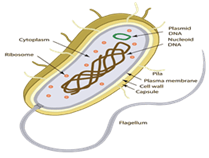
Prokaryotic
300
The maximum magnification of a compound light microscope?
What is 1500x?
400
Substance that condenses to form chromosomes when the cell divides.
What is chromatin?
400
Cellular structure that functions in cholesterol synthesis and breakdown, fat metabolism, and detoxification of drugs.
What is the Smooth ER(endoplasmic reticulum)?
400
Rod-shaped bodies made of microtubules; they are responsible for the direct formation of the mitotic spindle during cell division.
What are Centrioles?
400
Movement across the cell membrane requiring energy.
What is Active Transport?
400
A solution in which the amount of solute in the cells is less than in the solution.
What is an Hypertonic solution?
400
A cell type that may contain flagella.
both prokaryotic and eukaryotic
400
Features that plant cells have that animal cells do not.
What are a cell wall, and chloroplasts?
500
Passageways that allow for exchange of material with the rest of the cell.
What are nuclear pores?
500
A membranous "package" for the transport of proteins within the cells.
What are vesicles?
500
Membranous sacs of oxidase enzymes which detoxify harmful substances and break down free radicals.
What are Peroxisomes?
500
The source of energy to perform Active Transport.
What is ATP (Adenosine Triphosphate)?
500
In an emergency trauma room, a doctor accidentally gives a patient a large transfusion of distilled water directly into one of his veins instead of blood. What might happen if distilled water was given to the patient instead of blood?
Red blood cells will swell and burst.
500
The cell type that contains linear DNA.
Eukaryotic
500
The 4 parts that make up the modern Cell Theory
What are:
- Cells are the building blocks of all plants and animals.
- Cells are the smallest functioning units of life.
- Cells are produced through the division of pre-existing cells.
- Each cell maintains homeostasis.