10.1 - Cellular Respiration Overview
10.2 - The Process of Cellular Respiration
10.3 - Fermentation
Miscellaneous
100
What organelle is responsible for Krebs Cycle and Electron Transport Chain and what organelle does Glycolysis occur
Mitochondria for Krebs/ETC
Cytoplasm for Glycolysis
100
How many times does the Krebs Cycle run in a cycle?
Two times
100
What are the two types of fermentation
Alcoholic and Lactic Acid
100
What are the difference between the two six-carbon compounds in glucose and citric acid
Glucose becomes the pyruvate used in Krebs/ETC through Glycolysis
Citric acid is used in the Krebs cycle only to fuel the Electron carriers.
200
How much ATP does Glycolysis make overall?
4
Net is +2
200
What is the difference between prokaryotes and eukaryotes for cellular respiration
Prokaryotes do this in the cytoplasm, Eukaroytes have a mitochondria which allows for more ATP to be made.
200
How are fermentation and cellular respiration similar?
Both start with glycolysis and produce ATP
200
What is the main difference in short term and long term energy in the types of chemical reactions they use
Short term uses lactic acid fermentation
Long term uses Cellular respiration
300
How do Cellular Respiration and Photosynthesis work together?
They form a cycle due to their opposite parts. Photosynthesis uses O2, Water and Sunlight to make CO2 and Sugars, Cellular Respiration uses Sugars and oxygen to create CO2 and Energy.
300
What are the goals of NADH and FADH2 in the Electron Transport Chain?
To transfer high energy electrons and to allow Hydrogen to enter outside of the mitochondria.
300
Most bread rises primarily due to the CO2 produced during alcoholic fermentation as yeast feeds on sugars. Sourdough bread is unique in that it also has an initial stage, and requires a “starter” to act as a leavening agent. Michaela keeps a sourdough starter, refreshing it often to keep the starter alive and active. She adds a portion of the starter to dough when making sourdough bread.
Look at the diagram.
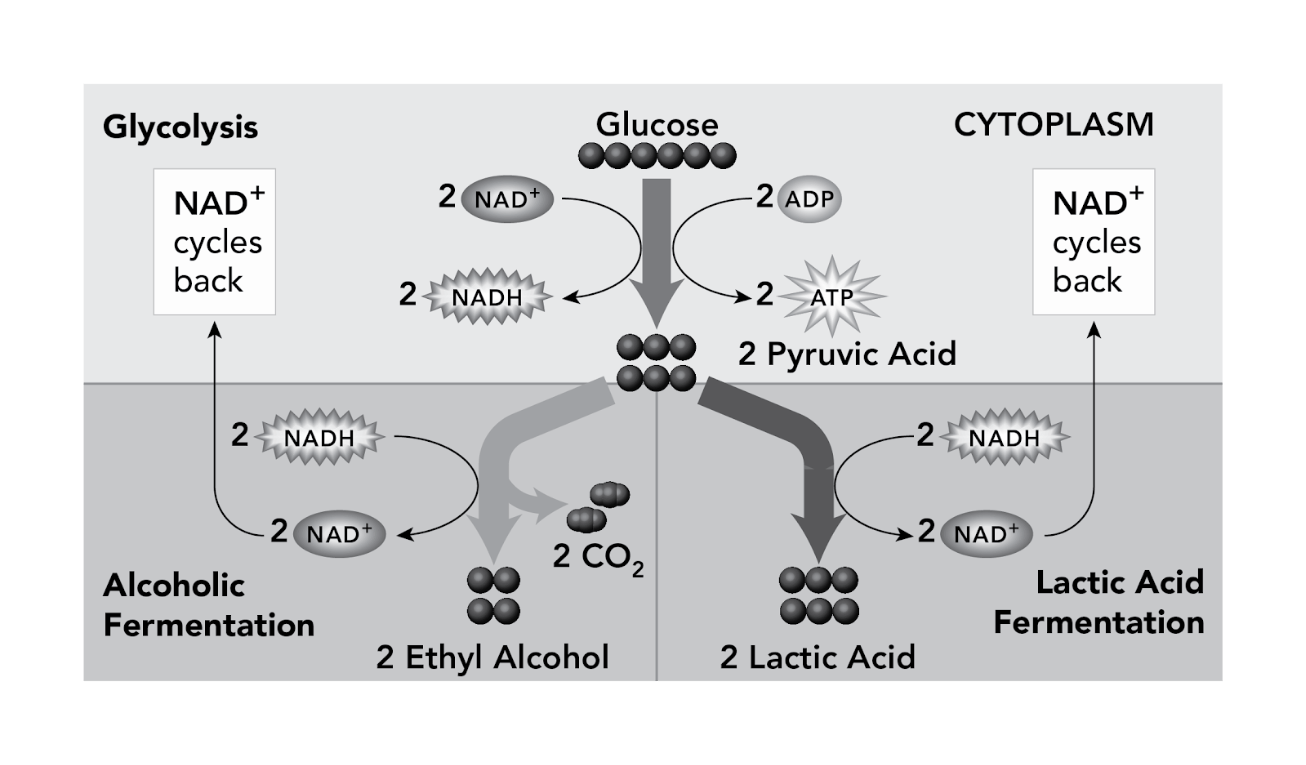
What is the BEST description of the process that occurs in the starter to give sourdough bread its famous tangy flavor?
a. Citric acid is produced in the citric acid cycle as the starter undergoes fermentation.
b. Lactic acid is produced from Lactobacilli as the starter undergoes fermentation.
c. Acetic acid is formed from the enzymatic oxidation of ethyl alcohol as the starter undergoes fermentation.
d. Pyruvic acid is produced from the enzymatic reduction of glucose as the starter undergoes fermentation.
D
300
What would happen if we lacked Oxygen for cellular respiration in thew steps of cellular respiration
There would be nothing to fuel the Electron Transport chain.
400
What are the reactants and products of Glycolysis?
R: Glucose, NAD+, ADP and ATP | P: Pyruvic Acid/Pyruvate, ATP and NADH
400
Where is CO2 made in cellular respiration?
The Krebs Cycle
400
Lamouri, Amos, Gerard and Isaac ran laps in the hallways in order to prepare for a basketball match. During this, their muscles used short bursts of energy by using ATP. However, after this they got tired and needed to take a break. Why is this?
They were using lactic acid fermentation to make the energy by breaking apart the pyruvate acid, but because lactic acid is toxic, it affected their bodies.
400
Where does the energy from food come from inside the body for cellular respiration?
Glucose
500
List the parts of cellular respiration that are aerobic and anaerobic
Aerobic - ETC and Krebs
Anaerobic - Glycolysis
500
Explain how Citric Acid gets produced
Acetyl-CoA adds the 2-carbon acetyl group to a 4-carbon molecule already present, producing a 6-carbon molecule called citric acid.
500
Why is it important to breathe after a heavy sprint?
Sprinting needs fermentation to give the energy but when we have more oxygen, we can remove lactic acid easier
500
What is a way bacteria that cannot use oxygen get their energy inside the body?
Anaerobic fermentation
glycolysis