Water Cycle
Weather vs. Climate
Clouds & Precipitation
Weather and tools
The sun and water cycle
Science Scenarios — Challenge Round
100
What process occurs when liquid water changes into water vapor?
Evaporation
100
What is the condition of the atmosphere at a specific time and place called?
Weather
100
What is precipitation?
Water that falls from clouds to Earth's surface, such as rain, snow, sleet, or hail.
100
Which instrument measures air temperature?
thermometer
100
What is the main source of energy that drives the water cycle?
The sun
100
A cold glass of water develops droplets on the outside. What process caused the droplets?
Condensation
200
What process causes water vapor to cool and turn into tiny liquid droplets that form clouds?
Condensation
200
What term describes the usual weather patterns of an area over many years?
Climate
200
What are clouds made of?
tiny water droplets and dust
200
Which instrument measures the amount of precipitation that has fallen?
Rain gauge
200
What process allows plants to release water vapor into the atmosphere?
Transpiration
200
Water flows downhill into a river after a rainstorm. What part of the water cycle is happening?
Run off
300
Name three main processes of the water cycle.
Evaporation, Condensation, and Precipitation
300
A student says, "It rained today, so our climate must be rainy." What is wrong with this statement?
One day's weather does not determine climate. Climate is based on weather patterns over many years.
300
How are rain and hail different?
A. Rain is a liquid form of condensation and hail is solid.
B. Hail can result in runoff and rain cannot.
C. Rain is liquid precipitation and hail is solid precipitation.
D. Rain is caused by evaporation and hail is not.
C
300
what is this called?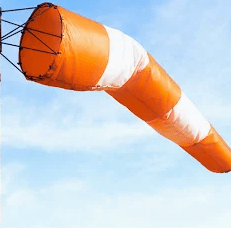
Wind sock
300
What is run off?
Water that flows across Earth's surface into streams, rivers, lakes, or oceans.
300
A synonym for collection is?
Accumulation
400
What occurs during percolation?
water seeps underground
400
City A has hot summers and mild winters most years. City B had a thunderstorm yesterday. Which statement describes climate, and why?
City A, because it describes typical weather conditions over many years.
400
What must happen for condensation to occur?
A. heating water vapor
B. Heating liquid water
C. Cooling Water Vapor
D. Cooling liquid water
C.
400
How are rain gauges and barometers similar?
A. Both measure precipitation
B. Both show day to day changes in climate
C. Both are observational tools without precise measurements
D. Both provide measurements related to the conditions of the atmosphere.
A.
400
Two identical puddles are outside. One is in direct sunlight and the other is in the shade. Predict which will usually evaporate faster and explain why.
The puddle in direct sunlight will usually evaporate faster because it receives more energy from the Sun.
400
How are condensation and evaporation different?
A. Condensation is due to cooling while evaporation is due to heating
B. Condensation changes liquid water to water vapor while evaporation changes water vapor to liquid water.
C. Condensation occurs underground while evaporation occurs in the atmosphere.
A.
500
A sealed container has water at the bottom and droplets on its lid after being placed in sunlight. Explain the two processes that caused this.
Sunlight warms the water, causing evaporation. Water vapor then cools on the lid and condenses into liquid droplets.
500
A desert receives unusually heavy rainfall for three days. Does that mean its climate has changed? Explain.
No. Three rainy days represent short-term weather conditions. Climate is determined by long-term patterns over many years.
500
A cloud forms as moist air rises and cools. Later, heavy rain begins. Explain how condensation and precipitation are connected.
Water vapor condenses into tiny water droplets. As droplets combine and become heavy enough, they fall to Earth's surface as precipitation.
500
Humidity measures what?
the amount of water vapor in the air
500
A forest is cleared and replaced with pavement. Predict two ways this could affect the movement of water through the water cycle.
Less transpiration occurs because there are fewer plants, and more runoff occurs because pavement prevents much of the water from soaking into the ground.
500
A potential squence of three states in the water cycle is shown below.
Runoff to ___________ to evaporation
What term belongs in the blank
A. precipitation
B. Condensation
C. Transpiration
D. Accumulation
D.