Cavities
Directional Terms
Planes
Miscellaneous
Lab-Microscope
100
An open space within body that is filled with fluid/organ(s).
What is a cavity?
100
Towards/at the top of the body.
What is superior?
100
Division of body into equal left and right sides.
What is midsagittal plane?
100
Position in which radius and ulna are parallel.
What is supine position?
100
Magnification of low power objective lens.
What is 10x?
200
The inner membrane layer that physically touches the organ.
What is visceral membrane?
200
Towards/at the top of head.
What is cranial?
200
Division of body into superior and inferior parts.
What is transverse?
200
This position serves as a common reference point and allows for the most common view of the body. (Feet flat, body erect, etc.)
What is anatomical position?
200
Calculation of Ocular lens magnification multiplied by objective lens magnification. (ocular x objective =)
What is total magnification?
300
Membrane found in cavities housing the lungs.
What is pleural membrane?
300
Towards the spine.
What is dorsal?
300
Division of body into anterior and posterior sides.
What is frontal/coronal?
300
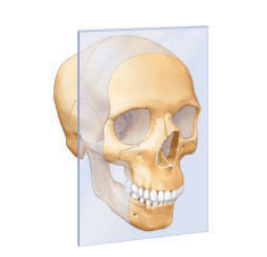 Name the plane.
What is Frontal/Coronal?
300
Bottom part of the microscope that provides a sturdy flat surface to support and steady the microscope.
What is the base?
400
Fluid found in the cranial cavity that protects and provides nutrients to the brain.
What is the cerebrospinal fluid (CSF)?
400
Towards the tail.
What is caudal?
400
Division of body into unequal left and right sides.
What is sagittal?
400
The thoracic cavity is _________ to the abdominopelvic cavity.
What is superior?
400
Black square where microscope slide rests.
What is the stage?
500
Body region containing the head, neck, and trunk.
What is the axial body region?
500
Towards the belly.
What is ventral?
500
An angled cut, usually 45 degrees.
What is oblique?
500
Organ housed in the vertebral cavity.
What is spinal cord?
500
Foundation from which all other microscope structures attach. It allows for organization of the electrical cord and is one of two structures used for transport
What is the arm?