Energy, Wavelength, Frequency
Periodic table & quantum numbers
All things electrons
Heat, enthalpy, etc
Random
100
A wave has a frequency of 8.65 MHz. What is the wavelength, in m?
(3 x 10^8) / (8.65 x 10^6 Hz) = 34.7 m
100
Which of these elements has the smallest first ionization energy? Which has the largest second ionization energy?
K, Ca, Ga, Ge, As
K: has 1 valence electron, so that one can be easily pulled off. However, the second electron is not valence, so it will take more energy to pull off. Also, ionization energy increases as you go across a period.
100
Estimate the effective nuclear charge for each of the elements below:
Ga
Sr
Te
Ga: +3
Sr: +2
Te: +6
100
What is the change in energy of a system if 100 kJ of heat are released to the system, and 25 kJ of heat are done on the system? Is this endothermic or exothermic?
-75 kJ
Exothermic
100
For sulfur, complete the following:
1.) electron configuration
2.) orbital diagram
3.) core, outer, and valence electrons
4.) predict the charge and configuration of stable ion
[Ne]3s2 3p4
- 10 core, 6 valence, 6 outer
Ion: -2 charge
[Ne] 3s2 3p6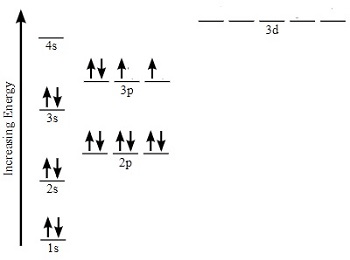
200
What is the energy, in J, of a 423 nm wavelength?
E = (6.626 x10^-34 Js)(3x10^8) / (423 x 10^-9 m) = 4.7 x 10^-19 J
200
Describe the periodic trends from left to right for the following:
* atomic radius
* first ionization energy
* electron affinity
* atomic radius decreases
* first ionization energy increases
* electron affinity becomes more negative (ability to gain electron increases)
200
Write the electron configuration of Tl.
[Xe] 6s2 4f14 5d10 6p1
200
When is change in enthalpy equal to q?
when pressure is constant = no work done by volume compression or expansion
200
Why, for transition metals, are the number of valence electrons and outer electrons different? Why are these numbers the same for main group elements?
Transition metal valence electrons INCLUDE the d shell. Outer electrons include those only in the s and p subshells, because these have the highest n value.
It's the same number for main group elements because their d shells are full.
300
The energy change of an electron transition in an element was measured to be E = 5.3 X 10⁻¹² J. a) Does this represent an emission or absorption of a photon? b) What is the wavelength, in m, of the line that would appear on this elements line spectrum for this transition?
a) positive, so emission
b) E = hc / wavelength
wavelength = hc / E = (6.626 x 10^-34)(3x10^8) / (5.3 x 10^12)
= 3.8 x 10^-14 m
300
What element is this:
[Ar] 4s2 3d10 4p 4
Se
300
Which law is being violated:

Pauli's exclusion principle
300
Consider the volume of a system that changes from 7 L to 25 L against a constant pressure. What is the change in volume? Is this an expansion or compression? What is the sign of w? Is work being done on the system or by the system?
Increases by 18 L, so it's expanding and doing work on the environment, so work is negative.
300
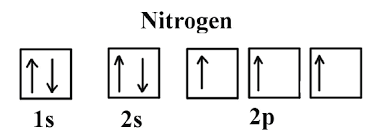
For nitrogen, complete the following:
1.) electron configuration
2.) orbital diagram
3.) core, outer, and valence electrons
4.) predict the charge and configuration of stable ion
1s2 2s2 2p3
2 core, 5 outer, 5 valence
Charge: -3
1s2 2s2 2p6
400
What is the energy associated with a wavelength of 235 micrometers?
E = (6.626 x 10^-34)(3 x 10^8) / (235 x 10^-6) =
8.46 x 10^-22 J
400
What are the quantum numbers (include all possible ml values) for Au? What sub shell is it in? (s, p, d, f?)
n = 5
l = 2
ml = -2, -1, 0, 1, 2
ms = + or - 1/2
5d sub shell
400
Write the condensed electron configuration and determine the number of a) inner b) outer and c) valence electrons for Mn.
[Ar]4s2 3d5
inner: 18
outer: 2
valence: 7
400
What are the signs associated with these values of q and w of a system:
The system RELEASES heat
The system has work DONE on it
Can you determine the sign of E?
Releases heat: -q
Work done on it: +w
Can't determine the sign of E, depends on the magnitude of the values of q and w.
400
50g of aluminum at 25 degrees C absorbs 5000 J of energy. What is the final temperature?
c of aluminum = 0.900 J/g C
Q = mcat
5000 J = (50g)(0.90 J/gc)(Tf - 25)
111.1 = Tf - 25
Tf = 136.1 degrees C
500
What is the frequency of a wave with a wavelength of 765 pm?
c/f = v
(3x10^8)/(765 x 10^12m) = 3.92 x 10^17 Hz
500
Cobalt can form two cations: a +2 cation, and a 3+ cation. What are the electron configurations for the neutral element and both cations?
Neutral: [Ar] 4s2 3d7
+2: [Ar] 3d7
+3: [Ar] 3d6
500
Predict the configuration of the stable ions of the elements below:
Sc +2
Mo +1
Sc: [Ar]3d1
Mo: [Kr] 4d5
- Mo neutral is [Kr] 5s1 4d5 because it is stabilized by a half full d shell, so it only loses the 5s1 one to be +1
500
How much heat energy, in J, is absorbed by 50.0 g of aluminum when it is heated from 20 degrees C to 100 degrees C? The specific heat capacity of aluminum is 0.90 J/g C.
Q = mcat
Q = (50g)(0.90J/gc)(100-20) = 3600 J
500
If 100g of iron is heated with 300 J of energy and its temperature increases by 10 degrees C, what is irons specific heat capacity? dont forget units.
300 = (100g)c(10degrees C)
300J / 1000 g C = c
c= 0.3 J / g C