Atomic Structure and Symbolism
Unit Conversion
Electromagnetic Radiation
Classification of Matter
Chemical formulas
Wildcard
100
What are the charges and placement of subatomic particles (N0, e-, p+)?
Neutrons and protons in the nucleus, electrons in a cloud around nucleus; protons have +1 charge, electrons -1, neutrons neutral
100
Convert 20.5 cm3 to m3.
2.05 x 10⁻⁵ m3
100
What is the equation that relates wavelength and frequency of electromagnetic radiation?
𝜈 = c/λ
100
What properties distinguish solids from liquids? Liquids from gases? Solids from gases?
Solids: unchanging dimensions, unchanging volume
Liquids: changing dimensions, unchanging volume
Gases: changing dimensions, changing volume
100
What is the difference between a molecular and empirical formula? Give an example of each.
Molecular formula = accounts for all atoms in molecule; Empirical = atoms in smallest whole # ratio
100
What are the diatomic elements?
H2, N2, F2, O2, I2, Cl2, Br2
200
Given the ion with a 3+ charge, 28 electrons, and a mass number of 71, write out the isotope formula
7131Ga3+
200
What is the mass of 50.0 mL of octane, with a density = 0.702 g/cm3?
35.2 g
200
List the Electromagnetic Radiation Spectrum starting from the shortest wavelength (include visible light, aka the rainbow)
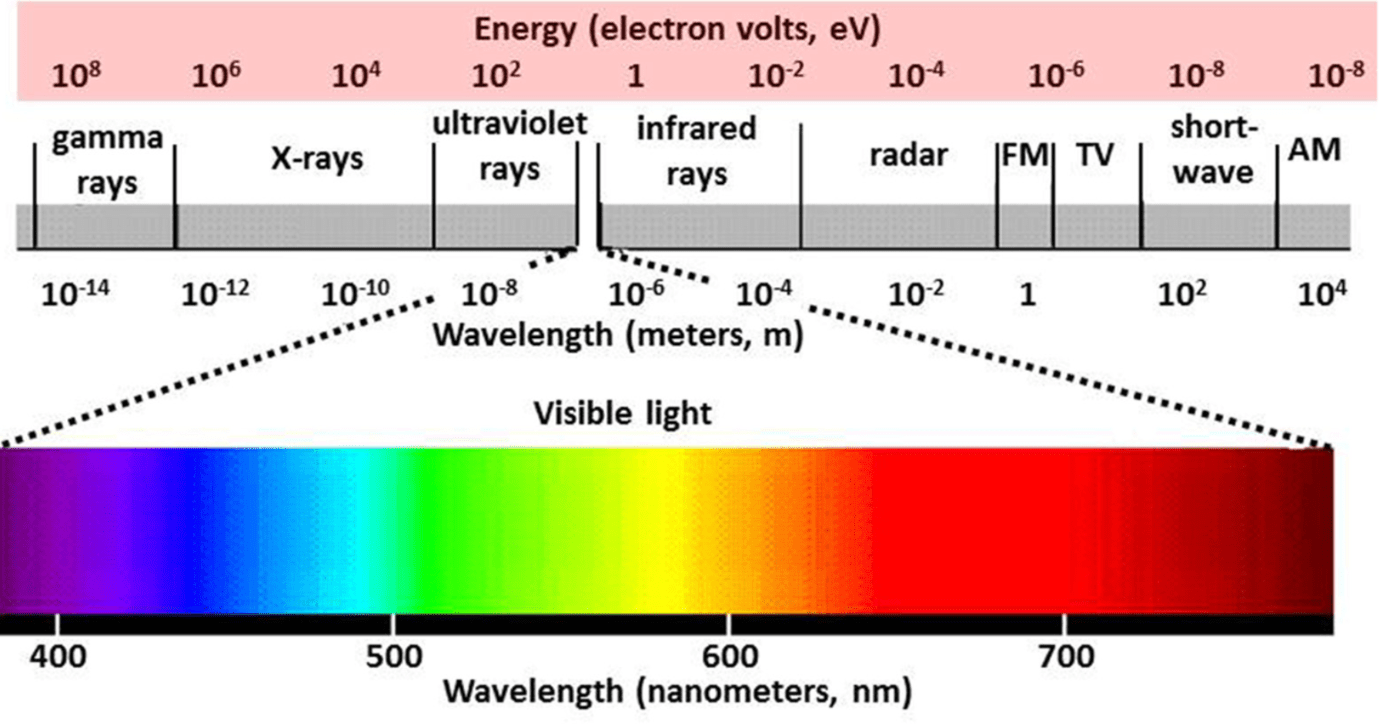
200
Is blood a heterogeneous or homogeneous mixture?
Homogeneous
200
What is the molar mass of caffeine (C8H10N4O2)?
194.19 g/mol
200
What are the polyatomic elements?
P4, S8, Se8
300
Using compounds as an example, explain the laws of multiple proportions, conservation of mass, and the law of constant composition.
Law of Conservation of Mass: number of atoms in = number of atoms out (H2O + CO2 = H2CO3)
Law of Constant Composition: a compound will always be made of the same elements with the same mass percents
Law of Multiple Proportions: When two elements form more than one compound, the masses of element B that combine with a fixed mass of element A always combine in ratios of small whole numbers, demonstrating that atoms combine in fixed, simple ratios
300
The density of a certain substance is 6.3 g/cm3. Aliens have landed on your planet and demand that properties be expressed in their units of density, glorps/eeks3. 1 glorp = 0.324 g, and 1 cm = 2.7 eeks. What is the density in alien units?
0.988 glorps/eeks3
300
FM-95, an FM radio station, broadcasts at a frequency of 9.51 × 10⁷ s−1 (95.1 MHz). What is the wavelength of these radio waves in meters?
3.15 m
300
Which of the following scenes depict pure substances?
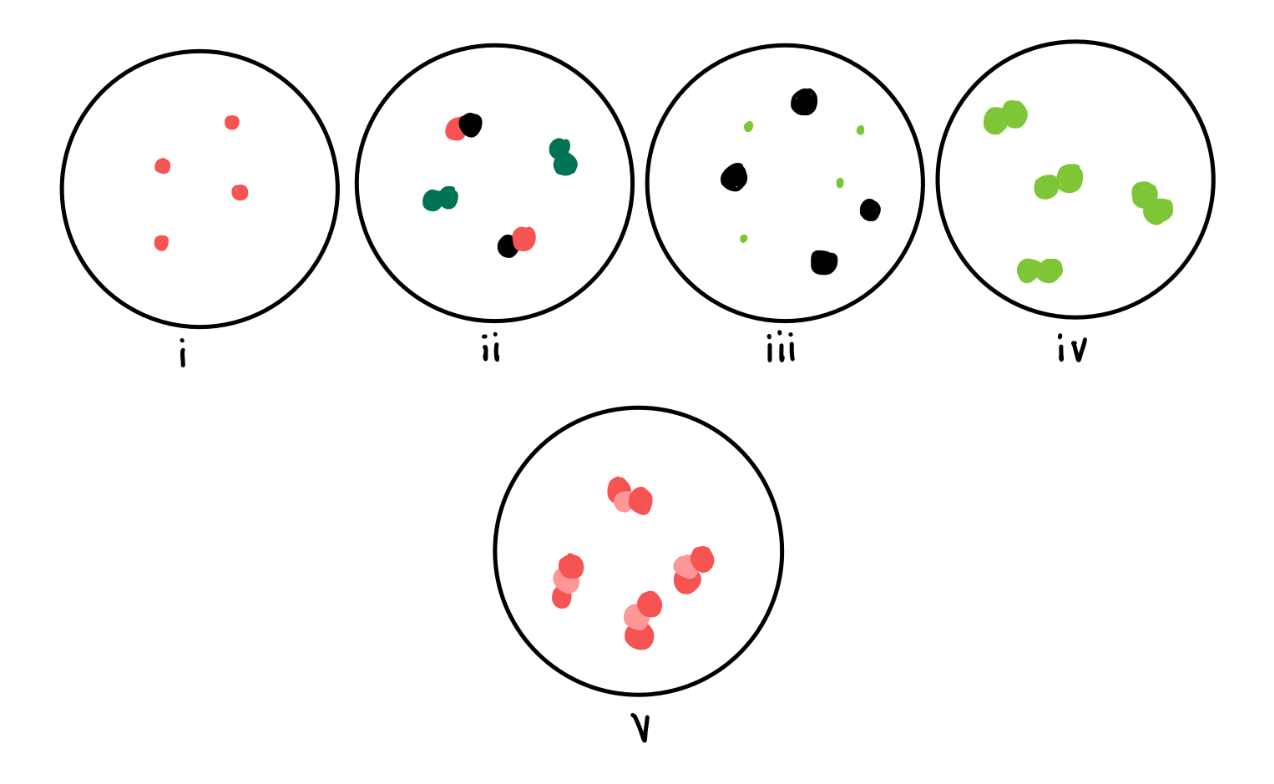
i, iv & v
300
Given 10.2 mol ethane, C2H6, what is the mass in grams?
3.1x10² g of C2H6
300
Describe the difference between accuracy and precision
Accuracy is how close the results are to the true answer, and precision is how close they are to one another
400
Yeast converts glucose to ethanol and carbon dioxide during anaerobic fermentation, as depicted in the simple chemical equation here:
glucose⟶ethanol+carbon dioxide
(a) If 200.0 g of glucose is fully converted, what will be the total mass of ethanol and carbon dioxide produced?
BONUS: What law does this represent?
200g
BONUS: Law of Conservation of Mass
400
The distance between the centers of the two oxygen atoms in an oxygen molecule is 1.21 × 10⁻⁹ dm. What is this distance in inches?
4.76x10⁻⁹ inches
400
A photon of light produced by a surgical laser has an energy of 3.027 × 10⁻¹⁹ J. Calculate the frequency and wavelength of the photon. What is the color of the emitted light?
ν = 4.568 × 10¹⁴ s−1; λ = 656.3 nm; red
400
Classify the six italicized properties in the following paragraph as chemical or physical:
Fluorine is a pale yellow gas that reacts with most substances. The free element melts at −220 °C and boils at −188 °C. Finely divided metals burn in fluorine with a bright flame. Nineteen grams of fluorine will react with 1.0 gram of hydrogen.
Pale yellow: physical
Gas: physical
Reacts with most substances: chemical
Melts at -220 oC: physical
Boils at -188 °C: physical
Metals burn in fluorine: chemical
Nineteen grams of fluorine will react with 1.0 gram of hydrogen: chemicals
400
How many molecules of fructose, C6H12O6, are in a sample of 53.02 g?
1.772 x 10²³ molecules
400
Is the following a scientific hypothesis, a theory, or a law: The sun is made of children’s lost teeth
Hypothesis
500
Calculate the average atomic mass of Lead (Pb) given the mass and abundance of its 4 isotopes: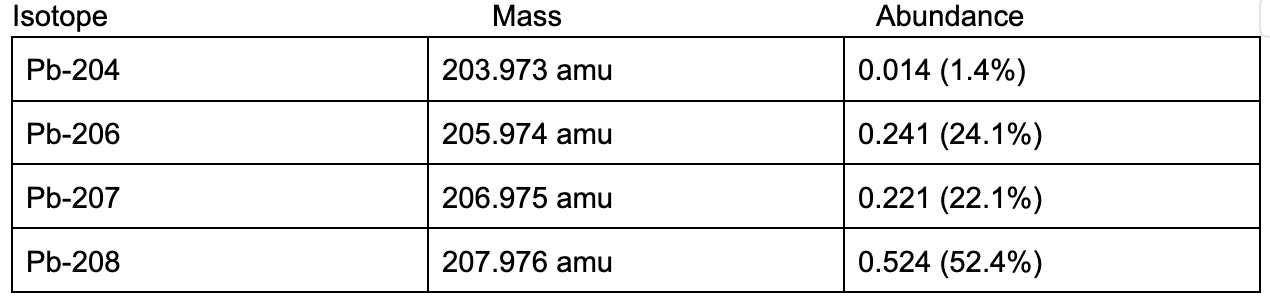
207 amu (should be correct sig figs; full answer = 207.216255)
500
The recommended dose for ibuprofen in an infant is 12.5 mg/kg of body mass every four hours. If ibuprofen is in liquid form with a density of 160 ng/5.0 dL how many mL should be administered to an infant weighing 8.9 lbs (1 kg= 2.2 lbs)
1.6x10⁸ mL
500
What is the threshold frequency for sodium metal if a photon with frequency 6.66 × 10¹⁴ s-1 ejects an electron with 7.74 × 10⁻²⁰ J kinetic energy? Will the photoelectric effect be observed if sodium is exposed to orange light?
5.49 × 10¹⁴ s−1; no
500
When elemental iron corrodes, it combines with oxygen in the air to ultimately form red-brown iron(III) oxide called rust.
If a shiny iron nail with an initial mass of 23.2 g is weighed after rusting, would you expect the mass to have increased, decreased, or remained the same? Explain
BONUS: Is this a physical or chemical change?
Increased as it would have combined with oxygen in the air, thus increasing the amount of matter and therefore the mass.
BONUS: Chemical
500
A certain nut crunch cereal contains 11.0 grams of sugar (sucrose, C12H22O11) per serving size of 60.0 grams. How many servings of this cereal must be eaten to consume 0.0278 moles of sugar?
0.865 servings, or about 1 serving
500
When and where is your exam?
7pm on Tuesday the 27th
location:
Last names start with A – G: Colombia 150
Last names start with H – L: Willamette 100
Last names start with M – P: Lillis 282
Last names start with Q – Z: Lillis 182