IMF's
Heating Curves
Vapor Pressure & Osmotic Pressure
Freezing Point and Boiling Point
Rate Laws
Integrated Rate Laws
Half Lives & Activation Energy
100
How do IMFs relate to boiling point and vapor pressure?
Stronger IMFs will have higher boiling points and lower vapor pressure
Boiling point: stronger forces means stronger attraction, so it’s harder to overcome those attractions in order for the liquid to become a gas
Vapor Pressure: Stronger attraction means smaller amounts of particles want to escape into the gas phase
100
A
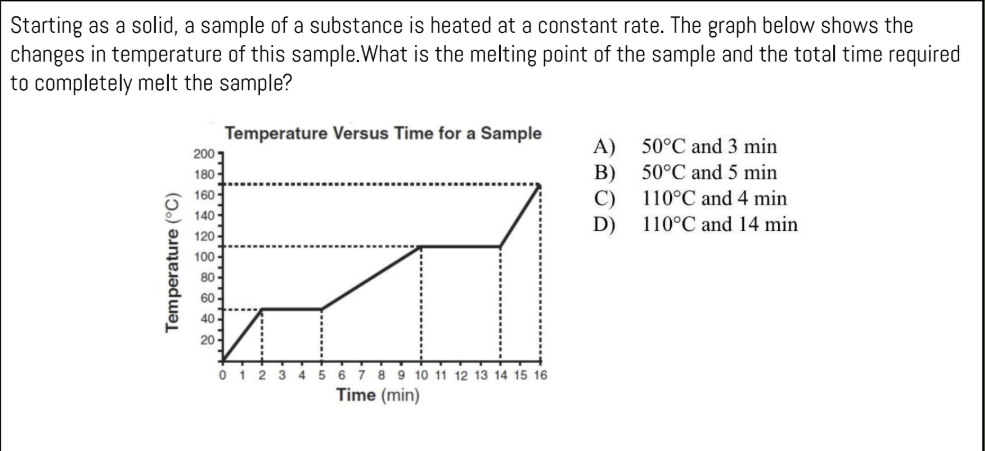
Melting starts at 50 oC and it melts from minute 2 to minute 5.
100
Calculate the vapor pressure of a nonvolatile solution made by dissolving 50.0 g glucose, C6H12O6, in 500 g of water. The vapor pressure of pure water is 47.1 torr at 37°C
Psoln = Xsolv x Posolv
Water is our solvent due to there being a larger amount of it
Answer: 46.63 torr
500g H2O xx 1/18.02 = 27.75 mol
50g glu xx 1/180.16 = 0.2775 mol
27.75/(27.75 + 0.2775) = 0.99
P = 0.99 xx 47.1 = 46.63
100
What is the freezing point depression when 62.2 g of toluene (C7H8) is dissolved in 481 g of naphthalene? The freezing point constant for naphthalene is 7.00 °C/m.
tf = (1) (7.00 °C/m) (0.675058 mol / 0.481 kg)
tf = 9.82 oC
100
Which reaction will proceed at a faster rate?
A
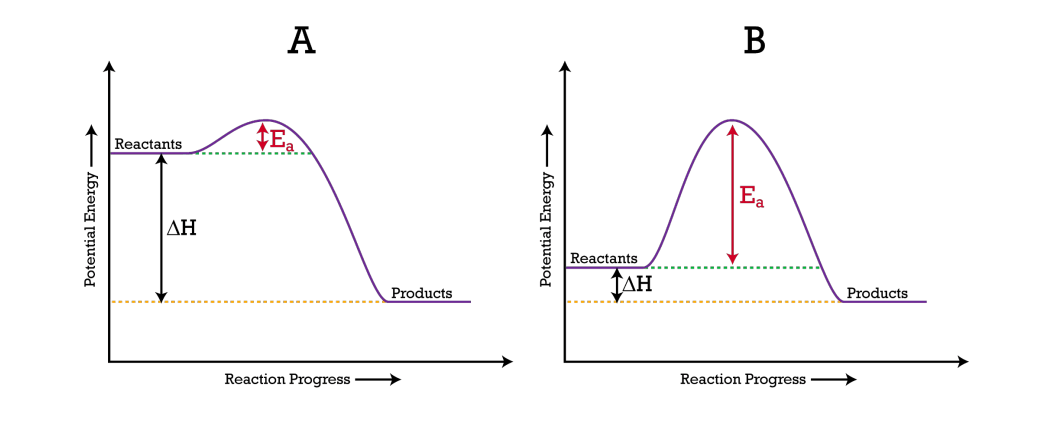
*the lower activation energy needed for the reaction to begin will make the reaction proceed at a quicker rate
100
Write the three integrated rate law equations:
Zero
First
Second
Zero: [A]t = -kt + [A]0
First: ln[A]t = -kt + ln[A]0
Second: 1 / [A]t = kt + 1 / [A]0
100
Write the three half life equations:
Zero
First
Second
Zero: t1/2 = [A]0 / 2k
First: t1/2 = 0.693 / k
Second: t1/2 = 1 / k[A]0
200
What is the strongest IMF for the following molecule?
CH3CH3
London Dispersion
*The symmetry of the molecule would result in it being nonpolar, so it would only have london dispersion
200
How much energy (in kJ) is required to heat 29.0g of ice from -13 oC to 64 oC? (ΔHfusion for water is 6.02 kJ/mol)
(Cs,ice = 2.09 J/g C)
(Cs,liquid = 4.18 J/g C)
q = (29g)(2.09)(0+13) = 0.788 kJ
ΔHfus = 1.609 mol x 6.02 kJ/mol = 9.69 kJ
q = (29g)(4.18)(64-0) = 7.76 kJ
0.788kJ + 9.69kJ + 7.76 kJ = 18.2 kJ
200
Calculate the osmotic pressure for a sample of aqueous 0.10 M Na3PO4 at 20°C.
3 Na+ & 1 PO43- → i = 4
T = 20C + 273.15 = 293.15 K
Π = (4)(0.10M)(0.08206)(293.15K) = 9.6 atm
200
A solution of 10g of sodium chloride is added to 100g of water in an attempt to elevate the boiling point. What is the new boiling point of the solution? Kb for water is 0.52 oC/m.
tb = (2)(0.52 C/m)(1.71 m) = 1.78
1.78 C + 100 C = 101.78 oC
200
Determine the units for the following in terms of M and s
a. Units for [A]?
b. Units for the rate of reaction?
c. Units for the rate constant of first order?
d. Units for rate constant of second order?
e. Units for rate constant of zero order?
a. M
b. M/s
c. 1/s
d. 1/M s
e. M/s
200
A reaction of the form A→Products is second-order with a rate constant of 0.225 1/M s.
If the initial concentration of A is 0.293 mol/L, what is the molar concentration of A after 35.4 s?
1/[A]t = (0.225)(35.4) + 1/0.293M = 11.4 1/M
[A]t = 0.0879 M
200
The activation energy (Ea) is 160 kJ/mol and the frequency factor(A) is 4.73×10¹⁰ 1/M s for the reaction below:
H2 (g) + I2 (g) → 2 HI(g)
What is the rate constant of the reaction at 300°C?
k = Ae-Ea/RT
k = (4.73 x 10¹⁰)e-[(1.60x10^5)/(8.314 x 573)]
k = 1.23 x 10⁻⁴ 1/M s
300
What is the strongest IMF for the following molecules?
CH2O
CH3CH2CH2OH
OF2
CH2O ---> Dipole-Dipole
*The oxygen connected to the carbon would pull the electron density more strongly than the hydrogens, resulting in a polar molecule
CH3CH2CH2OH ---> Hydrogen Bonding
*A hydrogen is bonded to an oxygen
OF2 ---> Dipole-Dipole
*This molecule would have a tetrahedral bent structure due to the two long pairs on oxygen, making it a polar molecule
300
Identify the phase changes and whether they are endothermic or exothermic:
Fusion
Freezing
Vaporization
Condensation
Sublimation
Deposition
Fusion: solid ---> liquid endothermic
Freezing: liquid ---> solid exothermic
Vaporization: liquid ---> gas endothermic
Condensation: gas ---> liquid exothermic
Sublimation: solid ---> gas endothermic
Deposition: gas ---> solid exothermic
300
A physiological saline solution is 0.92% NaCl by mass. What is the osmotic pressure of such a solution at a body temperature of 37 °C? (density = 1 g/ml)
(hint: assuming 100g of solution would help)
(2nd hint: assuming 100g of solution will give us the overall liters as well using the given density of the solution)
Assume 100g of solution, so we have 0.92g NaCl
100g solution ---> 100mL solution ---> 0.1 L
0.92g / 58.443 g/mol = 0.015742 mol / 0.100L = 0.157 M
Π = (2)(0.157)(0.08206)(310) = 7.99 atm
300
How many grams of fucose (C6H12O5) must be dissolved in 419 g of benzene to raise the boiling point by 3.8 °C? The boiling point constant for benzene is 2.67 °C/m.
3.8 = (1)(2.67)(m)
m = (1.423 mol/1 kg) x 0.419 kg = 0.596 mol
(0.596 mol) x (164.16g/mol) = 97.9 g
300
Determine the rate law and rate constant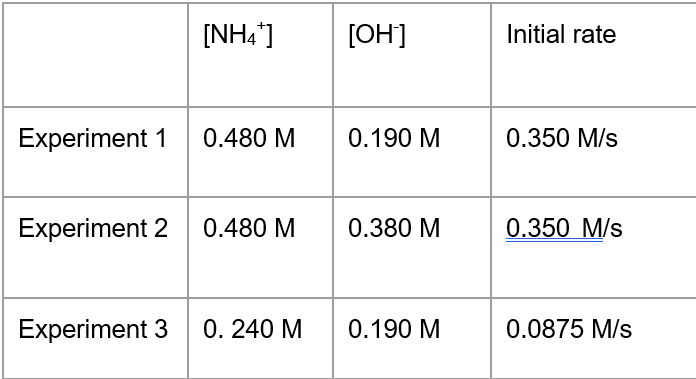
x = 2
y = 0
Rate = k[NH+4]
k = 2.42 1/M s
300
The reaction of butadiene gas (C4H6) with itself produces C8H12 gas as follows: 2 C4H6 → C8H12
The reaction is second order with a rate constant equal to 5.76×10⁻² M/min under certain conditions. If the initial concentration of butadiene is 0.200 M, what is the concentration remaining after 10.0 min?
1 / [A]t = kt + 1 / [A]0
1 / [A]t = (5.76 x 10⁻² M/min)(10min) + 1/[0.200M]
1 / [A]t = 5.576 M
[A]t = 0.179 M
300
A. How many half lives would it take for the concentration of NOCl to reach 12.5% of its original concentration?
B. How many half lives to reach 0.39% of its original volume?
(hint: you don't need to use any half life equations for this)
A. 3 half lives
B. 8 half lives
Explanation:
100% to 50% is 1 half life
50% to 25% is 2 half lives
25% to 12.5% is 3 half lives
12.5% to 6.25% is 4 half lives
etc.
400
Rank the following compounds from lowest to highest boiling points based on their IMF's
GeCl4 , CH4 , SIH4 , GeH4
CH₃OH , CH₃CH₂CH₃ , CH₃CH₂OH
GeCl4 , CH4 , SIH4 , GeH4
CH4 < SIH4 < GeH4 < GeCl4
*All of these compounds would have london dispersion, so we go off molar mass from least to greatest to determine our ranking
CH₃OH , CH₃CH₂CH₃ , CH₃CH₂OH
CH3CH2CH3 < CH3OH < CH3CH2OH
*Two of the molecules would have hydrogen bonding due to the OH, but the longer compound would have a higher BP due to a larger molar mass
400
Calculate the amount of heat (in kJ) that is released when 35.0g of benzene vapor(C6H6) is cooled from 96.0 oC to 26.4 oC
BP benzene: 80.09 oC ΔHvap = 30.72 kJ/mol
FP benzene: 5.49oC
Cs,liq = 1.74 J/g oC Cs,gas = 1.055 J/g oC
q = (35g)(1.055)(80.09 - 96) = -0.587 kJ
ΔHvap = -30.72 kJ/mol x 0.448 mol = -13.8 kJ
q = (35g)(1.74)(26.4 - 80.09) = -3.27 kJ
-17.7 kJ
400
Calculate the vapor pressure of a volatile solution of 74.0 g of benzene (C6H6) in 48.8 g of toluene (C7H8) at 25.0 °C. The vapor pressure of benzene is 95.1 torr and of toluene is 28.4 torr at this temperature.
Benzene: 74g / 78.113 (g/mol) = 0.947 mol
Toluene: 48.8g / 92.14 (g/mol) = 0.5296 mol
Xben = 0.947 / (0.947 + 0.5296) = 0.641
Xtol = 0.5296 / (0.947 + 0.5296) = 0.3586 mol
Psoln = (95.1 torr)(0.6414) + (28.4 torr)(0.3586) = 71.2 torr
400
2.00 g of some unknown compound reduces the freezing point of 75.00 g of benzene (C6H6) from 5.53 C to 4.90 C. What is the molar mass of the compound?
(4.90 - 5.53) oC = (1) (5.12) m
m = 0.123 mol/kg x 0.075 kg benzene = 0.00923 mol solute
2.00g / 0.00923 mol = 216.80 g/mol
400
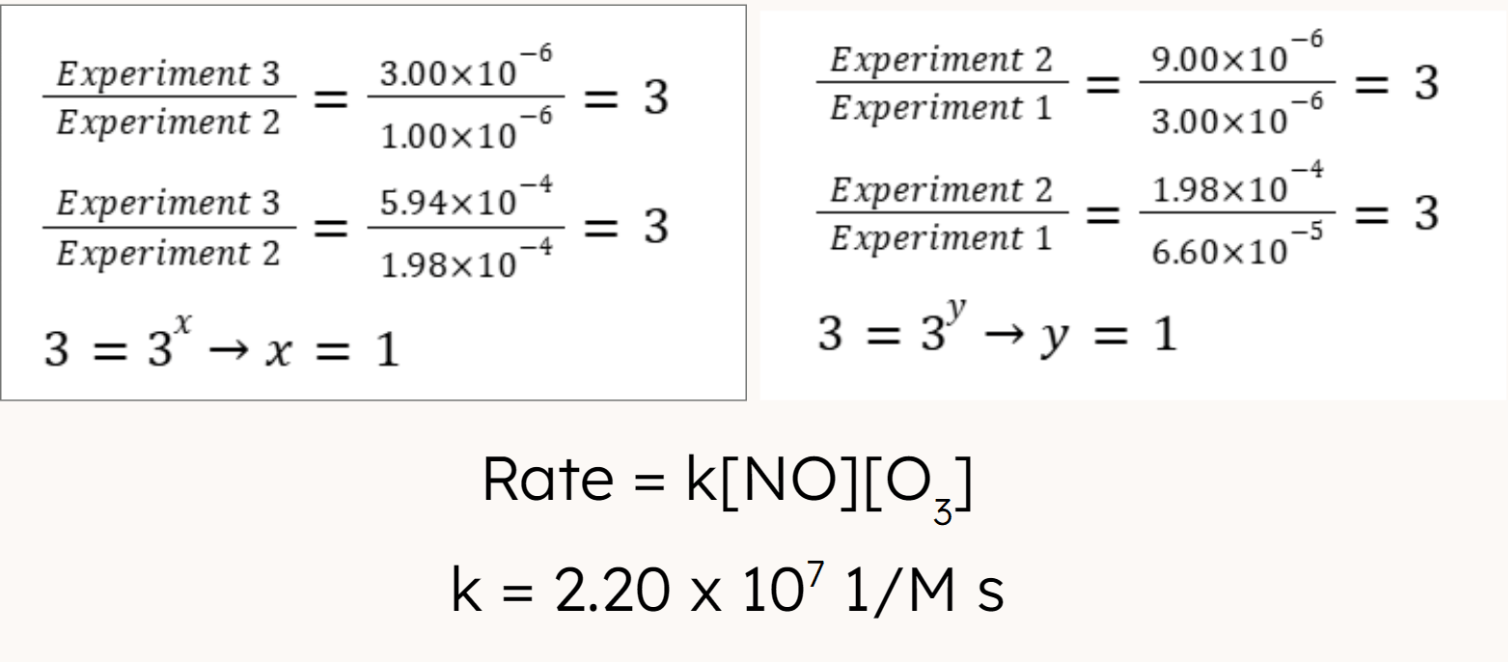
what is the rate law and value of the rate constant for this reaction?
400
H2O2(l) → 2H2O(l) + O2(g)
The decomposition of H2O2 to water and oxygen follows first order kinetics with a rate constant of 0.0410 min-1 . Calculate the [H2O2] after 10 minutes if [H2O2]0 is 0.200 M.
ln[H2O2]t− ln[H2O2]0 = −kt
ln[H2O2]t − ln[0.200]0 = (−0.0410 min−1 )(10 min)
[H2O2] = 0.132 M
400
Given that the rate constant is 11 1/M s at 345 K and the frequency factor is 20 1/M s, calculate the activation energy in kJ/mol.
ln(k) = ln(a) + (-Ea/RT)
-RTln(k/a) = Ea
-(8.314)(345) ln (11/20)
Ea = 1.715 kJ/mol
500
Define the following terms:
London-Dispersion
Dipole-Dipole
Hydrogen Bonding
London-Dispersion: temporary dipoles, something every molecule has
Dipole-Dipole: permanent dipoles that are present in polar molecules
Hydrogen Bonding: strong dipole molecules, occurs when a hydrogen is paired to a nitrogen, oxygen, or fluorine
500
How much heat (in kJ) is released when 73.0g of water is cooled from 136 oC to -27 oC?
Cs steam = 2.09 J/g C
Cs liquid H2O = 4.18 J/g C
ΔHvap = 40.7 kJ/mol)
q = (73g) (2.09) (100-136) = -5.49 kJ
ΔHvap = 4.05 mol x (-40.7 kJ/mol) = -164.9 kJ
q = (73) (4.18) (0-100) = -30.51 kJ
ΔHfus = 4.05 mol x (-6.02 kJ/mol) = -24.38 kJ
q = (73) (2.09) (-27-0) = -4.12 kJ
(-5.49 kJ) + (-164.9 kJ) + (-30.51 kJ) + (-24.38 kJ) + (-4.12 kJ) = -229.7 kJ
500
Hemoglobin is a large molecule that carries oxygen in human blood. A water solution that contains 0.263 g of hemoglobin (Hb) in 10.0 mL of solution has an osmotic pressure of 7.51 torr at 25 oC
What is the molar mass of the hemoglobin?
(Hint: Hemoglobin is considered a nonelectrolyte)
i = 1
T = 25 C + 273.15 K = 298.15 K
Π = iMRT → M = Π / (iRT)
M = (0.009882atm) / (1 x 0.08206 x 298.15K) = 0.000404M
0.000404M x 0.01 = 4.04 x 10⁻⁶ mol
0.263g / 4.04 x 10⁻⁶ mol = 6.51 x 10⁴ g/mol
500
Calculate the boiling point of a 4.81% by mass solution of magnesium chloride (MgCl2 ; molar mass = 95.211g/mol).
The van't Hoff factor of MgCl2 is 2.7
Kb of water is 0.512 °C/m
(hint: assume 100g of solution)
Assuming 100g of solution will give us 4.81g MgCl2 and 95.19g water
4.81g MgCl2 x 1mol/95.211g = 0.005052 mol
Δt = (2.7)(0.512 C/m)(0.005052mol / 0.00952 kg) = 0.73 oC
Δt = 100 C + 0.73 = 100.73 oC
500
Find the missing concentration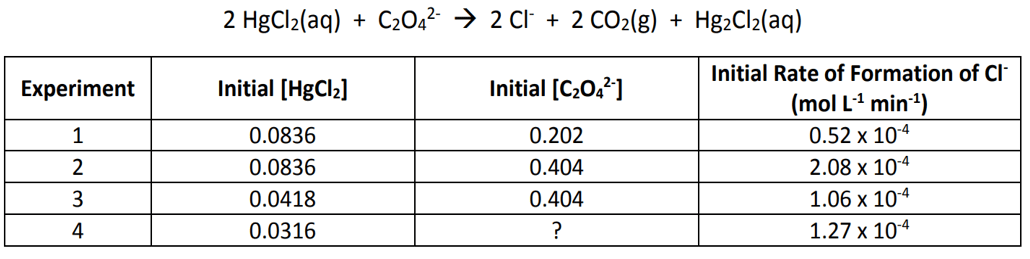
(hint: find the rate law, then the k value, then plug in for experiment 4 to find your missing concentration)
Rate = k[HgCl2][C2O42-]2
k = 0.0152 1/M2s
Ex 4 [C2O42-] concentration = 0.513 M
500
Consider the first-order decomposition of SO2Cl2. The concentration of SO2Cl2 decreases from 0.240 M to 0.120 M after 2.16 hrs at 340°C.
A. Calculate the time it takes for the concentration of SO2Cl2 to decrease from 0.100 M to 0.050 M?
B. From 0.520 M to 0.0325 M?
ln[A]t = -kt + ln[A]0
k = 0.321 1/h
A. from 0.100 M to 0.050 M
ln[0.050M] = -(0.321)t + ln[0.100M]
t = 2.16 hrs
B. From 0.520 M to 0.0325 M?
ln[0.0325M] = -(0.321)t + ln[0.520M]
t = 8.64 hrs
500
Anthropologists can estimate the age of a bone or other sample of organic matter by its carbon-14 content. The carbon-14 in a living organism is constant until the organism dies, after which carbon-14 decays with first-order kinetics and a half-life of 5730 years. Suppose a bone from an ancient human contains 19.5% of the C-14 found in living organisms. How old is the bone?
(Hint: assume the original concentration is 100%)
(second hint: you'll need to use both the first order half life equation and first order integrated rate equation)
Use half life equation to find k value:
k = 0.693 / 5730yrs = 1.21 x 10⁻⁴ 1/yr
Now plug in everything to integrated rate law:
ln(19.5) = -(1.21 x 10⁻⁴ 1/yr)(t) + ln(100)
t = 13500 years