Epidermis Layers
Cell Types
Dermis & Hypodermis
Skin Appendages
Random
100
Which epidermal layer is the deepest and contains a single row of continually renewing cells?
Stratum Basale
100
What cell type produces keratin and makes up most epidermal cells?
Keratinocytes
100
Name the two major layers of the dermis.
Papillary layer and reticular layer
100
What is a flexible strand that is made of dead keratinized cells?
Hair
100
Which pigment accumulates on the superficial side of the nucleus to protect it from UV radiation, and where is it produced?
Melanin produced by melanocytes
200
Which layer contains a weblike system of intermediate filaments that provide structural support and flexibility, and are attached to desmosomes.
Stratum Spinosum
200
Which epidermal cell synthesizes melanin and transfers it in melanosomes to keratinocytes?
Melanocytes
200
What is the purpose of the dermal papillae?
It provides increased friction through surface area and enhances grip strength.
200
Compare eccrine and apocrine sweat glands in location and composition of sweat.
Eccrine glands are abundant on palms, soles, forehead; produce mostly water (99%) with salt. Apocrine glands are in the axillary and genital regions; sweat includes fatty substances and proteins, causing odor.
200
What is a scalelike modification of the epidermis that forms a protective covering?
A nail
300
Which layer consists of 3–5 cell layers where keratinocytes flatten, organelles disintegrate, and keratohyaline and lamellated granules accumulate?
Stratum granulosum
300
Identify the epidermal immune cell that arises from bone marrow, is star-shaped, and functions as a phagocyte to activate immune responses.
Langerhans cells
300
SPEED ROUND- FIRST GROUP TO ANSWER CORRECTLY WINS
In order from superficial to deep write the three layers of the skin.
1. Epidermis
2. Dermis
3. Hypodermis
300
Describe the composition and primary functions of sebum.
Sebum lubricates and softens hair and skin, prevents hair brittleness, has bactericidal properties, and slows water loss in low humidity.
300
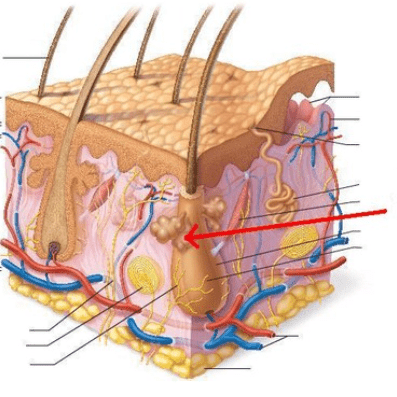
Sebaceous gland
400
In which type of skin is the stratum lucidum present, and what is its primary function?
Thick skin; it reduces friction between stratum granulosum and stratum corneum
400
Describe the function of Merkel cells.
They are mechanoreceptors that function in touch sensation.
400
Explain the clinical significance of cleavage (tension) lines and flexure lines for surgery and joint movement.
Incisions parallel to cleavage lines gape less and heal faster; flexure lines are dermal folds near joints where the dermis is tightly bound to deeper structures to allow movement.
400
What are the four main appendages of the epidermis listed in this chapter?
Nails, sweat glands, sebaceous (oil) glands, hair and hair follicles
400
Where is the Ceruminous gland found and what does it produce?
Found in the ear canal and produces a waxy substance called cerumen (ear wax).
500
Explain how the stratum corneum contributes to water conservation and protection; include the role of cell structure and extracellular substances.
The stratum corneum has 20+ layers of dead, keratinized cells that provide protection; the extracellular glycolipid waterproofs the skin and slows water loss.
500
How long does it take for our epidermis to completely renew?
Epidermal turnover ~25–45 days.
500
List three functions of the hypodermis.
functions: padding/protection, thermoregulation, energy storage, and anchoring skin to bone/muscle.
500
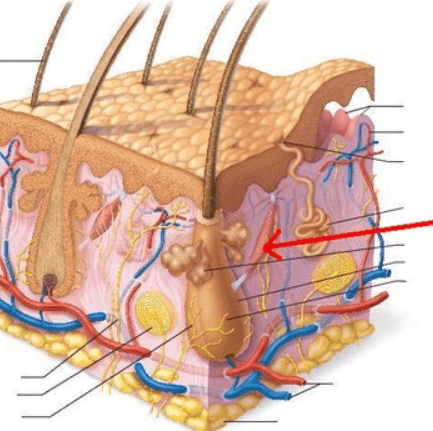
arrector pili muscle; raises hair (goosebumps)
500
What are the six functions of the Integumentary System?
Protection, Body Temp Regulation, Sense of Touch, Vitamin D production, Blood Reservior, and Excretion (sweat)