Tables
Graphs
Equations
Verifying Inverses
Finding Inverses
100
f(x)=-5
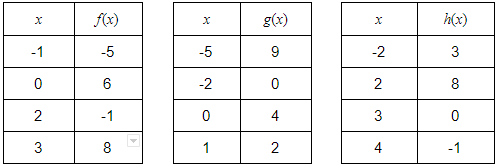
What is
x=-1
100
Determine
(d+e)(0)
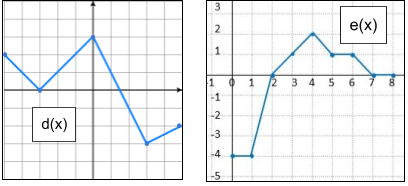
What is -1?
100
Find f(5)
f(x)=7-3x
What is -8?
100
The graphs of a function and its inverse should be symmetrical across _____ (equation).
What is
y=x ?
100
A point on f^-1(x) given that the point (9,-2) lies on f(x) .
What is (-2,9)?
200
(g-h)(4)
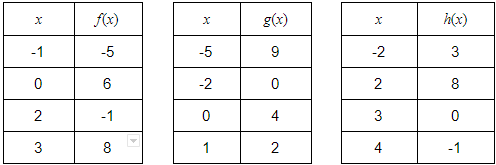
What is DNE since 4 is not in the domain of g?
200
(d@e)(0)
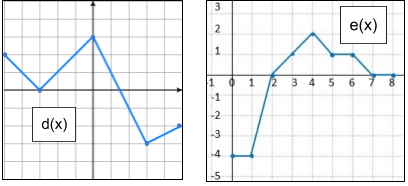
What is 1?
200
Find (g-h)(5)
g(x)=(x-8)/3
h(x)=4x-19
What is -2?
200
We can use ________ to verify inverse equations.
What is composition of functions? OR
What is graph and check for symmetry?
200
What is the inverse of
(x+3)/4
4x-3
300
(h@h)(-2)
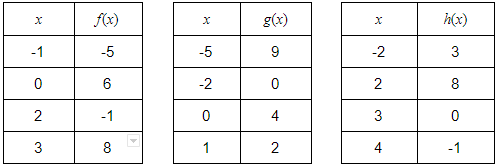
What is 0?
300
(e@d)(3)
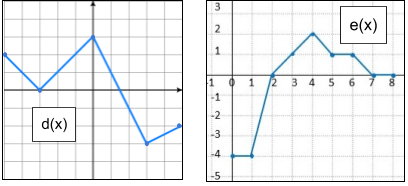
What is DNE since -3 is not in the domain of e?
300
Find (gf)(x)
f(x)=3x^2-1
g(x)=2-5x
What is
(gf)(x)=-15x^3+6x^2+5x-2
300
True or False: These represent inverse functions.
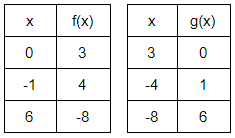
What is false because
(-1,4) ->(-4,1)
300
True or False (and explain): The dashed orange and solid black graphs are inverses.
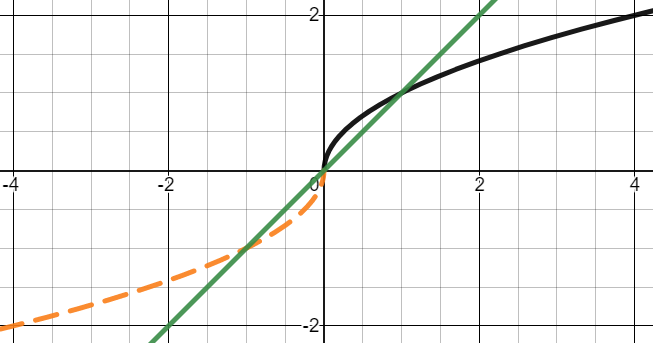
What is False since they are not symmetrical across the green line (y=x)?
400
True or False:
(h@f)(3)=2
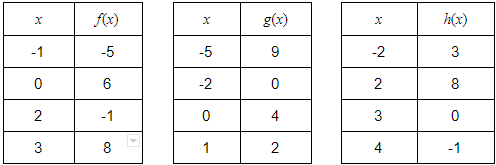
What is False since 8 is not in the domain of h(x)?
400
(ed)(5)
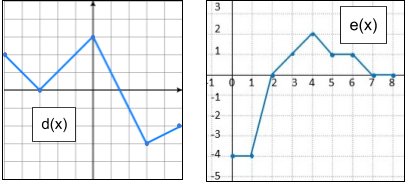
What is -2?
400
Find (f o g)(4)
f(x)=sqrt(x+6)
g(x)=-3x+2
What is DNE since you cannot square root a negative?
400
True or False: The function f(x)=8-x has an inverse of f^-1(x)=8-x .
What is True:
(f@f^-1)(x)=x
400
The inverse of
k(x)=2x-4
What is
k^-1(x)=(x+4)/2 OR
k^-1(x)=x/2+2
500
(_@h)(3)=6
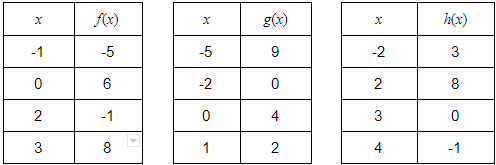
What is f?
500
(e/d)(2)
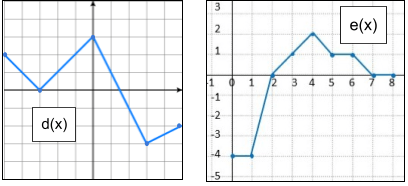
What is 0?
500
Find
(h@g)(x)
g(x)=x-2
h(x)=3x^2-5
What is
(h@g)(x)=3x^2-12x+7
500
True of False: The inverse of g(x)=3/2x-7 is g^-1(x)=(14-2x)/3 . (You must provide evidence as to why)
What is False:
(g@g^-1)(x)=-x and
(g^-1@g)(x)=(-3x+28)/3
500
The inverse of
g(x)=4x^2-3
What is
g^-1(x)=sqrt((x+3)/4) or
g^-1(x)=sqrt(x+3)/2