Vocabulary
Angles
Quadrilateral
Trapezoids
Polygon
100
A quadrilateral with both pairs of opposite sides parallel is called a
Parallelogram
100
Use the parallelogram to find
m< DAE 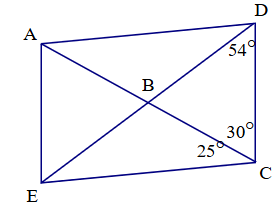
55 degrees
100
Can the following quadrilateral be proven to be a parallelogram based on the given information?
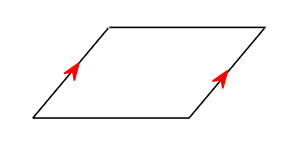
No. It cannot be proven because only one pair of opposite sides is parallel.
100
Name each type of special quadrilateral that can meet the given condition.
exactly one pair of parallel sides
trapezoid and isosceles trapezoid
100
A quadrilateral with two pairs of consecutive sides congruent and no opposite sides congruent is called a(n) __________.
kite
200
A polygon is _______ if no line containing a side contains a point within the interior of the polygon
Convex
200
Find the sum of the interior angle measures of a 14-gon
2160 degrees
200
Can the following quadrilateral be proven to be a parallelogram based on the given information?
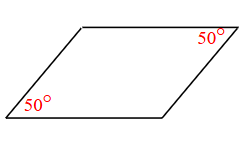
No. It cannot be proven because it only has one pair of opposite congruent angles.
200
The nonparallel sides of a trapezoid are each called a(n) __________.
leg
200
A _______ polygon is a polygon that is equilateral and equiangular.
regular
300
A quadrilateral with exactly one pair of parallel sides is called a(n)
trapezoid
300
Find the measures of the numbered angles in the kite.
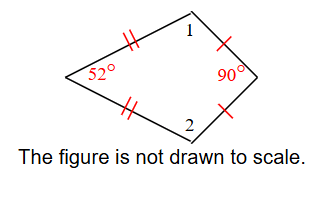
m<1 = 109 degrees
m<2 = 109 degrees
300
Can the following quadrilateral be proven to be a parallelogram based on the given information?
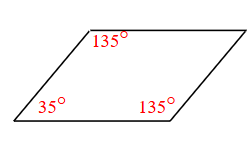
No. It cannot be proven because it does not have an angle that is supplementary to both of its consecutive angles.
300
A polygon with 4 sides is called a _______.
quadrilateral
300
A parallelogram with four right angles and all sides of equal length is called a/an
Square
400
A trapezoid with legs that are congruent is called a(n) _______ trapezoid.
isosceles
400
Find the measure of an exterior angle of a regular pentagon
72 degrees
400
A parallelogram with all sides of equal length without any right angles is called a/an _______.
rhombus
400
A trapezoid has two pairs of _______.
base angles
400
Name the polygon according to the number of sides. Then identify whether it is convex or concave. 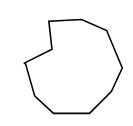
name: decagon
concave
500
A segment joining two nonconsecutive vertices of a convex polygon is called a(n) _______ of the polygon.
diagonal
500
Use polygon CDEFG to answer the following. Name the included side of <E and <F
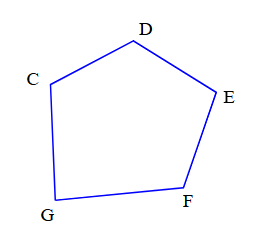
EF
500
A _______ is a parallelogram with four right angles.
rectangle
500
The segment that joins the midpoints of the legs of a trapezoid is called a _______.
midsegment
500
A(n) _______ polygon is a polygon with all angles congruent.
equiangular