Sets, Postulates, and Theorems
Undefined Terms & Relationships
Subsets of Lines & Planes
Segment & Angle Measure
Two-Dimensional Figures
3 dimensional figures and extra
100
Define equal sets and equivalent sets
Equal sets have exactly the same elements; equivalent sets have the same NUMBER of elements
100
Name three collinear points other than A, M, and B.
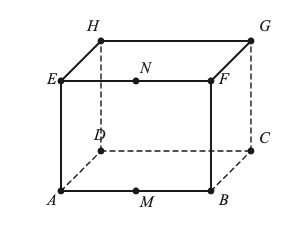
E, N, F
100
Name two rays in the diagram that are opposite rays.
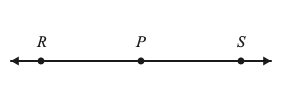
Ray PR and ray PS.
100
Point A has coordinate −4 and point B has coordinate 9 on a number line. Find AB.
AB = |−4 − 9| = 13
100
Using the two figures below, identify which is convex and which is concave.
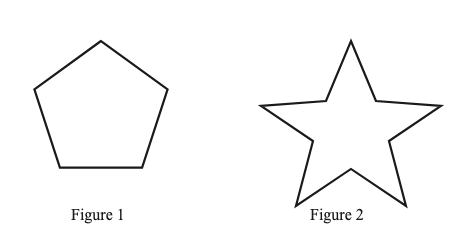
Figure 1 is convex
Figure 2 is concave
100
A polygon with 10 sides is called a ________________.
decagon
200
Let A = {1, 3, 5, 7} and B = {3, 5, 9, 11}. Find A ∪ B and A ∩ B.
A ∪ B = {1, 3, 5, 7, 9, 11} A ∩ B = {3, 5}
200
Name four coplanar points that are not all on the bottom face or all on the top face.
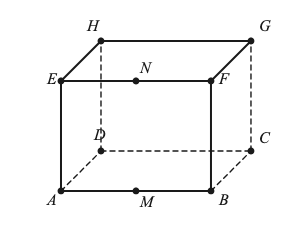
Any one face other than ABCD or EFGH — e.g., A, B, F, E (the front face).
200
Name the vertex and the two sides of ∠ABC.
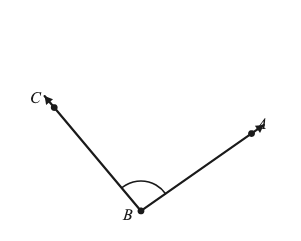
Vertex: B. Sides: ray BA and ray BC.
200
If A-B-C, AB = 17, and BC = 8, find AC.
AC = AB + BC = 17 + 8 = 25
200
Define equilateral polygon, equiangular polygon, and regular polygon.
Equilateral: all sides the same length. Equiangular: all angles the same measure. Regular: both equilateral and equiangular.
200
True or False: the empty set (∅) is a subset of every set.
True
300
Given U = {1, 2, 3, 4, 5, 6, 7, 8, 9, 10} and A = {1, 2, 3, 4, 5}, find A′ (the complement of A).
A′ = {6, 7, 8, 9, 10}
300
Name a pair of parallel lines.
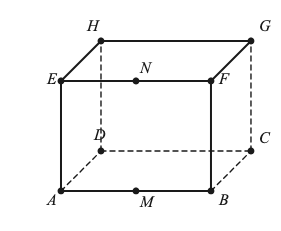
e.g., line AB and line EF.
300
What is the line separating two half-planes called?
The line separating the two half-planes is called the edge.
300
Points X, Y, Z lie on a line with X-Y-Z. If XY = 14 and XZ = 22, find YZ.
YZ = XZ − XY = 22 − 14 = 8
300
A polygon has 9 sides. What is it called? A polygon has 12 sides — what is it called?
9 sides = nonagon. 12 sides = dodecagon.
300
A polyhedron has 8 faces. What is it called?
Octahedron
400
Name the postulate described: “A line contains at least two points; a plane contains at least three noncollinear points; space contains at least four noncoplanar points.”
A. Line Postulate, B. Plane Postulate, C. Expansion Postulate, D. Flat Plane Postulate
C. Expansion Postulate
400
Name a pair of skew lines.
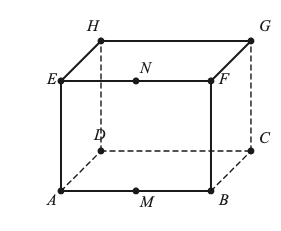
e.g., line AB and line DH (not coplanar, don't intersect, aren't parallel).
400
Two half-planes that share a common edge are called ________________ half-planes.
opposite
400
Using the diagram below, find m∠MNP.
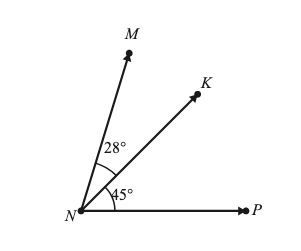
m∠MNP = m∠MNK + m∠KNP = 28° + 45° = 73°
400
Using the circle below (center O), identify which labeled segment is a radius, which is a diameter, and which is a chord that is NOT a diameter.
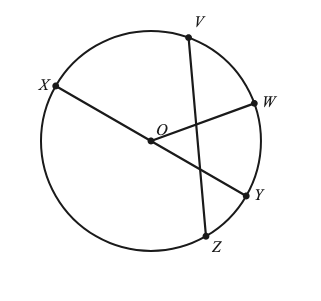
Radius: segment OW
Diameter: segment XY
Chord (not a diameter): segment VZ
400
A cone or cylinder is called circular if its ________________ is a circle.
Base
500
Which choice correctly states both the Flat Plane Postulate and the Line Intersection Postulate?
A. Flat Plane: If two points lie in a plane, the entire line containing them lies in that plane. Line Intersection: If two lines intersect, they intersect in exactly one point.
B. Flat Plane: If two planes intersect, they intersect in a line. Line Intersection: If two lines intersect, they intersect in a plane.
C. Flat Plane: Through any three noncollinear points there is exactly one plane. Line Intersection: If two lines intersect, they intersect in exactly one point.
D. Flat Plane: If two points lie in a plane, the entire line containing them lies in that plane. Line Intersection: If two lines intersect, they lie in the same plane.
A. Flat Plane: If two points lie in a plane, the entire line containing them lies in that plane. Line Intersection: If two lines intersect, they intersect in exactly one point.
500
True or False, and explain: if two lines are coplanar, they must intersect.
False — two coplanar lines could be parallel, which means they never intersect.
500
Classify each angle by its measure: 15°, 90°, 120°, 180°
15° = acute, 90° = right, 120° = obtuse, 180° = straight
500
A regular hexagon has side length 7 cm. find its perimeter.
6 × 7 = 42 cm