Temperature Conversions and Specific Heat
Heat of Vaporization
Heat of Fusion
Heating and Cooling Curves
Chemical Properties
100
What is 40°F converted into Celsius?
4.44°C
100
How much heat is required to vaporize 10.0 g of water if the heat of vaporization of water is 2.26 kJ/g?
22.6 kJ
100
How much heat is required to melt 10 g of a substance with a heat of fusion of 2.0 kJ/g?
20 kJ
100
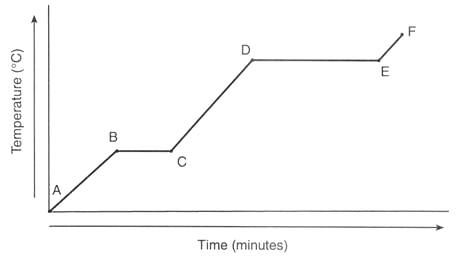 Which section represents the solid being heated?
A
100
Elleka mixes pulp-free orange juice and apple juice together to create a mixture. Is this mixture homogenous or heterogenous?
Homogenous
200
What is 5,842 J converted into Calories?
1.39 Cal
200
A sample requires 45 kJ of energy to completely vaporize. If the heat of vaporization is 2.25 kJ/g, what is the mass of the sample?
20 g
200
A substance has a heat of fusion of 3.5 kJ/g. How much energy is needed to melt 8.0 g?
28 kJ
200
Using the heating curve above, which section represents the melting point/phase change from solid → liquid?
B-->C
200
Iron oxidizes over time, causing rust. Is this a physical or chemical change?
Chemical
300
A 50.0 g sample of liquid water at an initial temperature of 22.0 °C absorbs 2,500.0 Joules of heat energy. What is the final temperature of the water?
The specific heat capacity of water is 4.184 J/(g/c)
33.95 °C
300
A liquid has a heat of vaporization of 1.50 kJ/g. How much energy is needed to vaporize 35 g?
52.5 kJ
300
A sample absorbs 60 kJ while melting. If its heat of fusion is 2.0 kJ/g, what is the mass of the sample?
30 g
300
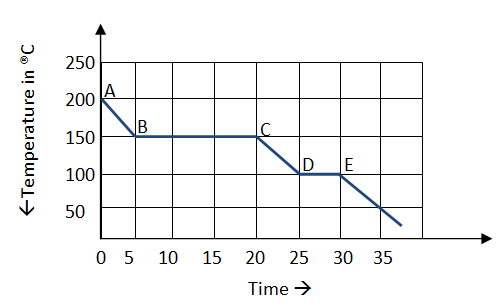
Which sequence correctly identifies the regions?
A.
A = gas, B = boiling, C = liquid, D = melting, E = solid
B.
A = solid, B = melting, C = liquid, D = freezing, E = gas
C.
A = gas, B = condensation, C = liquid, D = freezing, E = solid
D.
A = gas, B = freezing, C = liquid, D = condensation, E = solid
C
300
Elleka has a substance that expands to fill it's container, and has no definite shape. What state of matter is it?
Gas
400
A 250.0 g block of aluminum absorbs 6,750.0 Joules of heat energy. If the final temperature of the aluminum block reaches 55.0 °C, what was its initial temperature?
Specific heat of Aluminum is 0.900 J/(g/c)
25.0 °C
400
A sample of liquid requires 84.0 kJ to completely vaporize. If its heat of vaporization is 2.10 kJ/g, what is the mass of the sample?
40.0 g
400
A substance has a heat of fusion of 0.75 kJ/g. How much heat is needed to melt 120 g?
90 kJ
400
Which statement correctly explains why the temperature stays constant during the flat sections?
A. No energy is being added to the substance.
B. The energy is being used to change the phase rather than increase temperature.
C. The substance stops absorbing energy.
D. The thermometer cannot measure temperature during a phase change.
B
400
Elleka dissolves a spoonful of sugar into her coffee. The sugar becomes uniformly mixed with the coffee. Is this a physical or chemical change?
Physical
500
A 150.0 g sample of iron at an initial temperature of 22.0 °C is heated until it reaches a final temperature of 122.0 °C. How much heat energy in Joules did the iron absorb?
The specific heat of iron is 0.449 J/(g/C)
6,735.0 Joules
500
A substance has a heat of vaporization of 0.85 kJ/g. If 250 g of the substance is vaporized, how much energy is required in joules?
212,500 J
500
A sample requires 36,000 J to completely melt. Its heat of fusion is 1.50 kJ/g. What is the mass of the sample?
24 g
500
Using the cooling curve above, which section represents the freezing point?
D ---> E
500
As a substance cools, it condenses from gas into what?
Liquid