Muscle Up!
Nerves of Steel
Contract to Win
Power Play
Built to Last
The Muscle Advantage
100
What are the three types of muscles tissue in the human body?
Skeletal, smooth and cardiac muscle
100
What is a motor unit?
Fibers activated by same nerve; basic function of muscular activity
100
During which type of contraction does a muscle shorten as it produces force?
Concentric contraction
100
What is muscular strength?
The ability of a muscle or muscle group to produce force against resistance.
100
What is apoptosis?
Programmed cell death, a regulated process that removes cells from the body.
100
What is one example of a trainable factor that can improve a muscle's performance capacity?
fiber diameter, intra-muscle coordination, nerve impulse frequency, inter-muscle coordination, elasticity of muscle and its tendons, energy stores of muscle and liver, capillary density of muscle
200
This cylinder-shaped structure contains contractile machinery and organelles for cell respiration.
Muscle fiber
200
What is the all-or-none principle of muscle contraction?
A motor unit either contracts fully when its activation threshold is reached or does not contract if the threshold is not reached. The force of an entire muscle can still vary by recruiting more motor units and changing their firing rates.
200
What type of contraction occurs when a muscle produces force but the external load does not move because the load exceeds the force being generated?
Isometric contraction
200
What is muscular endurance, and name one sport that requires it.
The ability to sustain or repeatedly perform muscular work while resisting fatigue. Examples include swimming, rowing, and cross-country skiing.
200
What is the medical term for the age-related loss of muscle mass and strength?
Sarcopenia.
200
What is one example of a nontrainable factor that can influence a person's muscle performance?
number of fibers, fiber structure (ST or FT fibers)
300
What are the two main protein filaments responsible for muscle contraction?
Actin (thin filaments) and myosin (thick filaments).
300
What is an activation threshold?
Specific threshold that must be reached for activation
300
What type of contraction occurs when a muscle lengthens while controlling a load, such as lowering a dumbbell?
Eccentric contraction.
300
What is the difference between maximal strength and power?
Maximal strength is the greatest force a person can produce, while power is the ability to produce force rapidly.
300
How does lean muscle mass generally affect a person's strength?
Greater lean muscle mass generally allows greater force production because a larger muscle cross-sectional area can generate more force.
300
Which muscle fiber type is better suited for prolonged, low-intensity activities because of its high resistance to fatigue?
Slow-twitch (Type I) muscle fibers.
400
What is the difference between slow-twitch and fast-twitch muscle fibers when talking about endurance?
Slow-twitch fibers resist fatigue and support endurance. Fast-twitch fibers produce greater speed and force but generally fatigue more quickly
400
What is the difference between intramuscular and intermuscular coordination?
Intramuscular coordination involves motor units within one muscle; intermuscular coordination involves different muscles working together.
400
What type of contraction uses specialized equipment to maintain a constant movement speed throughout the range of motion?
Isokinetic contraction
400
How are movement speed and muscle force related during a concentric contraction?
As muscle-shortening speed increases, the force the muscle can produce decreases.
400
How does aging affect fast-twitch muscle fibers and physical performance?
Aging can contribute to the loss of fast-twitch fibers and motor units, reducing strength, power, balance, and the ability to perform rapid movements.
400
What is the difference between the central nervous system (CNS) and the peripheral nervous system (PNS) in relation to muscle activity?
The CNS consists of the brain and spinal cord, which process information and coordinate responses. The PNS connects the CNS to the rest of the body, carrying sensory information to the CNS and motor signals to muscles to produce movement.
500
Explain how a motor neuron signal leads to muscle contraction through actin, myosin, and sarcomeres.
The motor neuron stimulates the muscle fiber, triggering calcium release. Myosin heads bind to actin and pull the filaments, shortening sarcomeres and producing contraction.
500
How does strength training improve motor-unit recruitment and muscular coordination?
Training can improve motor-unit recruitment and activation, helping the nervous system produce more force. It can also improve coordination within and between muscles.
500
An athlete jumps upward after quickly bending their knees. What type of training uses this rapid stretch followed by a powerful muscle contraction to improve explosive power?
Plyometric training
500
What is the optimal joint angle in most muscles for maximum force production?
90-100
500
What is the difference between absolute strength and relative strength, and which is especially important in gymnastics?
Absolute strength is the total maximal force a person can produce, while relative strength is maximal strength divided by body mass. Relative strength is especially important in gymnastics because athletes must move and support their own body weight.
500
Label this diagram:
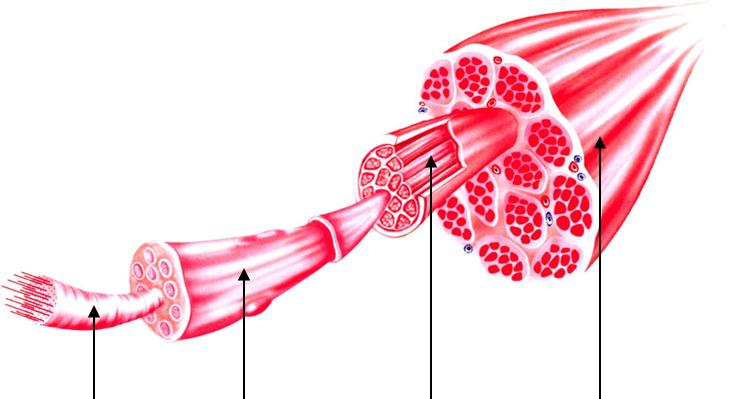
Myofibril, muscle fiber, muscle fiber bundle, muscle belly