Properties of
Exponents
Exponents
Any number or expression raised to the power of zero is always equal to _______.
1
What is the standard form of an exponential function?
y=a(b)^x
What does a represent in an exponential growth or an exponential decay function?
The initial (starting) amount
Simplify the expression. Write your answer using only positive exponents.
2^4*2^3
128
Tell whether the table represents a linear function or an exponential function. Explain.
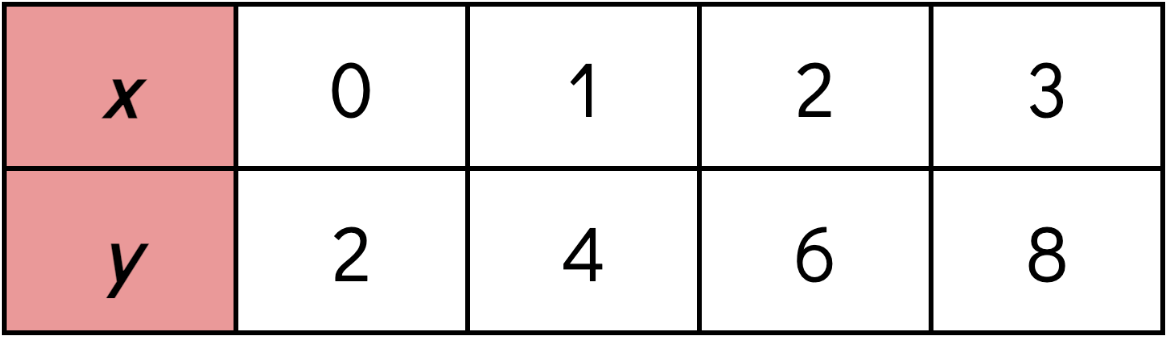
Linear Function – as x increases by 1, y increases by 2
Does the following function represent exponential growth or exponential decay? Explain.
y=0.25(1.56)^t
Exponential Growth – the number is parentheses is larger than 1
Simplify the expression. Write your answer using only positive exponents.
(x^5)^-3
1/x^15
Tell whether the table represents a linear function or an exponential function. Explain.
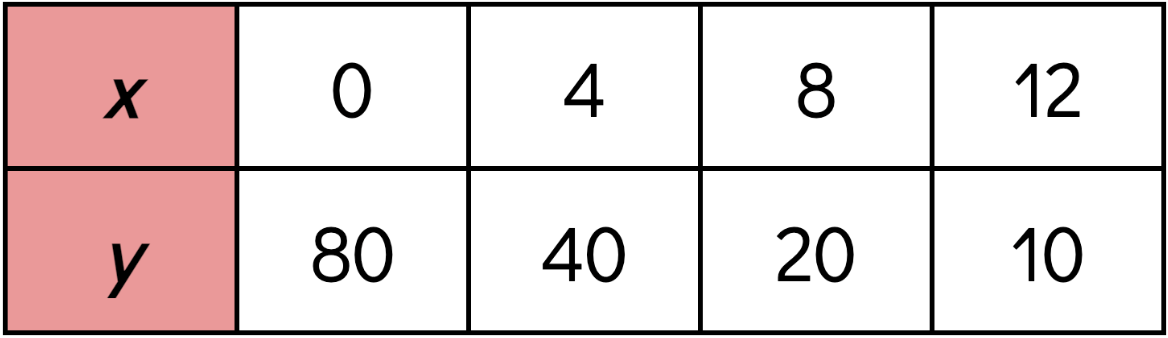
Exponential Function – as x increases by 4, y is multiplied by ½
Does the following function represent exponential growth or exponential decay? Explain.
y=–6(3/4)^t
Exponential Decay – the number in parentheses is between 0 and 1.
Simplify the expression. Write your answer using only positive exponents.
4x^0y^-3
4/y^3
Evaluate the following exponential function when x = 3.
y=-8(4)^x
–512
Identify the percent rate of change of the following exponential function.
y=0.25(1.56)^t
r = 56%
Simplify the expression. Write your answer using only positive exponents.
((2x^4y^2)/(5xy^6))^2
(4x^6)/(25y^8)
Evaluate the following exponential function when x = –4.
y=2(1/2)^x
32
Identify the percent rate of change of the following exponential function.
y=-6(3/4)^t
r = 25%