Vocabulary
Time Tables (6, 7, 8, 9)
Division of Equal Groups
Math Strategies
Miscellaneous
100
Any number multiplied by one, equals that number follows the ____________ .
A. Commutative
B. Associative
C. Array
D. Division
E. Skips
F. Equal
G. Multiplicative property of one
G. Multiplicative property of one
100
5 X 6 = ___________
30
100
_____ ÷ 8 = 10.
10 X 8 =____.
80
100

Express the multiplication fact shown by the number line.
4 x 3 = 12
100
Ellen has 63 cherries. she puts 7 cherries into each bowl. How many bowls does she use?
She uses 9 bowls.
200
When items are divided into ______ groups, the number of items in each group is the same.
A. Commutative
B. Associative
C. Array
D. Division
E. Skips
F. Equal
G. Multiplicative property of one
F. Equal
200
7 X 7 =
49
200
7 X ___ = 28.
28 ÷ ____ = 7.
4
200
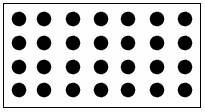
Express the multiplication fact using the array model.
4 x 7 = 28
200
8 X 5 X 2 =_________
80
300
The blank __________ property states that changing the order of numbers in a multiplication sentence does not change the answer.
A. Commutative
B. Associative
C. Array
D. Division
E. Skips
F. Equal
G. Multiplicative property of one
A. Commutative
300
8 X 4 =
32
300
7 x ___ = 35.
35 ÷ 7 = ______.
5
300
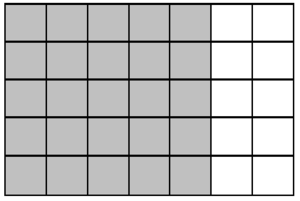
Express the multiplication fact shown by the area model.
5 x 5 = 25
300
Martin has 81 sheep. He divides his sheep equally into 9 pens. How many sheep does he have in each pen?
9 sheep
400
The ________ property states that changing the way numbers in a multiplication sentence are grouped does not change the answer.
A. Commutative
B. Associative
C. Array
D. Division
E. Skips
F. Equal
G. Multiplicative property of one
B. Associative
400
8 X 7 = ___________
56
400
6 x ___ = 36.
36 ÷ 6 = ____.
6
400
Show me the product, or answer to 9 x 4 using a strategy/trick we learned in class.
36
400
6 X 3 =_____.
3 X 6 =_____.
18
500
When using a number line to multiply, the number of _______ shows the number of equal groups.
A. Commutative
B. Associative
C. Array
D. Division
E. Skips
F. Equal
G. Multiplicative property of one
E. Skips
500
9 X 8 = ___________
72
500
99 ÷ ____ = 11.
___ x 11 = 99.
9
500
Draw a number line showing the multiplication sentence 6 x 4 = 24

500
3 X 2 X 7 =
42