Energy and Metabolism
Potential, Kinetic, Free, and Activation Energy
Laws of Thermodynamics
ATP
Enzymes
100
What is the term for: the concept of energy flow through living systems, such as cells.
Bioenergetics
100
What is energy?
The ability to do work
100
What does the first law of thermodynamics state?
The first law of thermodynamics deals with the total amount of energy in the universe.
It states that this total amount of energy is constant.
There has always been, and always will be, exactly the same amount of energy in the universe.
100
What does the structure of ATP consist of?
ATP is made up of a nucleotide, a five-carbon sugar, and three phosphate groups. The bonds that connect the phosphates (phosphoanhydride bonds) have high-energy content

100
What is an allosteric site?
An allosteric site is an alternate part of the enzyme that can bind to non–substrate molecules.
200
All of the chemical reactions that take place inside cells, including those that use energy and those that release energy, are the cell’s _________.
Metabolism
200
Energy associated with objects in motion is called _________. Give an example of this energy!
Kinetic energy
Ex: A speeding bullet, a walking person, the rapid movement of molecules in the air and electromagnetic radiation like light all have kinetic energy.
200
What does the second law of thermodynamics state?
The second law of thermodynamics states that every energy transfer involves some loss of energy in an unusable form, such as heat energy, resulting in a more disordered system. In other words, no energy transfer is completely efficient and tends toward disorder.
200
What is phosphorylation?
Phosphorylation is the chemical addition of a phosphoryl group (PO3-) to an organic molecule.
ATP donates its phosphate group to another molecule via a process known as phosphorylation.
In a phosphorylated state, the Na+ /K+ pump has more free energy and is triggered to undergo a conformational change.
This change allows it to release Na+ to the outside of the cell. It then binds extracellular K+ , which, through another conformational change, causes the phosphate to detach from the pump.
This release of phosphate triggers the K+ to be released to the inside of the cell.
The energy released from the hydrolysis of ATP is coupled with the energy required to power the pump and transport Na+ and K+ ions.
200
What is feedback inhibition?
The suppression of the activity of an enzyme
300
What is this the breakdown of?

Glucose into energy
300
The type of energy that refers to the potential to do work is called ____________. Give an example of this kind of energy
Potential energy
Ex: As a wrecking ball hangs motionless, it has 0 kinetic and 100 percent potential energy.
Once it is released, its kinetic energy begins to increase because it builds speed due to gravity.
At the same time, as it nears the ground, it loses potential energy. Somewhere mid-fall it has 50 percent kinetic and 50 percent potential energy.
Just before it hits the ground, the ball has nearly lost its potential energy and has near-maximal kinetic energy
300
_____ energy is defined as the energy transferred from one system to another that is not doing work
Heat energy
For example: when an airplane flies through the air, some of the energy of the flying plane is lost as heat energy due to friction with the surrounding air.
This friction heats the air by temporarily increasing the speed of air molecules.
300
True or False? The energy released from the hydrolysis of ATP into ADP + Pi is used to perform cellular work.
True
300
A substance that helps a chemical reaction to occur is a ________.
Catalyst
400
What is the primary energy currency of all cells?
ATP
400
The type of potential energy that exists within chemical bonds, and is released when those bonds are broken, is called ___________. Why is it important?
Chemical energy
Chemical energy is responsible for providing living cells with energy from food.
400
What is entropy? Explain with an example
Entropy is a measure of the disorder of a system.
As a system becomes more disordered, the lower its energy and the higher its entropy become.
400
Think: How does hydrolysis relate to ATP and ADP?
In other words, ATP is hydrolyzed into ADP in the following reaction:
Adenosine diphosphate (ADP) and one inorganic phosphate group (Pi )—have considerably lower free energy than the reactants: ATP and a water molecule.


400
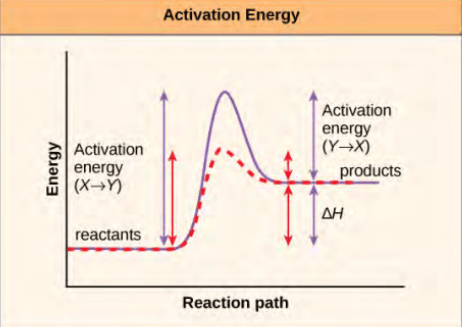
Which path represents a reaction with a catalyst and which path represents a reaction without a catalyst?

500
Fill in the blank: Each reaction step is facilitated, or catalyzed, by a protein called an ________.
These are important for catalyzing all types of biological reactions—those that require energy as well as those that release energy.
Enzyme
500
__________ energy specifically refers to the energy associated with a chemical reaction that is available after entropy is accounted for.
This is usable energy, or energy that is available to do work.
Gibbs free energy/free energy
500
True or False? The more energy that is lost by a system to its surroundings, the less ordered and more random the system is.
True!
500
Why is a large percentage of a cell’s ATP is spent powering the sodium-potassium pump?
Because cellular processes bring a great deal of sodium into the cell and potassium out of the cell.
The pump works constantly to stabilize cellular concentrations of sodium and potassium.
In order for the pump to turn one cycle (exporting three Na+ ions and importing two K+ ions), one molecule of ATP must be hydrolyzed.
500
What can cause enzymes to eventually denature? What does denature mean? eventually cause enzymes to denature, a process that changes the natural properties of a substance.
High temperatures, changes in pH
Denature: a process that changes the natural properties of a substance.
600
What are the two kinds of metabolic pathways and how do they differ?
These two opposite processes—the first requiring energy and the second producing energy—are referred to as anabolic (building) and catabolic (breaking down) pathways, respectively.
Metabolism is composed of building (anabolism) and degradation (catabolism)
Anabolic pathways require an input of energy to synthesize complex molecules from simpler ones
Catabolic pathways involve the degradation (or breakdown) of complex molecules into simpler ones.
600
Explain the difference between endergonic reactions and exergonic reactions
Chemical reactions that can be thought of as energy-storing molecules are called endergonic reactions, and they are non-spontaneous.
An endergonic reaction will not take place on its own without the addition of free energy.
Exergonic reactions require a small amount of energy input to get going before they can proceed with their energy-releasing steps.
These reactions have a net release of energy, but still require some energy in the beginning.
600
What is the difference between an open and closed system?
An open system is one in which energy can be transferred between the system and its surroundings. The stovetop system is open because heat can be lost into the air.
A closed system is one that cannot transfer energy to its surroundings. Biological organisms are open systems.
600
What does this formula show?

The formation of ATP
Since ATP hydrolysis releases energy, ATP regeneration must require an input of free energy.
600
What happens during enzyme inhibition?
In some cases of enzyme inhibition, an inhibitor molecule is similar enough to a substrate that it can bind to the active site and simply block the substrate from binding.
The enzyme is then inhibited through competitive inhibition, because an inhibitor molecule competes with the substrate for active site binding.