Functions
Slope
Variation
Graphing
Vocabulary
100
Is the relation a function? Explain
{(-7,6), (6,-7), (-7,9), (10,3)}
No, -7 domain has two partners in the range.
100
Find the slope that contains the points A(8,1) B(3,-1)
2/5
100
Find the constant of variation and write the equation for direct variation.
x y
-1 4
0 0
1 -4
2 -8
k = -4
y = -4x
100
Graph
y=3/4x -2
y-int=-2
slope=3/4
100
an ordered pair that makes an equation a true statement
solution
200
Is the relation a function? Explain
{(-2,0), (0,2), (2,0), (3,2)}
Yes, each domain only has one range partner.
200
Find the slope that contains the points C(7,3) D(-4,3)
0
200
Find the constant of variation and write the equation for direct variation.
x y
-3 -2
0 0
3 2
6 4
k =
2/3
y=2/3x
200
Graph
y < -x +2
m= -1
y-int = 2
dotted line
shaded to left
200
the equation y=mx+b where m is the slope and b is the y-intercept
slope-intercept form
300
Graph the relation and tell whether or not it is a function.
{(0,1), (3,5), (2,2), (1,2)}
Yes, it passes the vertical line test
300
Find the slope
5x-6y = -4
5/6
300
A linear function modeled by the equation y=kx where k cannot equal zero.
direct variation
300
Solve the system by graphing
2x=3y
y=2x+4
(-3,-2)
300
any equation whose graph is a line
linear equation
400
Graph the relation and tell whether or not it is a function.
{(-1,1), (-2,1), (-1,4), (2,6)}
No, it does not pass the vertical line test.
400
Find the slope
5x + y = 10
-5
400
The coefficient k in the equation y=kx
constant of variation
400
yle-x+2
Solve the system by graphing
x-2y>-4
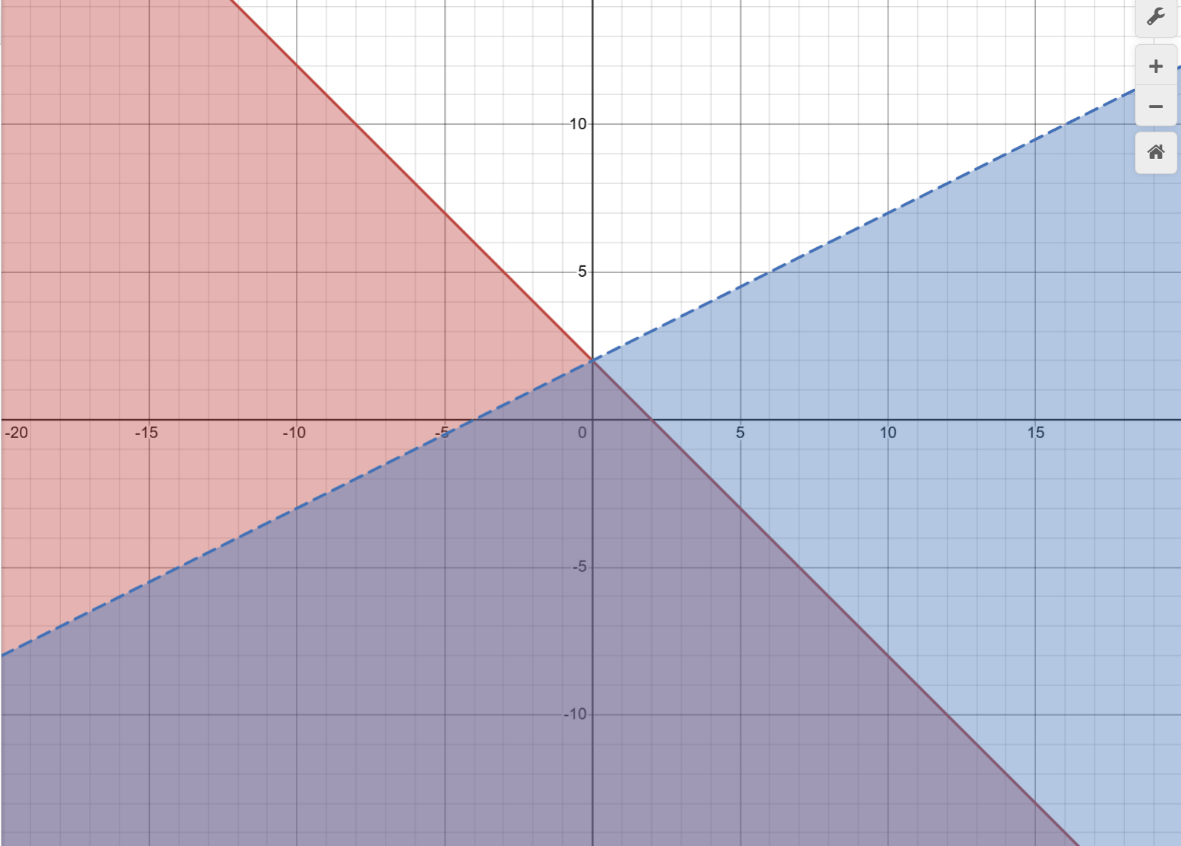
400
the first coordinates of the relation (the x coordinates)
domain
500
range
The second coordinates of the relation (the y coordinates)
500
slope
the ratio that describes the tilt of the line. The change is rise over the change in run
500
Function
each member of the domain is paired with exactly one member of the range
500
y-intercept
the point where the line crosses the y-axis
500
relation
a set of ordered pairs