Amendments
Trial Processes & Courts
Jury Types
Sources of Law
Supreme Court Cases
Constitutional Principles
100
6th Amendment...
You have the right to a fair and speedy trial, a lawyer, and the chance to hear and question witnesses if you are accused of a crime.
100
What is a unanimous verdict?
In a criminal trial, jurors must all agree on this before the defendant can be found guilty.
100
What is the role of a jury in a criminal trial?
To decide guilt or innocence UNIANIMOUSLY, ALL jurors must agree.
100
Code of Hammurabi, Ten Commandments (from the bible) and the Magna Carta, what was the significance of these codes?
The Code of Hammurabi, the Ten Commandments, and the Magna Carta were all important because they helped develop the idea of the rule of law.
The rule of law means that:
➡️ Everyone must follow the law
➡️ Laws are written down
➡️ Leaders are not above the law
100
“We conclude that in the field of public education the doctrine of ‘separate but equal’ has no place. Separate educational facilities are inherently unequal.”
This quote belongs to which landmark supreme court case?
BROWN V BOARD OF EDUCATION
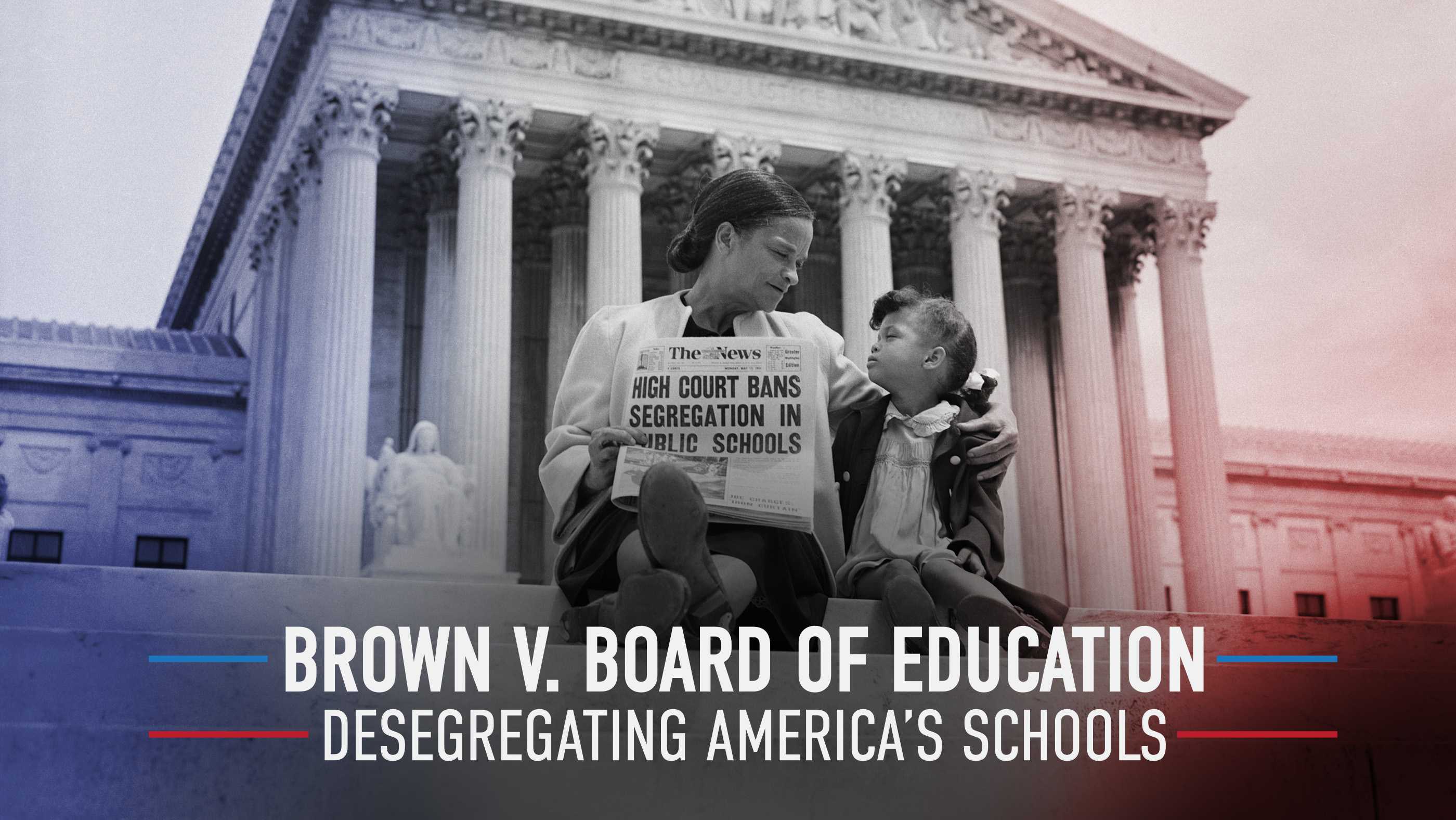
Here’s what they noticed:
Black students and white students were being sent to different schools just because of their race.
Even if the buildings, books, or buses were similar, being separated made Black students feel like they were less important.
This separation hurt students’ confidence and chances to succeed in school.
The Supreme Court decided that this kind of separation went against the 14th Amendment, which promises everyone equal protection under the law.
100
What is meant by judicial review?
the power of a court to determine whether a law is constitutional
200
7th Amendment...
You have the right to a jury trial in certain civil (non-criminal) cases, like when someone is suing for money.
200
What is missing in the blank?
FLOIRDA COUNTY COURTS → FLORIDA CIRCUIT COURTS→ ____________ → FLORIDA SUPREME COURT
FLORIDA DIISTRICT COURT OF APPEALS OR DCA 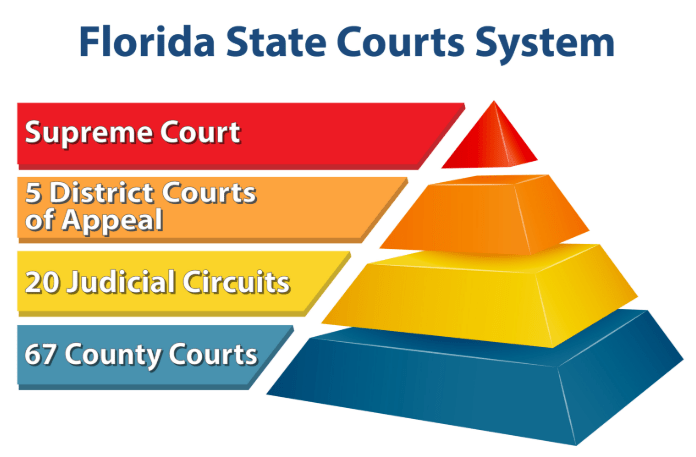
200
What is the job of a grand jury, to decide _____.
If there is enough evidence to charge the person with a crime and move the case to trial.
200
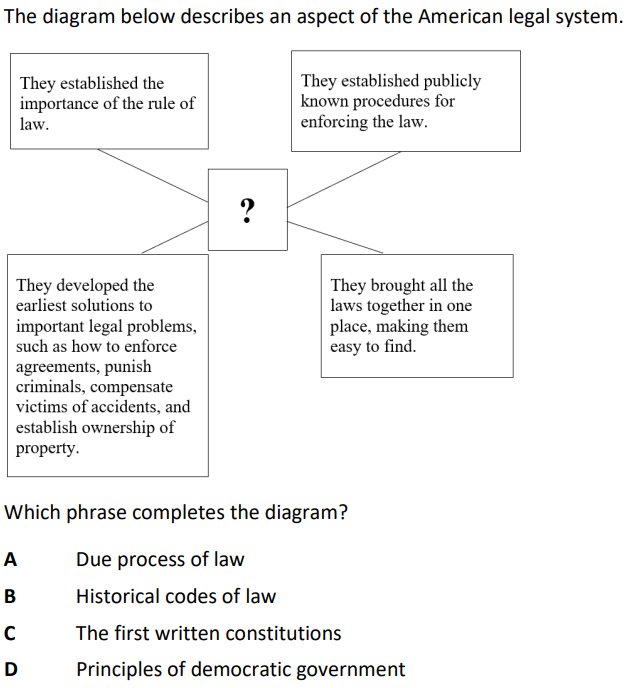
The correct answer is B: Historical codes of law.
Why?
All of the boxes describe what early legal codes (like the Code of Hammurabi, the Ten Commandments, and the Magna Carta) helped do:
They helped establish the rule of law
Created clear procedures for enforcing laws
Gave early solutions for legal issues like crime, agreements, and property
Brought laws together in one written place so people could find and follow them
These are all characteristics of historical codes of law
200
What was the impact AND constitutional principles of the U.S. Supreme Court’s decision in Miranda v. Arizona?
The Supreme Court’s decision meant that police must inform people of their rights before questioning them while they are in custody.
This led to the creation of Miranda Rights;
Constitutional Principles:
This decision was based on:
The Fifth Amendment → protects people from self-incrimination (being forced to say something that could make them look guilty).
The Sixth Amendment → guarantees the right to an attorney.
200
What is meant by rule of law?
Rule of law means that everyone must follow the law, including leaders and government officials.
It also means:
Laws are written down
Laws are applied fairly
No one is above the law
300
5th Amendment....
You cannot be forced to say something that makes you look guilty (self-incrimination), and the government must treat you fairly before taking your life, freedom, or property (due process).
300
Miracle was bitten by her neighbors 6 cats and 7 dogs when her neighbors forgot to bring them inside. Miracle decides to sue, she believes her pain and suffering are worth more than $100,000. In which court should she file her legal action against her neighbor. County, Circuit, Supreme Court, or District Court of Appeals? AND WHY!
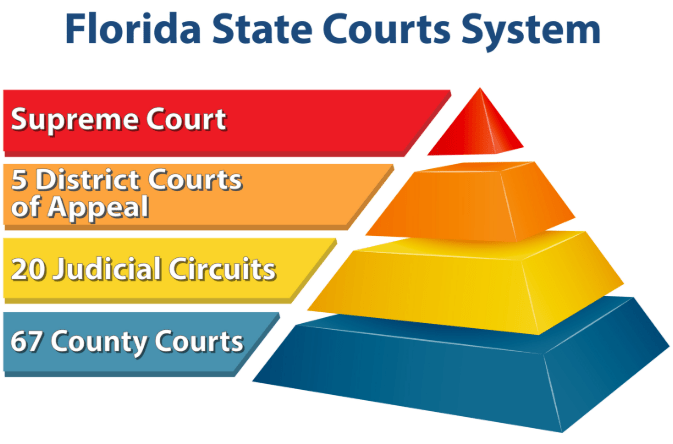
Miracle is suing for money because she was injured. This makes it a civil case (not a criminal case). In Florida:
County Court handles smaller civil cases, usually when someone is asking for $50,000 or less.
Circuit Court handles larger civil cases, when someone is asking for more than $50,000 in damages.
Since Miracle believes her pain and suffering are worth more than $100,000, her case is too big for County Court.
The Supreme Court does not hold trials like this.
The District Court of Appeals only reviews cases after a trial to check for legal mistakes.
So, she must file in Circuit Court because it handles major civil cases involving large amounts of money.
300
What is the job of a trial jury (petit jury)? To decide _____.
GUILT OR INNOCENCE.
A trial jury comes after a GRAND JURY. Their job is to:
Listen to all the evidence in court
Hear from witnesses
Decide if the person is guilty or not guilty
300
Sha'Zaria buys a new face cream from a store and develops a serious rash after using it. She later finds out the product was contaminated during manufacturing. She wants the company to pay for her medical bills and pain. Which type of law would be used to hold the company responsible and why?
A civil because ____.
B military because ____.
C criminal because ____.
D constitutional because ____.
This situation would be handled under civil law because Sha'Zaria is asking the company to pay money for the harm she suffered (like medical bills and pain).
Civil law deals with:
Disputes between people or businesses
Injuries caused by negligence
Cases where someone wants compensation (money)
It is not criminal law because the government is not trying to send the company to jail.
It is not military law because no one involved is in the armed forces.
It is not constitutional law because this is not about rights in the Constitution.
300
What was the important outcome and constitutional amendments of the U.S. Supreme Court’s decision in United States v. Nixon (1974)?
Impact:
The Supreme Court ruled that President Nixon had to turn over the Watergate tapes. This limited the use of executive privilege.
Constitutional Principle:
It reinforced rule of law and checks and balances by showing that no one — not even the President — is above the law.
300
The passage below is from the Supreme Court’s decision in the case of Marbury v. Madison (1803).
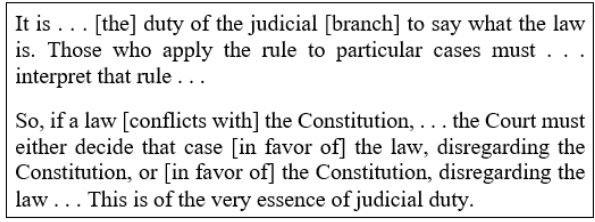
What conclusion did the Court reach to solve the problem identified in the second paragraph above?
A It had to come up with a new law of its own.
B It should follow the law because it was more recent.
C It must annul any law that contradicts the Constitution.
D It could choose to follow either the law or the Constitution.
The correct answer is C: It must annul any law that contradicts the Constitution.
The passage explains that when a law conflicts with the Constitution, the Court must follow the Constitution instead. This established judicial review, meaning the Supreme Court can strike down laws that go against the Constitution.
400
Due Process Clauses of the 5th & 14th Amendment states...
The Due Process Clauses of the 5th and 14th Amendments state that the government cannot deprive any person of life, liberty, or property without due process of law.
This means the government must follow fair procedures and respect people’s legal rights before taking away:
Their freedom
Their possessions
Or their life
The 5th Amendment applies this rule to the federal government, and the 14th Amendment applies it to the state governments.
400
In a criminal trial, ____ jurors must determine guilt or innocence.
A. ALL
B. MAJORITY
C. MINORITY
ALL 
400
Juliette has been accused of stealing an expensive leather. A video from the scene shows someone who looks like her, Who decides if she stole the purse?
A. The judge
B. A jury of her Peers
C. A district attorney
The correct answer is B: a jury of peers.
Here’s why:
In a criminal trial like theft, it is the jury’s job to decide if the person is guilty or not guilty. A jury is a group of regular people from the community who listen to the evidence in court, like the video and what Juliette says.
The trial judge makes sure the trial is fair and follows the rules, but does not decide if Juliette is guilty.
The district attorney is the lawyer trying to prove Juliette stole the purse.
The Court of Appeal only looks at cases after a trial to see if any mistakes were made.
So, the people who decide if Juliette stole the purse are a jury of her peers — people like her from the community.
400
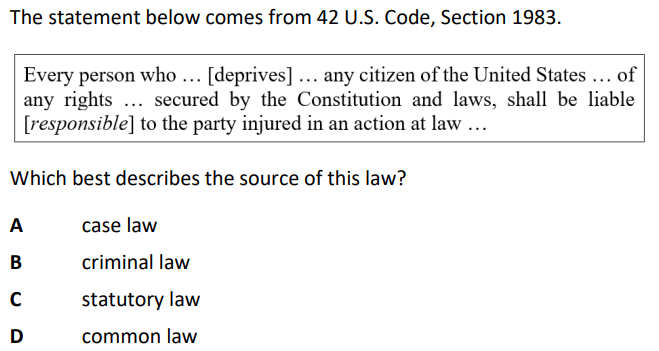
The correct answer is C: statutory law.
Here’s how we know:
The statement comes from 42 U.S. Code, Section 1983.
The U.S. Code is a collection of laws that were written and passed by Congress.
Laws created by legislatures (like Congress) are called statutory laws.
Why not the others?
Case law = laws based on court decisions
Criminal law = deals with crimes and punishment
Common law = based on customs and past court rulings
Since this law was written and passed by Congress, its source is statutory law.
400
The passage below is from a speech by Frederick Douglass about a decision of the U.S. Supreme Court. Which case was Frederick Douglass referring to in this speech?
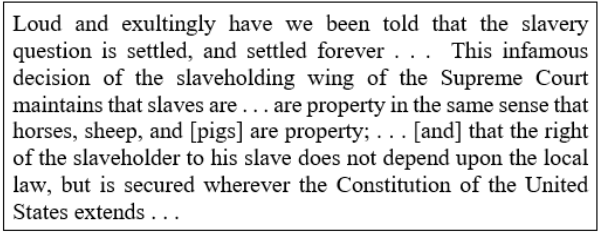
This excerpt is about Dred Scott v. Sandford (1857).
Why?
The passage says that enslaved people were considered property and that slaveholders had the right to their enslaved people wherever the Constitution applied — even in free states or territories.
In Dred Scott v. Sandford, the Supreme Court ruled that:
Enslaved people were not citizens
They were considered property
Congress could not ban slavery in U.S. territories
So this excerpt is criticizing the Court’s decision that protected slavery by treating enslaved people as property under the Constitution.
400
What is meant by the 14th Amendment's Equal Protection clause?
Equal protection means the government must treat all people the same under the law and cannot unfairly discriminate against certain groups.
In simple terms: laws must be applied fairly to everyone, not just to some people.
500
Equal Protection Clause of the 14th Amendment States...
No state shall deny to any person within its jurisdiction the equal protection of the laws.
This means that states must treat all people fairly under the law and cannot apply laws in a way that unfairly discriminates against certain groups of people.
Several landmark Supreme Court cases are based on the Equal Protection Clause of the 14th Amendment, including:
Brown v. Board of Education (1954)
→ Ruled that racial segregation in public schools was unconstitutional because it did not provide equal protection under the law.Plessy v. Ferguson (1896)
→ Earlier case that allowed segregation under “separate but equal” (later overturned by Brown for violating equal protection).
500
What is missing in the blank?
________________ → FLORIDA CIRCUIT COURTS→ FLORIDA DISTRICT COURT OF APPEALS →FLORIDA SUPREME COURT
FLORIDA COUNTY COURT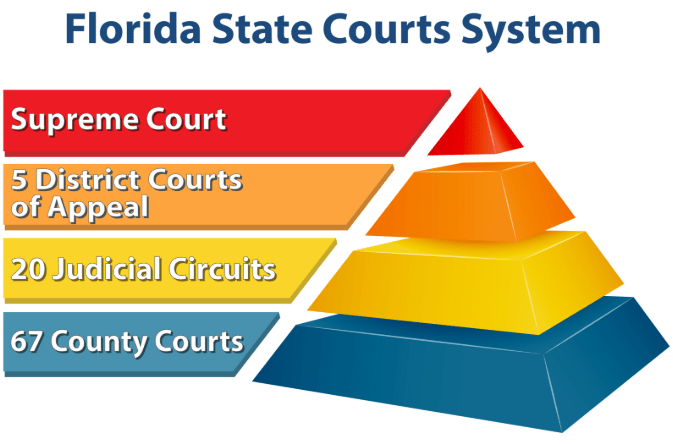
500
Why do appellate courts not have juries?
Appellate courts don’t have juries because they are not deciding what happened — they are deciding if the trial was fair and followed the law.
A jury’s job in a trial court is to:
Listen to witnesses
Look at evidence (like the video in Juliette’s case)
Decide what the facts are
Decide if the person is guilty or not guilty
But in an appellate court, there are:
No new witnesses
No new evidence
No one trying to prove guilt again
500
Which of the following is an example of a natural law?
A Any person who commits a serious crime should be punished.
B Every person is entitled to the right to life, liberty and property.
C Each person should pay the correct amount of sales tax when purchasing an item.
D Any person who accidentally injures another should pay some kind of compensation
The correct answer is B: Every person is entitled to the right to life, liberty and property.
This is an example of natural law because it describes rights that people are believed to have just for being human — not because a government created them.
Natural law is based on ideas about:
Fairness
Morality
Basic human rights
Rights like life, liberty, and property are considered natural rights because they exist even if no laws are written down.
500
In Re Gault Impact and constitutional principles are....
Impact:
Juveniles accused of crimes were given important due process rights in court, such as:
The right to an attorney
The right to be told the charges against them
The right to confront and question witnesses
Constitutional Principles:
This decision was based on the 14th Amendment’s Due Process Clause, which guarantees fairness under the law — even for minors in juvenile court.
500
What is meant by due process?
Due process means the government must treat people fairly and follow the law before taking away someone’s life, freedom, or property.
This includes things like:
Being told what you are accused of
Having a chance to defend yourself
Having a fair trial