Solutions
Kinetics
Chemical Equilibrium
100
Which statement is true?
1) When a nonvolatile solute is added to a solvent, the solute vapor pressure decreases.
2) When a nonvolatile solute is added to a solution, the solvent vapor pressure increases.
3) When a nonvolatile solute is added to a solvent, the solute vapor pressure increases.
4) When a nonvolatile solute is added to a solution, the solvent vapor pressure decreases.
4) When a nonvolatile solute is added to a solution, the solvent vapor pressure decreases.
100
Which statement is true?
1) The rate constant does not depend on the activation energy for a reaction where the products are lower in energy than the reactants.
2) A catalyst raises the activation energy of a reaction.
3) Rate constants are temperature dependent.
4) The addition of a homogeneous catalyst does not change the activation energy of a given reaction.
5) None of the above.
3) Rate constants are temperature dependent.
100
Which statement is true?
1) Dynamic equilibrium occurs when the rate of the forward reaction equals the rate of the reverse reaction.
2) The equilibrium constant for the forward reaction is equal to the equilibrium constant for the reverse reaction.
3) A reaction quotient larger than the equilibrium constant means the reaction will favor the production of more products.
4) Dynamic equilibrium indicates that the amount of reactants and products are equal.
1) Dynamic equilibrium occurs when the rate of the forward reaction equals the rate of the reverse reaction.
200
We have two aqueous solutions with the same molality prepared from the following solutes: FeCl3 and MgI2. Which solution would have a higher freezing point?
MgI2 (fewer particles, f.p. drops less)
200
What could be done to increase the rate of the following reaction?
N2 + 3H2 --> 2NH3
a) Decrease the temperature
b) Add a catalyst
c) Increase the temperature
d) Add a catalyst and increase the temperature
e) Decrease the temperature and add a catalyst
d) Add a catalyst and increase the temperature
200
Equilibrium is established for the exothermic reaction:
Br2(g) + 5F2(g) <---> 2BrF5(g)
The equilibrium constant for the formation of BrF5 is 4.12x10⁻⁵. What is the equilibrium constant for the reverse reaction? Will it make more product of reactant?
Krev = 2.43x10⁴ > 1, product favored
300
You use paper chromatography to separate the active ingredients in the following drugs. The stationary phase is coated with CCl4 and CH3OH (methanol) is used as the mobile phase. List all intermolecular forces between methanol and each drug, rank their attractions as strong, weak, or weakest, and label them on the chromatogram.
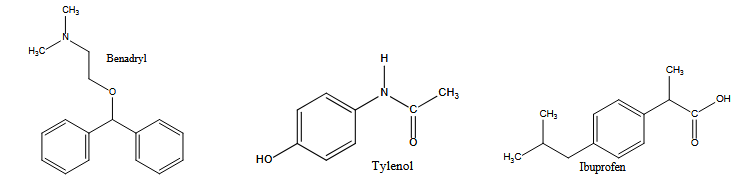
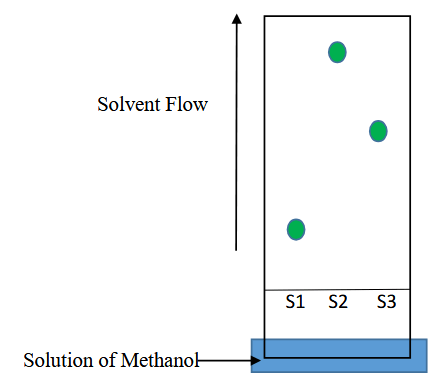
Benadryl: dipole-induced dipole, London forces; weakest; S1
Tylenol: dipole-dipole, H-bonding, London forces; strong; S2
Ibuprofen: dipole-dipole, London forces, H-bonding; weak; S3
300
What is the order of reaction if t1/2 = 71.7s when [A]0 = 0.175M and k = 1.23x10⁻³? (Assume correct units for k based on the order of reaction)
Zero
300
Once equilibrium is established, the reaction is put in an ice bath. How will the system reestablish equilibrium? How does it affect Q and K?
Equilibrium will shift to the right, Q will stay the same, and K will increase.
400
A solution of 2.53g of a compound having the empirical formula C6H5P in 25.0g of benzene (C6H6) is observed to freeze at 4.3oC. Find the molecular formula of the solute. (Normal freezing point of benzene is 5.5oC and Kf = 5.12oC/m)
C24H20P4
400
What is the order of reaction if it1/2 = 4646s when [A]0 = 0.175M and k = 1.23x10⁻³
Second
400
NO can be formed from the following reaction:
N2(g) + O2(g) <---> 2NO(g) DeltaH = -451 (kJ)/(mol)
An experiment is performed with 0.25M N2 and O2 and 0.35M NO in the flask. The equilibrium constant is 6.1x10⁻³ at 25oC. What are the equilibrium concentrations for all 3 molecules?
[N2] = [O2] = 0.409M
[NO] = 0.0319 M
500
A 17.5% by mass FeCl3 aqueous solution was prepared (density 1.05 g/mL). Calculate the vapor pressure for this solution at 40°C (water at this temp is 55.3 mmHg), determine the freezing point (Kf = 1.86oC/m), and find the osmotic pressure.
Psoln = 50.5 mmHg
T = -9.74oC
pi=116.6 atm
500
What is the overall reaction and rate law for the following mechanism? Label the diagram.
Step 1: W + W <---> W2
Step 2: W2 + W --> W3
Step 3: W3 + X --> W + Y + Z
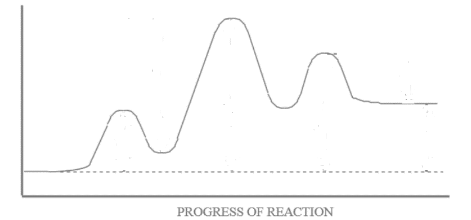
2W + X --> Y + Z (int. W2 and W3)
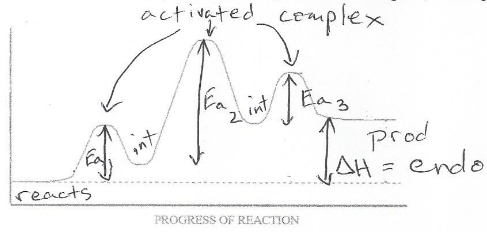
Rate = k2[W2][W] (substitute W2)
Rate = k2*k1/k'1 [W]3 = k[W]3
500
The chemical reaction for hydrogen iodide production is:
H2(g) + I2(g) <---> 2HI(g) DeltaH=123.8(kJ)/(mol)
The current method yields at equilibrium concentrations of 0.175M both H2, I2, and 0.215M HI. Your boss wants you to shift the equilibrium by adding 0.525M amounts of each reactant. What are the concentrations of reactants and HI produced when the equilibrium is re-established?
[H2] = [I2] = 0.500M
[HI] = 0.615M