Chapter 12 Theory
Chapter 13 Theory
Chapter 12 Problems
Chapter 13 Problems
100
Catalysts increase reaction rates by doing what? (1 min)
Providing an alternate reaction mechanism with a lower activation energy.
100
Which of the following is true regarding equilibrium? Explain why the other answers are false. (1 min)
The concentration of the products and reactants are the same.
The forward and reverse reactions occur at equal rates.
The forward and reverse reactions have the same rate constant.
All of the above.
The forward and reverse reactions occur at equal rates.
100
What is the half-life for the first-order decay of 32P? With k= 4.85x10⁻² per day? (2 min)
14.29 days
100
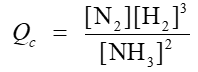
What is Qc for the following reaction? (2 min)
2 NH3(g) ⇋ N2(g) + 3 H2(g)
200
Doubling [A] quadruples the reaction rate. What is the order of the reaction with respect to A? (1 min)
Second order.
200
Do you expect K to be less than, equal to, or greater than 1 for the following reaction? (3 min)
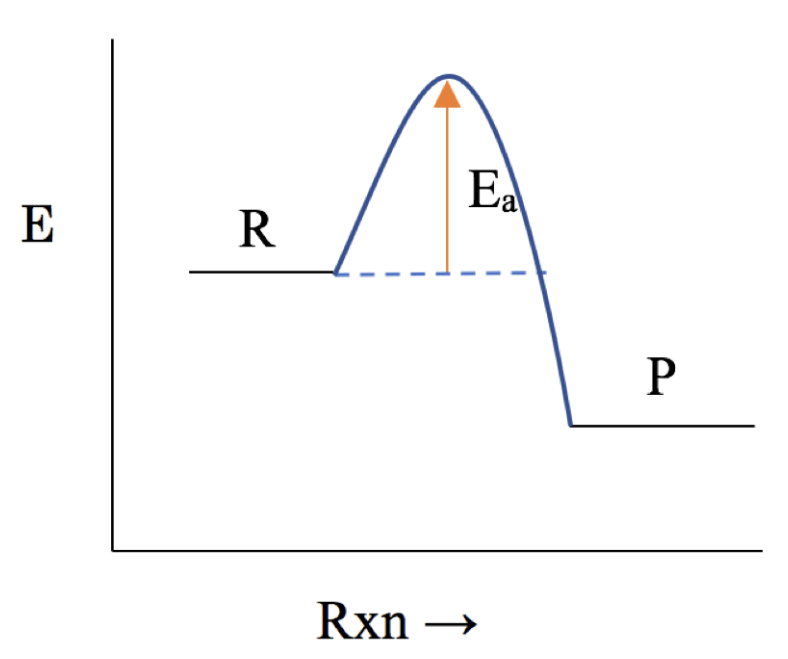
K > 1.
200
What is the molecularity of the rate-determining step in the proposed mechanism? (2 min)
Step 1 H2(g) + 2 NO(g) → N2O(g) + H2O(g) (slow)
Step 2 N2O(g) + H2(g) → N2(g) + H2O(g) (fast)
Termolecular
200
What is the gas-phase reaction equation for the following equation? (2 min)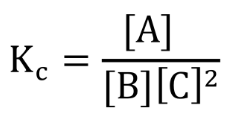
B(g) + 2 C(g) ⇌ A(g)
300
Which of the following does not affect the reaction rate? Explain why. (1 min)
Surface Area
Temperature
Polarity
A Catalyst
Polarity. In general, we already know the reaction that's occurring, and therefore any effects polarity has on the reaction rate are already taken into account.
300
Is the following equation heterogenous or homogenous? (1 min)
P4(g) + 5 O2(g) ⇋ P4O10(s)
Heterogenous
300
What is the rate equation for the rate-limiting step for this mechanism? (2 min)
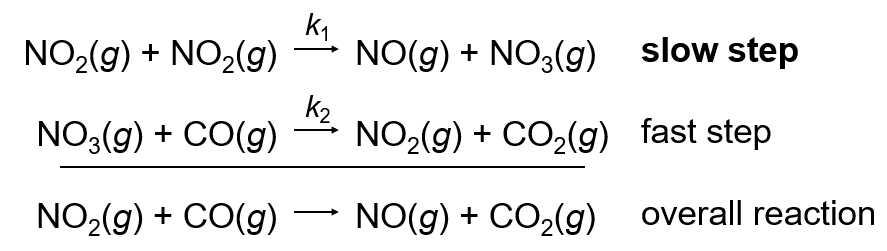
k1[NO2]2
300
The following exothermic reaction has a Kc = 9.60 at 100°C. Calculate Kp. (3 min)
N2 (g) + 3 H2 (g) ⇌ 2 NH3 (g)
0.0102 atm
400
Which of the following affects the collision rate of molecules in the gas phase? (1 min)
Speed
Mass
Molecular Diameter
All of the above
All of the above
400
The balanced, homogenous, gas-phase reaction, A + B ⇌ Y + X has Kc = 1.1 x 10⁶ at 472 K. At equilibrium... (1 min)
Products dominate
Reactants dominate
Only products exist
Only reactants exist
Equal amount of products and reactants
Only products exist.
400
The rate constant at 325°C for the decomposition of C4H8 is 6.1x10⁻⁸ s-1. The activation energy is 261 kJ/mol for C4H8. Find the number of collisions per second, A. (7 min)
3.789 x 10¹⁵ s-1
400
The value of Kc for the following reaction is 2.4. What is the equilibrium concentration of CO (g) if the equilibrium concentration of CO2 (g) is 0.50 M? (5 min)
C (s) + CO2 (g) ⇌ 2 CO (g)
1.095 M
500
Which species has the greatest rate of appearance in the reaction below? (3 min)
2 H₂S + O₂ → 2 S + 2 H₂O
Both S and H2O have identical rates
500
An equilibrium is established for the endothermic reaction 2 CO(g) + MoO₂(s) ⇌ 2 CO₂(g) + Mo(s). Which way will the reaction proceed if the volume of the container is decreased? (2 min)
No change.
500
The half–life of a reaction of compound A to give compounds D and E is 8.50 min when the initial concentration of A is 0.150 M. How long will it take for the concentration to drop to 0.0300 M if the reaction is first order with respect to A? (7 min)
19.74 min
500
At 700K, 1.500 mol HI is added to a 2.00L container and allowed to come to equilibrium. Calculate the equilibrium concentration of HI. Include the RICE table. (7 min)
H2 + I2 ⇌ 2HI Kc = 57
0.599 M