Chapter 6 Part 1
Chapter 6 Part 2
Chapter 7
Chapter 8
Good Luck
100
The only element that belongs to a group of all its own.
Hydrogen
100
The amount of energy required to remove an electron from an atom.
Ionization energy
100
Type of chemical bond that shares electrons.
Covalent
100
The shape of an atom of H2O.
Bent
100
The two elements that have a full outer shell with two valence electrons.
Helium (He) and Hydrogen (H)
200
This chemist came up with the "law of octaves"
John Newlands
200
Type of element placed along the stairstep line.
Metalloid
200
Type of chemical bond that "steals" electrons.
Ionic
200
The bond angle of a compound containing 4 regions of electrons.
109.50
200
Bond that involves a free sea of electrons.
Metallic bond
300
Scientist responsible for the "modern periodic law".
Henry Moseley
300
This is the name of the elements that belong in group 2.
Alkaline-Earth Metals
300
This is what holds an ionic bond together.
Polarity (opposite charges)
300
The hybrid orbital we will use when dealing with a compound containing three regions of electrons.
SP2
300
The absolute, unequivocally, undeniable best way to remember that opposites attract.
Mr. and Mrs. Krentz
400
This scientist came up with the idea of "element periodicity".
Johann Dobereiner
400
Name for group 13 elements.
Boron Group
400
Draw the correct Lewis structure for CHCl3.
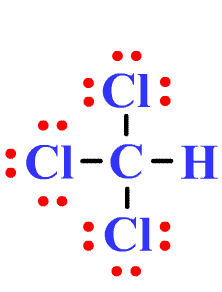
400
Orbital used by the Pi bond.
P orbital
400
Name for group 17 on the periodic table is.
Halogens
500
Name for the rule which states that "Properties of elements vary periodically with their atomic number".
Periodic Law
500
Ionization energy does this (increases or decreases) as we move across the table from left to right.
Increases
500
The type of charge the sodium atom will obtain in a NaCl bond.
+ (positive)
500
Orbital hybridization of the Carbon in COCl2.
2SP2 P
500
Collective name for the elements that are naturally diatomic.
Hydrogen 7