Scientific Notation
Unit Conversion
Ideal Gas Math
Unit Lore
Ideal Gas Lore
100
The number 0.000816 expressed in standard scientific notation.
What is 8.16 × 10⁻⁴?
100
8.5 miles converted to kilometers (given 1 mile = 1.609 km).
What is 13.7 km (or 14 km with significant figures)?
100
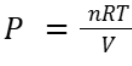
The pressure in kPa of 1.50 mol of gas in a 12.0 L vessel at 300.0 K (using R = 8.314 (kPa · L)/(mol · K)).
What is 312 kPa?
100
The exponential factor or power of 10 represented by the metric prefix "milli-" (m).
What is 10⁻³ (or one-thousandth)?
100
The definitions of the variables (P, V, T) in the Ideal Gas Law equation.
What are Volume, Pressure, and Temperature?
200
5.13 × 10⁵ converted into standard decimal notation.
What is 513,000?
200
A pressure of 1.85 atm converted to millimeters of mercury (given 1 atm = 760 mmHg).
What is 1,410 mmHg?
200
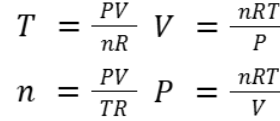
The volume in liters occupied by 3.20 mol of gas at 150.0 kPa and 290.0 K (using R = 8.314 (kPa · L)/(mol · K)).
What is 51.4 L?
200
The exponential factor or power of 10 represented by the metric prefix "Mega-" (M).
What is 10⁶ (or one million)?
200
TRUE or FALSE: The ideal gas law works differently, for gases at different weights.
What is FALSE?
300
The value of the expression (4.0 × 10⁵) × (1.5 × 10⁻²) in scientific notation.
What is 6.0 × 10³?
300
4.2 gallons converted to liters (given 1 gallon = 3.785 L).
What is 15.9 L (or 16 L with significant figures)?
300

The amount of gas in moles if a sample has a pressure of 220.0 kPa, a volume of 45.0 L, and a temperature of 320.0 K (using R = 8.314 (kPa · L)/(mol · K)).
What is 3.72 mol?
300
The freezing point of water in Celsius.
What is 0°C
DOUBLE: Explain what 0°F is!
300
The reason why Kelvin is used for temperature calculations with the ideal gas law.
What is that it has no negative values?
400
The quotient of (9.3 × 10⁷) ÷ (3.0 × 10⁴) expressed in scientific notation.
What is 3.1 × 10³?
400
6.2 kilograms converted to milligrams.
What is 6.2 × 10⁶ mg (or 6,200,000 mg)?
400

The temperature in Kelvin of a gas sample where P = 180.0 kPa, V = 120.0 L, and n = 6.50 mol (using R = 8.314 (kPa · L)/(mol · K)).
… Answer with sig figs for full points
What is 400. K (or 399.7 K)?
400
The explanation for why standard defined conversion factors (e.g., 1 foot = 12 inches) do not limit significant figures in calculations.
What are exact definitions with infinite significant figures?
400

The effect on volume according to Charles's Law when temperature increases at constant pressure and amount of gas (n).
What is an increase in volume (directly proportional)?
500
The sum of (3.2 × 10⁴) + (5.0 × 10³) expressed in standard scientific notation.
What is 3.7 × 10⁴?
500
A density of 2.70 g/cm³ converted to kilograms per cubic meter.
...Probably hardest question. I believe!
(Nothing on the test at this level)
What is 2,700 kg/m³?
500
The amount of gas in moles if the pressure is 1.20 atm (given 1 atm = 101,325 Pa), the volume is 15,000 mL, and the temperature is 300.0 K.
What is 0.73 mol?
500
The approximate value of absolute zero in degrees Celsius.
What is -273.15°C
500
The effect on gas pressure when decreasing temperature to half of its original Kelvin value in a rigid container.
What is the pressure being cut in half?