Scientists
Experiments/Models
Average Atomic Mass
Periodic Trends
Vocabulary
Atomic Particles
100
The scientist whose work allowed for the reorganization of the periodic table.
Who is Moseley?
100
The experiment conducted by Rutherford
What is the gold-foil experiment (who did it and what did it prove)?
100
55% of a sample is found to have a mass of 28. The rest has a mass of 29. What is the average atomic mass of this sample?
28.45 amu
100
Atomic radius _____________ going across the periodic table and _____________ going down the periodic table.
What is decreases and increases?
100
A charged element
What is an ion?
100
The number of electrons in a neutral atom of silicon.
What is 14?
200
The scientist who discovered the neutral particle in an atom
Who is Sir James Chadwick?
200
the experiment done by J. J. Thomson, in which a beam of electrons was sent through a glass container, proving atoms have negative, mobile charges
What is the cathode-ray tube experiment (who did it and what did it prove)?
200
An element has an average mass of 74.922 amu. If there are only isotopes with a mass of 76 and a mass of 74 for this element, which isotope has the higher abundance?
76
200
Electronegativity ________________ going across the periodic table, and _______________ going down the periodic table.
What is increases, decreases?
200
The distance of the outermost valence electrons to the center of the nucleus.
What is atomic radius?
200
How many protons, neutrons and electrons are present in an ion of oxygen with a -2 charge and a mass of 14 amu?
P: 8
N: 6
E: 10
300
Used atomic spectra to defend electrons existing in 'energy levels' and energy change results in emission and absorption of energy, often as light.
Who is Niels Bohr?
300
The discovery made by the oil-drop experiment conducted by Millikan.
What is the charge of an electron?
300
The average atomic mass for boron based on the information below
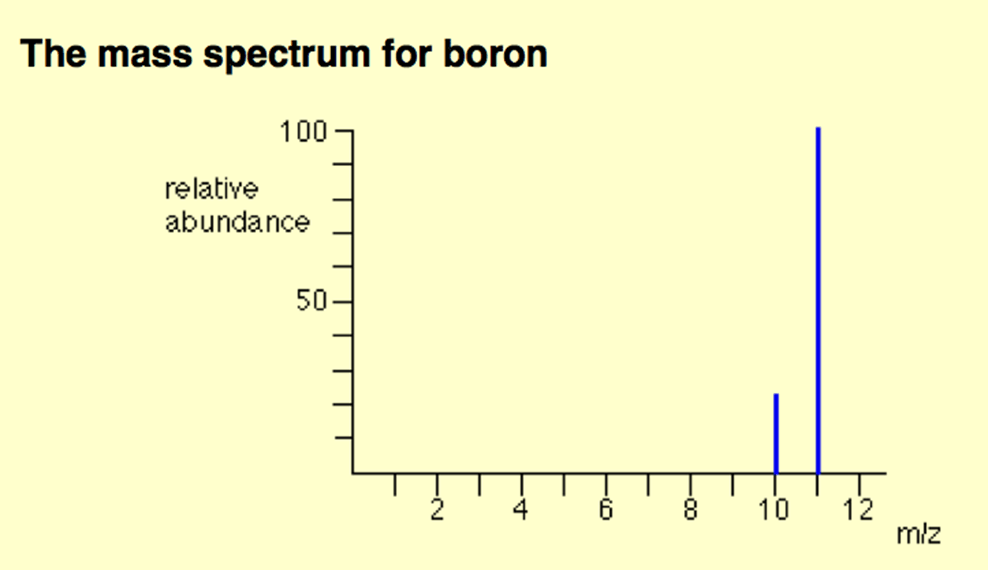
10.8 amu
300
The most electronegative element
F
300
Two or more of the same element with different masses.
What are isotopes?
300
Write the protons, neutrons, electrons, atomic number and mass number for 
P: 47
N: 61
E: 46
AN: 47
MN: 108
400
With Hans Jensen discovered nuclear spin, helped to explain stability of nuclei despite large numbers of charges
Who is Maria Goeppert Mayer?
400
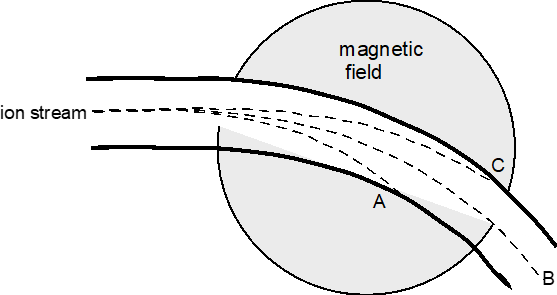 Explain the above schematic of a mass spectrometer.
ions go through field, influenced by magnetic field, particles whose paths change the fastest are the lightest, detector on other side determines how much of each isotope the sample contains.
400
Give the average atomic mass and atomic symbol for the most common isotope of the element represented below.
Chlorine.
3517Cl
400
The electron that Miss Zange needed to put the most energy in in order to remove it, when she removed three electrons from a Beryllium atom.
The last one removed (the 2p6 electron)
400
The energy required to remove an electron.
What is ionization energy?
400
Write the atomic symbol for an atom that has an atomic number of 27, 33 neutrons and is neutrally charged.

500
discovered that electrons exist mostly in orbitals, or 'probability clouds'
Who is de Broglie and Erwin Schrodinger?
500
A sketch and explanation of the gold-foil experiment.
Gold-foil - alpha particles bombarded thin sheet of gold, were expected to all bounce off but most went through, indicating that atoms are mostly made of empty space.
500
The average atomic mass and identity of an element of which 78.7% has a mass of 24, 10.1% has a mass of 25 and 11.2% has a mass of 26 amu.
Mg, 24.33 amu
500
An explanation of the relationship between ionization energy and atomic radius. (the why in addition to the what, points to best answer)
A smaller atomic radius will have a larger ionization energy. A smaller atomic radius means the electrons are closer to the attractive, positively charged nucleus, which therefore has a stronger pull on them that needs to be overcome in order for an electron to be removed.
500
The ability of an element to attract shared electrons.
What is electronegativity?
500
Write the protons, neutrons, electrons, atomic number and mass number for 
P: 73
N: 105
E: 70
AN: 73
MN: 178