Terminology
Terminology pt. 2
Solving
Misc.
100
What is the net energy change during the dissolving process?
Enthalpy of solution
100
Would N2 dissolve in water? What about MgS?
No
Yes
100
What is the molality of a solution which has 9.2 kg of solvent and 2 mol of solute?
.22 m
100
What is the dissolving process in solid-in-liquid solutions called?
Solvation
200
As you increase the temperature of a gaseous solution, what happens to its solubility?
It decreases
200
What states that the solubility of a gas is directly proportional to the partial pressure of the gas above the solution?
Henry's law
200
What is the amount concentration of 83.2 g of sulfuric acid dissolved in 200.1 L of water?
.004 M
200
What are heterogenous mixtures that contain large particles?
Suspensions
300
What are colligative properties?
The properties of solvents that change as the number of solute particles in the solution changes
300
At 90 oC, what is the most soluble substance? What is the solubility of NH3 at 20 oC?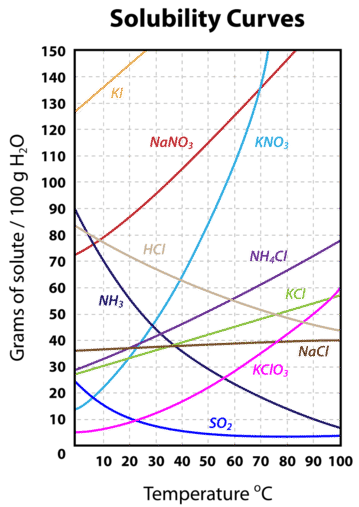
NH4Cl
55 g of NH3 per 100 g of H2O
300
How much water is needed to make a 2 M solution from 47.02 g of Hydrochloric acid?
.65 L of H2O
300
What is molarity (or amount concentration)
Compares the moles of solute with the volume of solution
400
What is the difference between an unsaturated, saturated, and supersaturated solution?
Unsaturated - a solution which contains less than the maximum amount of solute that it can hold at the current conditions
Saturated - when a solution contains the maximum amount of solute at a given temperature
Supersaturated solution - dissolving more than the maximum amount of solute
400
What is the Tyndall effect?
The ability of colloids to scatter light particles
400
Billy Bob 9 M acetic acid solution. How much water and acetic acid is needed to make 1 L of .5 M solution?
.055 L of acetic acid
.944 L of water
400
What is molality?
Compares the moles of solute per kilogram of solvent
500
What are five properties of solutions?
Solutions cannot be filtered out of a solution
Solutes do NOT settle out of solution
Solutions are uniform
Solutions are not chemically combined
Solutions can vary in their concentration
500
Explain three factors that can affect the rate of solution.
Higher temperatures leads to faster dissolution
Stirring the solution = more particle collisions = faster dissolution
Higher surface area = faster dissolution
500
587.32 g of sugar is dissolved in 9.000 kg of benzene? What is this solution's freezing and boiling points?
Boiling point: 80.63 oC
Freezing point: 4.502 oC
500
What happens to the following things when you add stuff to a substance?
Vapor pressure
Boiling point
Freezing point
Vapor pressure goes down
Boiling point goes up
Freezing point goes down