States of Matter
Elements and Atoms
Nuclear Notations
Periodic Table
100
This is anything that has mass and occupies space.
What is matter?
100
This is a pure substance made up of only one type of atom.
What is an element?
100
These are the three subatomic particles.
What are protons, neutrons and electrons?
100
This is the horizontal row in the periodic table.
What is a period?
200
These are the three common states of matter.
What are solid, liquid and gas?
200
This is the smallest particle of an element that can exist on its own.
What is an atom?
200
This subatomic particle has a positive charge.
What is a proton?
200
This is the vertical column in the periodic table.
What is a group?
300
In this state, particles are closely packed and only vibrate about fixed positions.
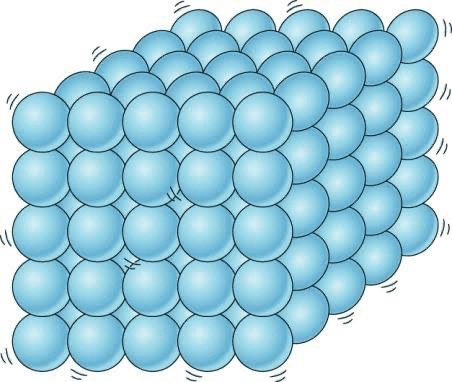
What is a solid?
300
This part of the atom contains protons and neutrons.
What is the nucleus?
300
In the nuclear notation ²³₁₁Na, this number represents the atomic number.
What is 11?
300
The group number tells the number of these in an atom of the first 20 elements.
What are outer shell electrons?
400
This is the name of the change when a gas turns into a liquid.
What is condensation?
400
Name one difference between an element and a compound.
An element contains one type of atom, while a compound contains two or more different elements chemically combined.
400
In the nuclear notation ²³₁₁Na, calculate the number of neutrons.
What is 12?
400
The period number tells the number of these in an atom.
What are occupied electron shells or energy levels?
500
Explain why gases are easier to compress than solids and liquids.
Because gas particles are far apart with lots of empty space between them.
500
An atom is said to be neutral. What does this mean?
It means the atom has equal numbers of protons and electrons.
500
State the electronic configuration for an atom with 13 electrons.
What is 2,8,3?
500
Put these elements in the correct order seen on the periodic table: oxygen, lithium, beryllium, boron, carbon.
What is lithium, beryllium, boron, carbon, oxygen?