Water
Carbs/ Lipids
Protein/ Nucleic Acids
Bonding
Molecules and our diet
100
Draw a water molecule that demonstrates polarity.
 What is 1 oxygen with partially negative charge, and two hydrogen with partially positive charge-
due to the greater electronegativity of oxygen vs hydrogen
Polar covalent bonds which cause one side of a molecule to become slightly charged. The other side can be neutral or the opposite chagre.
A molecule with two slight charges is considered dipolar.
100
The primary function of carbohydrates.
What is energy storage and use.
100
In what types of food would you find your best sources of protein?
What are meat, egg, (some) cheese, beans.
100
The type of bond where electrons are given or taken away.
What is an ionic bond.
100
How much energy do we get from 1 gram of the following: carbs, lipids, and protein?
What is 4kcal/gram from carbs and protein, 9kcals/ gram for lipids.
200
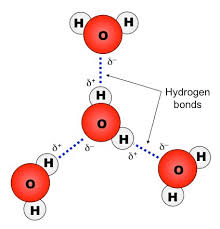
What is a hydrogen bond?
A hydrogen bond is an attraction between the postive side of one water molecule and the negative side of a different water molecule.
NOTE: It is an attraction not an exchange of electrons so it is not a true bond.
200
What is the monomer of carbohydrates.
What are monosaccharides.
200
The monomer of protein is (ie the building blocks of protein are).
What are amino acids
200
The type of bond where electrons are shared unevenly.
What is polar covalent bond
200
If you need energy fast, or will play a basketball game tomorrow, what should you eat today?
What are carbs (noodles, bread, rice, etc) because of their fast release of energy.
300
How does polarity lead to cohesion and adhesion?
What is the polarity of the individual molecules are attracted to themselves through hydrogen bonds (+/- attraction) causing cohesion. Or the molecules are attracted to another charged molecule causing adhesion.
300
What are types of lipids?
What are fats, waxes, oils, and phospholipids.
300
Name 3 functions of protein in living things.
What are: increase of reaction rate, regulation of body function, structure, transport of molecules, energy storage.
300
The difference between a polar covalent and non-polar covalent bond.
What is the uneven sharing and even sharing of electrons.
300
Why is saturated fat considered worse for you than unsaturated fat?
What are the double bonds within the fatty acid chains. Saturated fat contains no double bonds, and stacks it self up easier making is harder to digest, whereas unsaturated fat has double bonds creating bends in the fatty acid chains making it easier to digest.
NOTE: not all saturated fat is bad. Some studies seem to indicate that saturated fat can help you raise your good cholesterol (HDL)
400
The fact that water is more attracted to itself than it is to air, creates this known property of water.
What is high surface tension.
400
Name two examples of disaccharide.
What are sucrose, lactose, fructose.
400
One nucleotide consists of:
What is 1 sugar, 1 phosphate, 1 base
400
How energy is stored in molecules
What is the making of a chemical bond.
400
Name 3 things that water does for you.
What is flushing the toxins from the blood stream, reduce stress, helps with digestion and constipation, younger healthier looking skin, reduces the risk of cancers, etc.
500
Explain why water is important to our bodies using at least 3 of the properties of water.
What is universal solvency- minerals and vitamins and nutrients dissolve in blood stream, cohesion and adhesion -allow nutrients to move through the blood because they are dissolved they are then carried specific heat capacity- helps to maintain that we don't overheat too quickly by absorbing heat through hydrogen bonds.
500
Explain the reason why oil and water do not mix.
What is the polarity. Like dissolves like, water is polar and lipids are non-polar therefore they do not mix because the charges do not allow them to.
500
Draw the structure of DNA. Label all relevant parts including circling 1 nucleotide.
Answers vary. Should have phosphate, deoxyribose sugar, adenine, thymine, cytosine, guanine, and covalent bonds labeled.

500
Explain how a polar covalent bond is made.
What is electronegativity, or the pull of an atom on it's electrons. When two atoms has similar electronegativities but one atom has a greater electronegativity than another, the electrons spend more time around that atom than the other.
500
Discuss which is better for you:


Both contain similar amounts of fat with the pizza being slightly more. However the pizza contains significantly more protein and less sodium than the Ramen. However Ramen contains less carbohydrates with less added sugar, which is a positive them. While this is a positive thing, the pizza definately has more vitamins and minerals. They both contain similar amounts of fiber. In gereral it is probably dependent on what you are looking for, however the more well balanced of all of them is the pizza (in my opinion).