Hot Stuff
Bond Voyage
Rate Expectations
Shift Happens
Proton Patrol
100
The temperature of the surroundings rises during a reaction because energy has been transferred from the reacting system to the surroundings. This word describes the reaction.
What is exothermic?
100
Contrary to the occasional chemistry crime committed in student explanations, breaking a chemical bond does not release energy. It does this instead.
What is absorbs energy?
100
Reaction rate can be expressed as the change in this quantity of a reactant or product per unit time.
What is concentration?
100
At equilibrium, the forward reaction has not stopped. Instead, its rate is equal to the rate of this reaction.
What is the backward/reverse reaction?
100
Under Brønsted-Lowry theory, this species donates a proton.
What is an acid?
200

Products appear at a higher potential energy than reactants. This type of reaction has occurred.
What is endothermic?
200
For the reaction
H₂ + Cl₂ → 2HCl,
these are the bonds that must be broken before new H–Cl bonds can form.
What are the H–H bond and the Cl–Cl bond?
200
Crushing a solid reactant into a powder usually speeds up its reaction because it increases this property available for collisions.
What is surface area?
200
At equilibrium,
K = 4.2 \times 10^7
The equilibrium mixture therefore strongly favours this side of the equation.
What are the products?
200
Remove one proton from
H_2PO_4^-
and you obtain this conjugate base.
What is
HPO_4^{2-}
300
Two beakers contain water at 40 °C, but one contains ten times as much water as the other. They have the same value of this quantity, although the larger sample contains more thermal energy.
What is temperature?
300
The C–H bond in methane does not have exactly the same enthalpy as every C–H bond in every other molecule. This is why data-booklet bond enthalpies are described using this word.
What is average?
300
Two particles collide, but nothing happens. They had enough energy, so collision theory says this other requirement may have been wrong.
What is the collision orientation / geometry?
300
For
2SO_2(g) + O_2(g) \leftrightarrow 2SO_3(g)
this is the equilibrium expression.
What is
K = \frac{[SO_3]^2}{[SO_2]^2[O_2]}
300
A 0.001 mol dm⁻³ HCl solution and a 0.10 mol dm⁻³ ethanoic acid solution are compared. Despite being less concentrated, HCl still earns this description because it ionises to a greater extent.
What is the stronger acid?
400
A reaction heats 100 g of water by 5.0 °C. Taking
c = 4.18\ J\ g^{-1}\ K^{-1}
, this amount of heat is absorbed by the water.
What is 2.09 kJ?
400
For the reaction:
H_2 + Cl_2 \rightarrow 2HCl
using the Chemistry Data Booklet, this is the approximate reaction enthalpy.
What is
\Delta H = (436 + 242) - (2 \times 431) = -184\ \kJ\ mol^{-1}
400
On a gas-volume graph, a tangent at t=40 passes through (20 s, 30 cm³) and (60 s, 70 cm³). This is the instantaneous rate at 40 s.
What is 1.0 cm³ s⁻¹?
400
For
N_2(g) + 3H_2(g) \leftrightarrow 2NH_3(g)
increasing the pressure at constant temperature shifts equilibrium in this direction, while leaving K unchanged.
What is toward the products / to the right?
400
A solution has [H^+] = 2.5 \times 10^{-3}\ mol\ dm^{-3} . This is its pH, to two decimal places.
What is 2.60?
500
50.0 cm³ of 1.00 mol dm⁻³ HCl is mixed with 50.0 cm³ of 1.00 mol dm⁻³ NaOH. The mixture, assumed to have a mass of 100 g, warms by 6.8 °C. Using
c = 4.18\ J\ g^{-1}\ K^{-1}
this is the experimental enthalpy change of neutralisation per mole of water formed.
What is approximately −56.8 kJ mol⁻¹?
500
C(s) + O_2(g) \rightarrow CO_2(g) \ Delta H = -394\ \kJ\ mol^{-1}
CO(g) + \frac{1}{2}O_2(g) \rightarrow CO_2(g) \ Delta H = -283\ \kJ\ mol^{-1}
By Hess's law, this is ΔH for
C(s) + \frac{1}{2}O_2(g) \rightarrow CO(g)
\Delta H = -111\ \kJ\ mol^{-1}
500
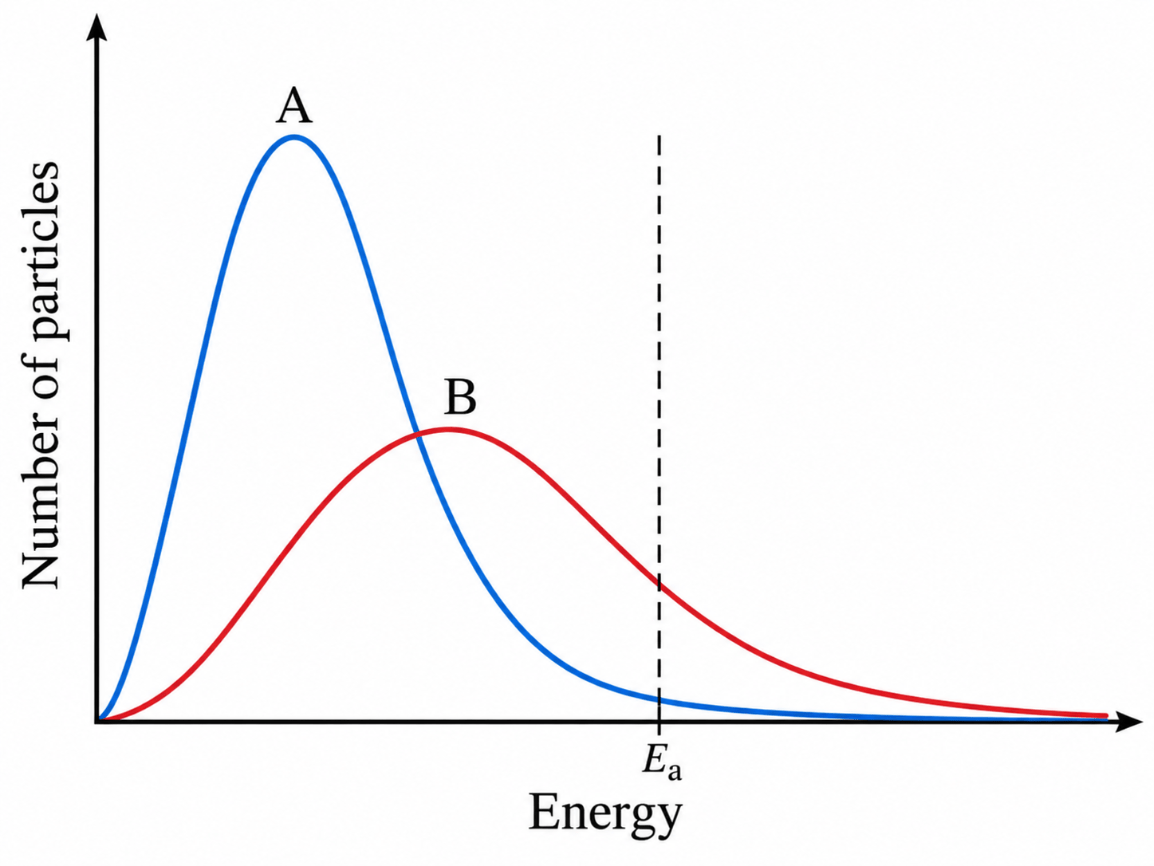
Curves A and B represent the same sample at two temperatures. Curve B has a lower peak, is broader and extends further toward high energies. This curve represents the sample at this condition.
What is the higher temperature?
500
The forward Haber reaction is exothermic:
N_2(g) + 3H_2(g) \leftrightarrow 2NH_3(g)
Raising the temperature causes these two changes: the equilibrium shifts in this direction, and K changes in this way.
What are: shifts left and K decreases?
500
25.0 cm³ of 0.100 mol dm⁻³ HCl reaches the equivalence point after 20.0 cm³ NaOH is added. This is the concentration of the NaOH.
What is 0.125 mol dm⁻³?