Molarity/Dilution & Soln Stoichiometry
Thermochemistry Part I
Thermochemistry Part II
Gases & The KMT
Electron Configurations
Electronic Structure Of Atoms & Quantum Numbers
100
Expresses the concentration of a solution as the number of moles of solute in a liter of solution
What is Molarity?
100
It is the heat energy that is being absorbed or evolved by a system during the progression of a chemical reaction. The change in this term indicates whether a particular rxn is endothermic or exothermic.
What is Enthalpy? ∆H
100
The amount of energy needed to increase the temperature of a substance by 1 Kelvin is the _____ of a substance
What is heat capacity?
100
Rank the following gases from least dense to most dense at 1.00 atm and 298 K: CO, N2O, Cl2, HF.
What is : HF (20 g/mol) 6 CO (28 g/mol) 6 N2O (44 g/mol) 6 Cl2 (71 g/mol)
*The density of a gas increases with increasing molar mass. d = PMm/RT
100
Difference between valence electrons & core electrons?
What is “Valence electrons” are those involved in chemical bonding. They are part or all of the outer-shell electrons listed after the core & “Core electrons” are inner-shell electrons that have the electron configuration of the nearest noble-gas element.
100
This states that no two electrons in an atom can have the same set of four quantum numbers n, l, ml, and ms.
What is the Pauli Exclusion Principle?
200
Calculate the molarity of a solution made by dissolving 23.4 g of sodium sulfate (Na2SO4) in enough water to form 125 mL of solution.
What is 1.32 M?
200
The change in this term can occur in two ways: heat transfer & work being done by or on the system.
What is internal energy? ∆E
200
Difference between: enthalpy of formation & standard enthalpy of formation
What is Enthalpy of formation is the enthalpy change that occurs when a compound is formed from its component elements & Standard enthalpy of formation, ∆Hof , is the enthalpy change that accompanies formation of one mole of a substance from elements in their standard states.
200
Suppose you have a fixed amount of an ideal gas at a constant volume. If the pressure of the gas is doubled while the volume is held constant, what happens to its temperature?
What is doubles?
*For a fixed amount of ideal gas at constant volume, if the pressure is doubled, the temperature also doubles.
200
Identify the element & write the condensed electron configuration: 1s22s22p43s1
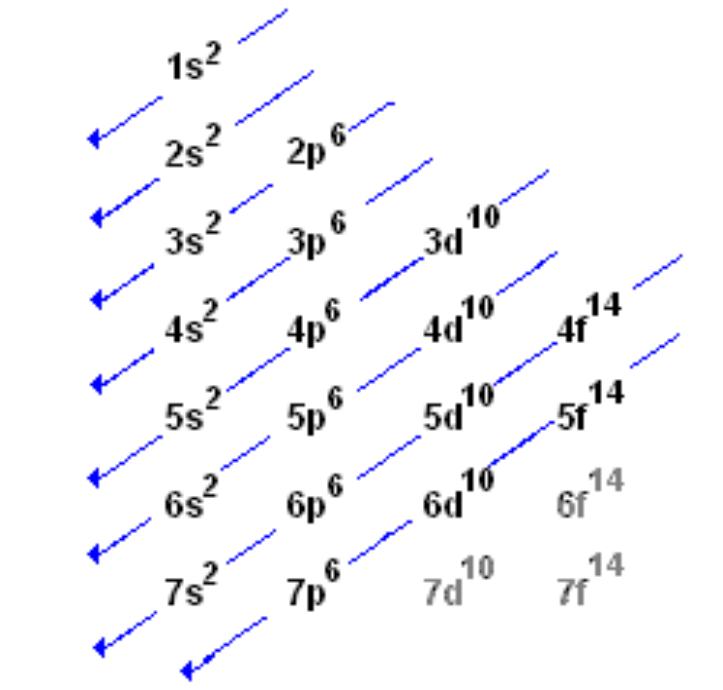
What is Fluorine (F) & [He]2s22p5?

200
If an electron makes a transition from the n = 4 level to a lower-energy level, n= 3, 2, or 1, which transition would produce a photon with the shortest wavelength?
What is n = 4 state to the n = 1 state?
*Wavelength is inversely proportional to Energy. E = hv = hc/wavelength(lamda). The electron loses the most energy on transitioning from the n= 4 state to the n = 1 state, and the photon emitted in that transition has the highest energy and the smallest wavelength
300
The molar concentration of each ion present in a 0.025 M aqueous solution of calcium nitrate
What is 0.025 M in Ca2+ & 0.050 M in NO3-
Explanation: Calcium nitrate is composed of calcium ions (Ca2+) and nitrate ions (NO3-), so its chemical formula is Ca(NO3)2. Because there are two NO3 - ions for each Ca2+ ion, each mole of Ca(NO3)2 that dissolves dissociates into 1 mol of Ca2+ and 2 mol of NO3 -.
300
A gas is confined to a cylinder under constant atmospheric pressure. When 0.49 kJ of heat is added to the gas, it expands and does 0.214 kJ of work on the surroundings. What are the values of ∆H and ∆E for this process?
What is 0.49kJ & 0.276kJ?
*Work is being done by the system so w is negative. At constant pressure ∆H = qp .
300
Which will require more heat, increasing the temperature of 1 mol of C8H18(l) by a certain amount or increasing the temperature of 1 mol of H2Ol(l) by the same amount? Specifc heat of C8H18(l) is s 2.22 J/gK
What is C8H18?
Explanation: molar heat capacity that is the amount of heat required to increase in 1K the temperature of 1 mole of substance.That means the substance with higher molar heat requires more energy to increase its temperature. Molar mass times specific heat.
300
Calculate the number of molecules in a deep breath of air whose volume is 2.25 L at body temperature, 37 °C, and a pressure of 735 torr. (1atm = 760torr)
What is 5.15 x 10²² molecules?
*Use PV=nRT to solve for moles present in a deep breath of air (0.08554 moles) then multiply that by 6.022 x 10²³ molecules of gas.
300
write the condensed electron configuration and determine the number of unpaired electrons for the ground state of Ga
What is [Ar]4s23d104p1 & 1 unpaired electron?

300
A hydrogen atom orbital has n = 5 and ml = -2. What are the possible values of l for this orbital?
What is 2,3 or 4?
400
The quantity of Cl- in a municipal water supply is determined by titrating the sample with Ag+. The precipitation reaction taking place during the titration is Ag+(aq) + Cl-(aq) ---> AgCl(s).
How many grams of chloride ion is in a sample of the water if 20.2 mL of 0.100 M Ag+ is needed to react with all the chloride in the sample?
What is 7.17 x 10⁻² g Cl-?
Explanation: use the volume and molarity of Ag+ to calculate the number of moles of Ag+ used in the titration. We then use the balanced equation to determine the moles of Cl- in the sample and from that the grams of Cl-.
400
A 100.0-g bar of gold is heated from 25 °C to 50 °C during which it absorbs 322 J of heat. Assume the volume of the gold bar remains constant. Calculate the change in internal energy of the system and determine whether the process is endothermic or exothermic.
What is 322J & endothermic?
Explanation: At constant volume ∆E = qv, since the volume is constant, no work is done on the gold bar. The system absorbed energy from its surroundings therefore the reaction is endothermic.
400
The initial temperature of 150g of ethanol was 22oC. What will be the final temperature of the ethanol if 3240 J was needed to raise the temperature of the ethanol is what?
What is 30.9oC?
400
Determine whether each of the following changes will increase, decrease, or not affect the rate with which gas molecules collide with the walls of their container: (a) increasing the volume of the container, (b) increasing the temperature, (c) increasing the molar mass of the gas.
What is Decrease, increase, decrease?
400
Electron Configuration for Ca2+

What is 1s22s22p63s23p6 or [Ar]?
*Originally [Ar]4s2, Calcium loses 2 electrons to become a Ca two plus ion and therefore loses the 2 electrons from the s orbital.
400
Which of the following represent impossible combinations of n and l? (a) 1p, (b) 4s, (c) 5f, (d) 2d
What is 1p & 2d? or (a) & (d)
500
Pure acetic acid, known as glacial acetic acid, is a liquid with a density of 1.049 g/mL at 25 °C. Calculate the molarity of a solution of acetic acid made by dissolving 20.00 mL of glacial acetic acid at 25 °C in enough water to make 250.0 mL of solution.
What is 1.398 M CH3COOH?
Explanation: Use density to determine the mass of 20.00mL of acetic acid: m=dxv => 1.049 g/mL x 20.00 mL = 20.98g then use molar mass of acetic acid to find moles. Use moles of acetc acid divided by 0.02L. Molarity would be 17.48M then use dilution equation (M1V1=M2V2) to get a final concentration of 1.3984M (3sigfigs) = 1.398M.
500
Consider the following reaction:
2 CH3OH(g) ---> 2CH4(g) + O2(g) ∆H = +252.8 kJ
(a) Is this reaction exothermic or endothermic?
(b) Calculate the amount of heat transferred when 24.0 g of CH3OH(g) is decomposed by this reaction at constant pressure
What is endothermic & 94.7kJ of heat transferred (q).
explanation: ∆H shows that heat has been taken in from the surroundings in order for the reaction to proceed, so this is an endothermic reaction. At constant pressure enthalpy equals heat transferred. The mass of CH3OH(g) decomposed n this reaction is done by finding the molar mass and multiplying it by 2 mols to get 64.1g which then you do 24.0g x (252.8kJ/64.1g) = 94.7kJ
500
Ethanol (C2H5OH) is blended with gasoline as an automobile fuel.
(a) Write a balanced equation for the combustion of liquid ethanol in air.
(b) Calculate the standard enthalpy change for the reaction, assuming H2O(g) as a product.
(c) Calculate the mass of CO2 produced per kJ of heat emitted.
What is C2H5OH(l) + 3O2(g) ----> 2CO2(g) + 3 H2O(g), ∆Horxn = -1234.8kJ & 0.071284 g CO2/kJ heat emitted?
Explanation: 2 mol of CO2 is produced per 1234.8kJ of heat emitted. And there are 44.01g of CO2 in 1 mol. So mass of CO2 produced per kJ of heat emitted is (2mol/1234.8kJ)(44.01g/mol)
500
Chlorine dioxide gas (ClO2) is used as a commercial bleaching agent. It bleaches materials by oxidizing them. In the course of these reactions, the ClO2 is itself reduced. One method of preparing ClO2 is by the reaction of chlorine and sodium chlorite:
Cl2(g) + 2 NaClO2(s) ---> 2 ClO2(g) + 2NaCl(s)
If you allow 15.0 g of NaClO2 to react with 2.00 L of chlorine gas at a pressure of 1.50 atm at 21 °C, how many grams of ClO2 can be prepared?
What is 11.2 g ClO2?
*Limiting Reactant Problem
500
Which ion with a +1 charge has the electron configuration 1s22s22p63s23p63d104s24p6?
Which ion with a –2 charge has this configuration?
Which noble gas are they isoelectronic to?
What is Rb+ & Se2−, isoelectronic to Krypton?
*Rb [Kr] 5s¹, Rb+ [Ar]4s23d104p6 & Se [Ar] 3d10 4s2 4p4, Se2- [Ar]4s23d104p6 or for all it can just be [Kr]
500
List one possible set of quantum numbers (l, ml , ms) for the n = 3 shell, and determine the number of electrons that can be in the shell and each of its subshells.
What is n=3, l=1, ml = 0, ms= -1/2, 18 electrons & 2, 6 & 10 in each subshell?
Explanation: n=3, ((l) can be any integer between 0 and n - 1, 0,1,2 in this case), ml = -l to l & ms can be either -1/2 to 1/2. 2n2 tells you max electrons in given shell which n=3. Subshells: s,p & d. 2(2l+1).