Vocab
formulas
problems
100
Within a closed, isolated system, energy can change form, but the total amount of energy is constant.
_law of conservation of energy__
100
GPE
mgh
100
Determine the mechanical energy for a 5.0-kg stone perched near the edge of a cliff 25.0 m high. Use the base of the cliff as the reference level. put in scientific notation
E = PE + KE
PE = mgh
E = mgh + 0 J
= (5.0 kg)(9.8 N/kg)(25.0 m)
= 1.2 x10^3 J
200
The position at which the potential energy is defined to be zero is a(n)
reference level
200
result of and elastic collision
KEafter=KEbefore
200
What would be the gravitational potential energy for a 63.5-kg skateboarder at the top of the starting ramp?
PE = (mg)h = (622 N)(0.61 m) = 380 J
300
The sum of the kinetic and potential energy of a system is
mechanical energy
300
Joule
1kg*m^2/s^2
300
How could you change the ramp design so that a 63.5-kg skateboarder moves twice as fast at the bottom? For now, ignore air resistance and friction between the skateboard and ramp. Explain why this design change would work in terms of the conservation of mechanical energy.
If you want to go twice as fast, you need four times as much kinetic energy, (KE), so make the ramp four times higher. (KE is proportional to the square of velocity.) Because the potential energy of the ramp drop is converted to kinetic energy, the system must have four times as much potential energy. Gravitational potential energy is directly proportional to the height; so to get four times the potential energy you need four times the height.
400
The stored energy of an Earth-object system as a result of gravitational attraction between the object and Earth
GPE
400
KEtrans
1/2mv^2
400
Assume that the same 63.5-kg skateboarder in part a falls off the side of the ramp. What is the kinetic energy from the skateboarder’s falling motion just before she reaches the ground?
Use the conservation of mechanical energy here. The gravitational potential energy change is equal to the kinetic energy change: is (63.5-kg)(9.8 N/kg)(0.61 m) = 380 J
500
A collision in which kinetic energy is converted to other forms is
INELASITC COLLISION
500
momentum
mv
500
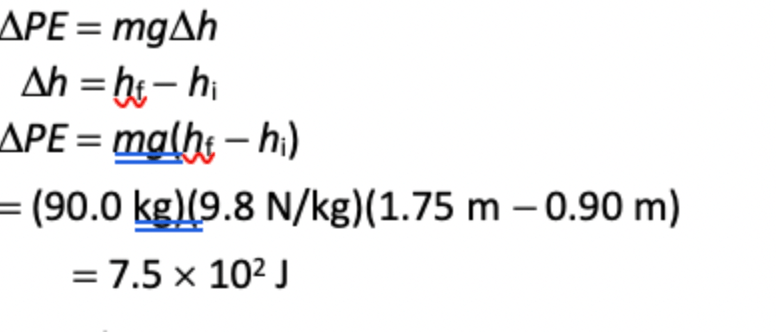
A weight trainer lifts a 90.0-kg barbell from a stand 0.90 m high and raises it to a height of
1.75 m. What is the increase in the potential energy of the barbell-Earth system?