Solid, Liquid and Gas
Mixtures
Elements
Density
Chemical and Physical Changes
100
Which is usually the most dense? The least dense?
solid, liquid, gas
Solids are usually the most dense since they usually (not always) have more mass.
Gases are usually the least dense since they usually (not always) have less mass and that mass is spread out (more volume)
100
What is a homogeneous mixture?
A mixture where substances are physically combined. They mix so well, that usually one dissolves in another (called a solution). The particles look uniform throughout. You cannot see the individual substances as it has the same composition throughout.
100
Which properties is NOT characteristic of a metal?
malleable
luster
mostly gases
ductile
fair conductors of heat
semiconductors of electricity
mostly gases - (those are the nonmetals)
fair conductors of heat (those are the metalloids)
semiconductors (those are the metalloids)
100
Density means:
A. if something will sink or float in another substance
B. how much mass is packed into a given volume (size)
C. relative density
B
A is relative density, not density
100
True or false:
A color change is always evidence of a chemical change.
false
Adding liquid or powder color to something is a physical change because it changes what it looked like. It did NOT create a new substance.
200
Which state of matter has a shape and a volume that does not change?
solids
200
Sand and water is an example of which type of mixture?
A. heterogeneous mixture
B. homogeneous mixture
A
They do not mix. The sand settles on the bottom.
200
1. Sulfur is an example of a nonmetal. Which of these is a physical property of many nonmetals?
A. shiny
B. brittle
C. malleable
D. conductor of electricity
B
the rest are properties of metals
200
If two objects are the volume (same size), but one floats and one sinks, then which is differente?
A. density
B. mass
C. density and mass
C
Density - we know they have different densities because one is floating and one is sinking.
Mass - we know they have different mass because if one is floating and one is sinking, but they are the same size(volume), then something has to make one sink. That something is its mass. It has more stuff packed into it which makes it heavier.
200
Which two are examples of a physical change and not a chemical change
A. mixing baking soda and vinegar
B. frying an egg
C. boiling water
D. burning wood
E. sugar dissolving in water
F. putting a liquid into the freezer to freeze it
C, E, F
Dissolving does not change a substance into something new. It is a mixture that can be reversed by boiling the mixture to evaporate the water.
Boiling water is a phase change (a change in the state of matter). No new substance is created.
Freezing something is a physical change. It is still the same thing. The state of matter changed. No new substance is created.
300
Which of the following is false.
A is false, B is false, both are false.
A. The mass of a gas cannot be measured.
B. A solid can become a liquid when energy is removed.
Both are false
A. We did this in class with a balloon deflated and inflated. It has mass that can be measured on a scale or balance.
B. To move a solid to a liquid, we need to ADD energy. It takes energy for those particles to move. Just like you need energy to move. Particles in a liquid move more because they have more energy. We can add more kinetic energy by adding thermal energy.
300
True or false:
A heterogeneous mixture is easy to separate, but a homogeneous mixture cannot be separated.
false
BOTH can be separated, but it is harder to separate a homogeneous mixture because you cannot see the different substances.
300
If an element is a semiconductor of electricity, it is a
A. metal
B. nonmetal
C. metalloid
C
300
Ice, water and oil are placed in a beaker together. Based on the density numbers, what is the order from the TOP to the Bottom.
Ice D = .91 g/ml
Water
oil D = .83 g/ml
oil
ice
water
Remember that the density of water = 1 g/ml
300
True or false:
Chemical changes only occur if there is a production of a gas
false
400
Which two physical states have a definite volume:
A. solid
B. liquid
C. gas
solid and liquid
the volume of a gas changes constantly
A definite volume (kind of) means that when you move the substance from one container to another, the amount or size does not change.
400
A pure substance is a:
A. mixture
B. combination of two substances mixed together
C. an element or compound
C
It is not a mixture at all. It is chemically combined elements (called compounds) or elements by themselves. It is ONE type of particle. So either it is just oxygen or it is just hydrogen or it is hydrogen and oxygen combine chemically throughout and not mixed with anything physically.
400
Metalloids are:
good conductors of heat
bad conductors of heat
fair conductors of heat
fair conductors of heat
they are not great, but can conduct some heat
400
When a substance's VOLUME increases while the MASS stays the same, what occurs?
A. Density decreases
B. Density increases
C. Density stays the same
A
Density will decrease because density is how much stuff is packed into a specific size. If you have the same amount of stuff packed into a bigger size, you are spreading it out which decreases the density. That is how boats float. A lot of mass, but spread out.
D = M/V,
400
Which of the following is not a sign of a chemical change:
production of a gas
phase change
change in color
precipitate form
thermal energy increase or decrease
phase change
changing from a solid, liquid or gas is a physical change that happens when thermal energy is added or removed.
500
Which states of matter have a shape and volume that changes?
gas
500
How can you determine if a substance is a pure substance or a mixture?
A. A pure substance can be separated into parts and a mixture cannot be.
B. A mixture can be physically separated into parts and a pure substance cannot be.
C. Both pure substances and mixtures are the same throughout and cannot be separated.
B.
500
A student makes observations about an unknown substance. They notice that the substance is a gas, dull and brittle. Which of classification might the element belong to?
A. metal
B. nonmetal
C. metalloid
B
Those are all (properties) characteristics of non-metals. Remember that nonmetals are the opposite of metals.
500
Ice has a density of about .91 g/ml
In which substance below would it sink to the bottom?
A. Olive oil D = .91 g/ml
B. Honey D = 1.4g/ml
C. Baby Oil D = .83 g/ml
D. Dish Soap D = 1.04 g/ml
C
The ice would sink below the baby oil as it is more dense than the baby oil. It would NOT sink in the olive oil because it has the SAME density.
500
Which are examples of a chemical change:
A. fireworks
B. cutting a piece of copper wire
C. Statue of Liberty turning green
D. elephant toothpaste
E. liquid turning pink when a red powder is added to it
A, C, D
600
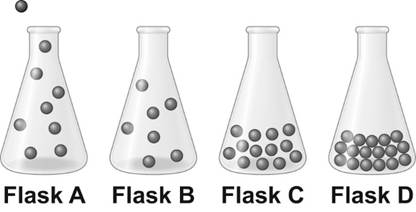
Which flask represents the state in which particles have the LEAST kinetic energy?
A. Flask A, which represents a gas
B. Flask A, which represents a solid
C. Flask D, which represents a gas
D. Flask D, which represents a solid
D
600
Is a pure substance the same as a mixture?
NOOOOOO
Pure substances are made from elements either by themselves or combined CHEMICALLY with other elements. YOU cannot make a pure substance. YOU can make a mixture.
600
Where are the metalloids and nonmetals found on the periodic table?
Metalloids touch the zig zag line on the periodic table. They are between the metals and nonmetals.
Nonmetals are on the far right. They are to the right of the metalloids and the zigzag line.
600
Which of these would sink?
substance A has a density of .8
substance B has a density of 1.2
B
The higher density means it will sink. In a jar, it would be on the bottom and substance A would be floating on top of it.
600
Which are chemical and which are physical changes?
tearing
cutting
dissolving
temperature changes just by combing two substances
tearing, cutting, dissolving NO NEW substance is formed are physical changes. temperature changes that happen without obvious reasons are a sign of chemical change.