hodgepodge
Chemistry Basics
Water Water
Carbon
Macro means big
100
A testable explanation for a set of observations based on the available data and guided by inductive reasoning.
What is a hypothesis?
100
The number of protons in the nucleus of an atom, unique for each element and designated by a subscript.
What is the atomic number?
How does this differ from atomic mass?
100
Having no affinity for water; tending to coalesce and form droplets in water.
What is hydrophobic?
100
A specific configuration of atoms commonly attached to the carbon skeletons of organic molecules and involved in chemical reactions.
What are functional groups?
100
A long molecule consisting of many similar or identical monomers linked together by covalent bonds.
What is a polymer?
200
A type of cell with a membrane-enclosed nucleus and membrane-enclosed organelles.
What is eukaryotic?
200
A chemical bond resulting from the attraction between oppositely charged ions
What is an ionic bond?
200
The linking together of like molecules, often by hydrogen bonds
What is cohesion?
200
One of two or more compounds that have the same numbers of atoms of the same elements but different structures and hence different properties.
What are isomers?
200
A chemical reaction in which two molecules become covalently bonded to each other with the removal of a water molecule
What is dehydration synthesis?
*What is hydrolysis?
300
A localized group of organisms that belong to the same species
What is a population?
300
A type of covalent bond in which electrons are shared equally between two atoms of similar electronegativity.
What is a non-polar covalent bond?
300
The dissolving agent of a solution
What is a solvent?
vs - solute, solution
300
An adenine-containing nucleoside triphosphate that releases free energy when its phosphate bonds are hydrolyzed. This energy is used to drive endergonic reactions in cells.
What is ATP?
300
Any of a group of large biological molecules, including fats, phospholipids, and steroids, that mix poorly, if at all, with water?
What are lipids?
400
A nucleic acid molecule, usually a double-stranded helix, in which each polynucleotide strand consists of nucleotide monomers with a deoxyribose sugar and the nitrogenous bases adenine (A), cytosine (C), guanine (G), and thymine (T); capable of being replicated and determining the inherited structure of a cell’s proteins.
What is DNA?
400
An electron in the outermost electron shell.
What is a valence electron?
400
A solution that contains a weak acid and its corresponding base - minimizes changes in pH when acids or bases are added to the solution.
What is a buffer?
400
The study of carbon compounds
What is organic chemistry?
400
A macromolecule serving as a catalyst, a chemical agent that increases the rate of a reaction without being consumed by the reaction
What is an enzyme?
500
The application of scientific knowledge for a specific purpose, often involving industry or commerce but also including uses in basic research.
What is technology?
500
One of several atomic forms of an element, each with the same number of protons but a different number of neutrons, thus differing in atomic mass.
What is an isotope?
500
A common measure of solute concentration, referring to the number of moles of solute per liter of solution
What is molarity?
500
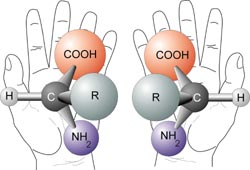
One of two compounds that are mirror images of each other and that differ in shape due to the presence of an asymmetric carbon
What is an enantiomer?
500
The overall shape of a protein molecule due to interactions of amino acid side chains, including hydrophobic interactions, ionic bonds, hydrogen bonds, and disulfide bridges
What is tertiary structure?