Communication & Language
Perception
Communication Principles
Cultural Communication
Self-Concept
100
Body movement, touch, territory, voice, distance, time, clothing, environment/setting
What is Nonverbal Communication?
100
An internal, subconscious process that impacts how you see the world & receive information
What is Perception?
100
A form of communication in which the message is carried out using some channel other than those used in face-to-face communication
What is Mediated Communication?
100
When members of 2+ cultures/co-cultures communicate, and their communication is influenced by their different cultural perceptions – both nonverbally and verbally
What is Intercultural Communication?
100
Forming your self-concept by evaluating yourself in comparison to certain “reference groups” in your life, such as other teams/athletes, your classmates, figures of authority, etc.
What Social Comparison Theory?
200
Provides a sense of identity, affiliation, power/politeness, sexism/racism, precision/vagueness, language of responsibility
What are the impacts of language?
200
Observation, attribution, integration, and confirmation
What are the Steps of the Social Perception Process?
200
Interactions that are mediated in a way that crosses boundaries between mass- and interpersonal contexts (ex. a marriage proposal being broadcasted on the big screen in a stadium)
What is Masspersonal Communication?
200
A group of people, usually defined by geographic boundaries, who share and learn the same language, values, religion, customs
What is Macro-Culture?
BONUS: Explain how Subcultures and Co-Cultures relate/interact with the Macro-Culture
200
Building a self-concept based on the judgements and interactions with those around you; they can have + or - effects on self image (ex: Receiving a lot of compliments when you dress a certain way will make you dress like that more, especially if you rarely receive compliments when you dress another way)
What is Reflected Appraisal Theory?
BONUS: What kind of appraisal is most influential on our self-concepts?
300
Three different ways of communicating the same message: one of them clarifies the speaker as the source of the message, the other expresses judgment on the other person, and the third conveys the message as the responsibility of both the listener and the speaker
What is “I”/”You”/”We” language?
300
Seeking out & holding to information that supports your already existing opinions, therefore strengthening that perception in your mind
What is Confirmation Bias?
300
Acting on exaggerated beliefs learned from a broad categorizing system, and expressing those beliefs until proven wrong
What is stereotyping/generalizing?
BONUS: Describe how stereotyping influences perception, and vice-versa
300
Defining your culture and way of life as better than others'
What is Ethnocentrism?
300
Sending bids for attention, then achieving reciprocity, intimacy, and catharsis
What is Self-Disclosure?
400
The ability to recognize and adapt the language patterns you use in different social contexts, such as how you talk with your friends vs. your family vs. figures of authority
What is Convergence (or Code Switching)?
400
Forming an overall positive/negative impression of a person based on only one or two prominent characteristics
What is the Halo/Horns Effect?
400
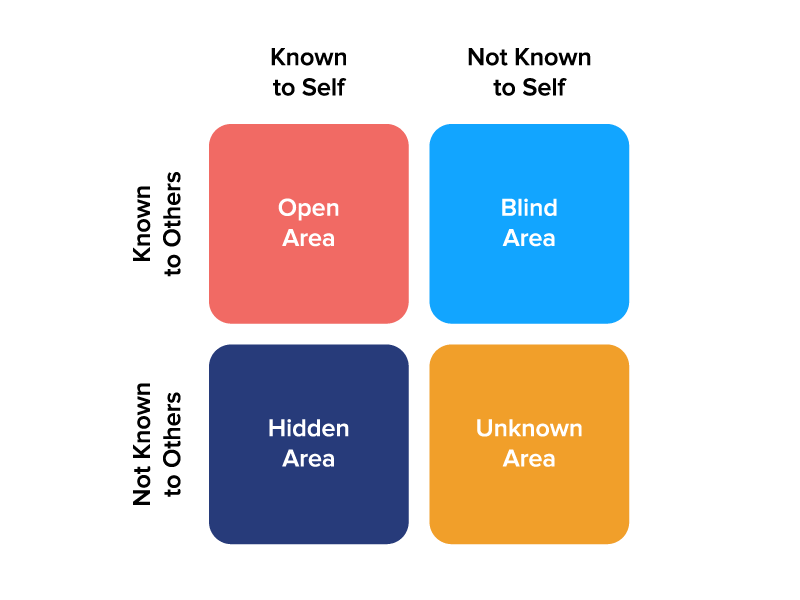
This model, depicting the different levels of self-disclosure & self-awareness
What is the Johari Window?
400
Cultures that prioritize self-reliance, individual rewards, and fluidity around groups vs. those that prioritize cooperation, harmony, and are group-centered
What is Individualistic vs. Collectivistic Culture?
400
Who you are in honest moments of reflections vs. how you present yourself for other people
What is your Perceived Self vs. Presenting Self?
500
Using generalized similarities between several objects or concepts in order to be purposefully vague and indirect
What is Language Abstraction?
500
Recognizing your internal interpretations of what’s before you, considering 2 possible interpretations, and seeking clarification/confirmation of those interpretations
What is Perception Checking?
500
The phenomenon in which the beliefs/expectations we hold for ourselves increase the likelihood of good things happening
What is the Self-Fulfilling Prophecy?
BONUS: Name the 4 steps OR 2 types of the Self-Fulfilling Prophecy
500
Cultures that tend to be more direct, blunt, and straightforward with communication vs. those that tend to be more indirect, relational, and values putting the relationship over getting to the point
What are Low Context vs. High Context Cultures?
500
The process of developing deeper intimacy with another person through layers of mutual self-disclosure and other forms of vulnerability. These layers are: Cliché (superficial), Facts (intimate), Ideas (personal), Feelings (core).
What is the Social Penetration Model (the self-disclosure “onion”)?