Quadratic Graphs
Adding & Subtracting Complex numbers
Multiplying Complex Numbers
Mixed Complex Number Operations
Graphs of Equations, Inequalities & Systems
100
What is the vertex of
y=-2(x+1)2 - 7
(-1, -7)
100
(3 +4i)+(5+5i)
8 + 9i
100
(3 +4i)(5+5i)
-5 + 35i
100
(4 +i)-(6+2i)
-2-i
100
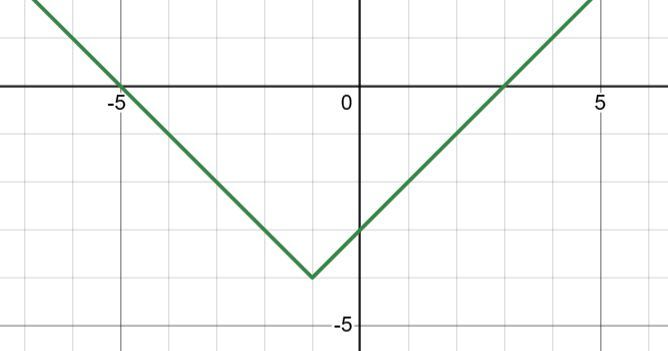 What function family does this represent?
Absolute Value
200
What are the x-intercepts of
y=3(x+1)(x-5)
-1 and 5
200
(2 -3i)+(6+7i)
8 + 4i
200
(1 -3i)(2+4i)
14-2i
200
(2 +2i)(4+i)
6+10i
200
What is the y-intercept of this graph?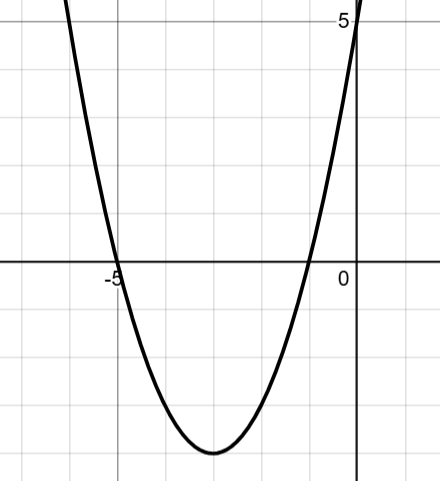
5
300
What is the end behavior of the graph of
y=-2(x-1)2 + 4
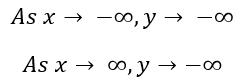
300
(-6 -i)+(2-3i)
-4 - 4i
300
3i ( 4-i)
3+12i
300
(2 +7i)+(4+6i)
8 + 13i
300
What is the slope of this graph?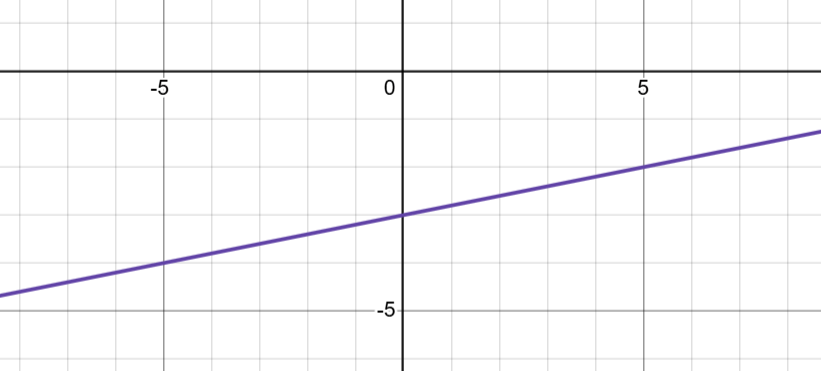
1/5
400
What is the equation in Vertex Form of this graph: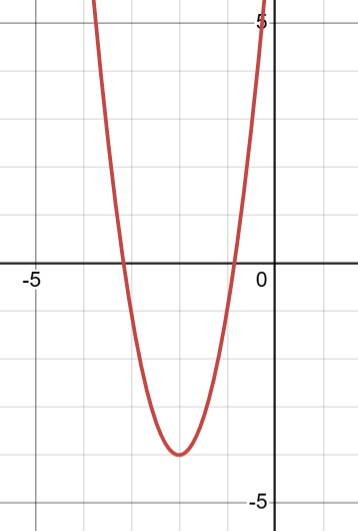
y= 3(x+2)2 -4
400
(6 +7i)-(3+5i)
3+2i
400
(2 +3i)(2-3i)
13
400
6(2-5i)
12-30i
400
What is the solution to this system?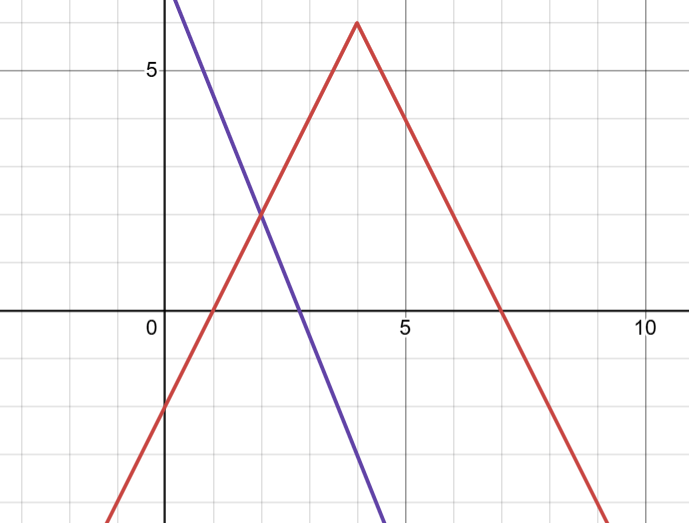
(2,2)
500
What is the equation of this graph: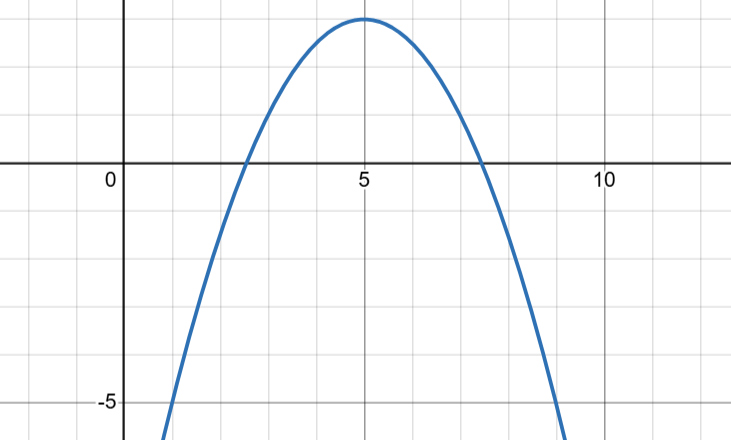
y= -0.5(x-5)2 +3
500
(8 +i)-(-2-2i)
10+3i
500
(2 +5i)^2
-21+20i
500
(3+5i)-(-2-4i)
5+9i
500
Is (9,-6) a solution to this system of 3 inequalities?
No, (9,-6) is only a solution for two of the 3 inequalities, but it is not in the shaded region of the blue absolute value inequality, so it is not a solution to the entire system.