Exam 1 (Ch. 1-3)
Exam 2 (Ch. 4-6)
Exam 3 (Ch. 7-9)
Exam 4 (Ch. 12, 13, 16, 17)
Misc.
100
What is a compound?
A substance consisting of two or more different elements combined in a fixed ratio.
100
What chemical process builds macromolecules?
Dehydration Reaction/Synthesis
100
What metabolic pathway does glycolysis represent?
Catabolic pathway; glucose is broken down into pyruvate
100
What does DNA polymerase I & III do?
DNA pol III - Synthesizes new DNA strand by adding nucleotides to an RNA primer or pre-existing DNA strand.
DNA pol I - Removes RNA nucleotides of primer & replaces them with DNA nucleotides.
100
What is a radioactive isotope?
An isotope of an element that has a decaying nucleus which gives off particles and energy.
200
What is a buffer?
A substance that minimizes change in H+/OH- concentration; substance that resists change in pH/pOH.
200
What are the main types of polysaccharides, what do they do, and how do they differ in structure?
Storage Polysaccharides - Stored Energy, Ex.: Glycogen, Starch
Structural Polysaccharides - Physical Structure, Ex.: Cellulose, Chitin
The glycosidic linkages are different between storage & structural polysaccharides.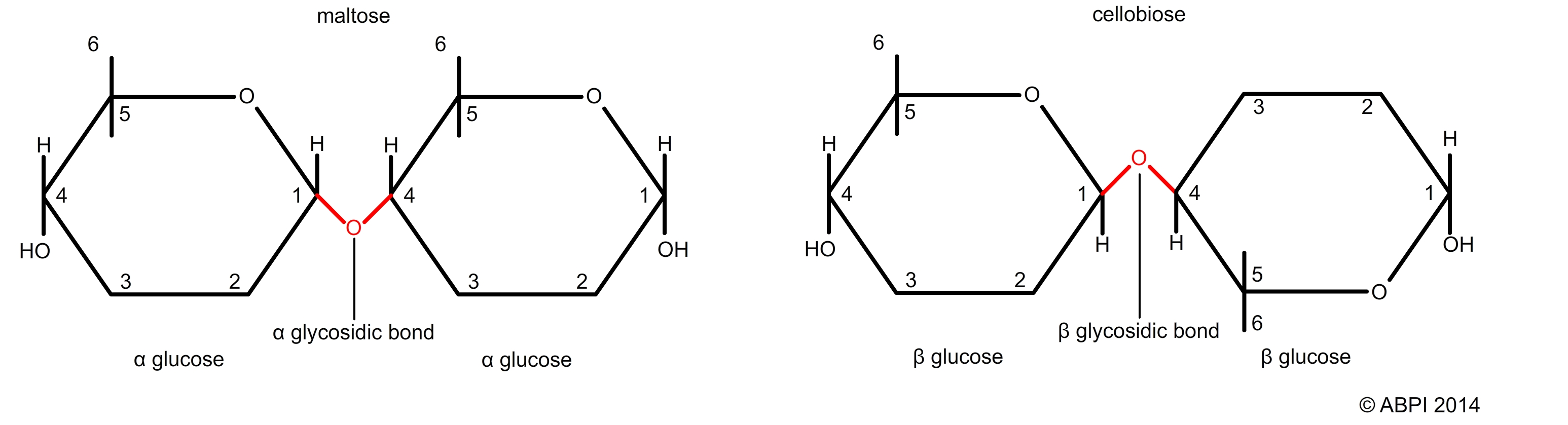
200
How does an enzyme help speed up reactions?
Enzymes lower the energy barrier, which is the minimum energy the reactants must have to start a reaction.
200
In which directions is DNA synthesized on the leading & lagging strands?
Leading - Towards the fork
Lagging - Away from the fork
200
How does cholesterol help with membrane fluidity?
At moderate temperature, it reduces fluidity by restricting phospholipid movement.
At low temperature, it prevents solidification by disrupting the packing of phospholipids.
300
What chemical bonds are present in a glass of water?
Covalent bonds within water, Hydrogen bonds between water
300
What are the differences between cilia and flagella?
Flagella are larger, fewer in quantity (one or a few per cell), primarily for cell movement
Cilia are smaller, larger in quantity, and move materials surrounding cells
300
How much ATP does each step of cellular respiration produce?
Glycolysis: 2
Citric acid/Krebs Cycle: 2
Oxidative Phosphorylation (Chemiosmosis): 26-28
300
How is genetic diversity created during meiosis?
Crossing over of homologous chromosomes during Prophase I.
Independent assortment of homologous chromosomes during Metaphase I.
300
What is the difference between meiosis I & meiosis II?
Meiosis I separates homologous chromosomes to form 2 haploid daughter cells.
Meiosis II separates sister chromatids to form 4 haploid daughter cells.
400
What is electronegativity and how does it influence chemical bonds?
The attraction of a particular atom for electrons. Differences in electronegativity between atoms can cause the bonded molecule to be polar/nonpolar.
400
What are some differences between eukaryotic and prokaryotic cells?
Prokaryotes: No nucleus, No membrane-bound organelles, DNA in free nucleoid region, Smaller
Eukaryotes: DNA enclosed in nucleus, Has membrane-bound organelles, Larger
400
If a patient drank a lot of salty water that enters their blood plasma, what might happen to their red blood cells?
Their blood becomes hypertonic; the environment around the cells has more salt concentration; the red blood cells will shrivel.
400
What occurs in mRNA processing?
Addition of GTP molecule to the 5' end ('G cap').
Addition of poly-A tail to 3' end.
mRNA splicing; removal introns & splicing of exons
400
How many chromosome pairs & sister chromatids does a cell have before & after S Phase?
Before - 46 chromosomes, 46 chromatids
After - 46 chromosomes, 92 sister chromatids
500
Why is water excellent for moderating temperature?
Water has a high specific heat, which means that water will change temperature less than other substances when exchanging heat.
500
What is the main property of a phosphate group and what is it used for?
Contributes negative charge; When attached, allows molecules to interact with water and release energy (ex. ATP)
500
Describe allosteric regulation.
When the binding of a regulatory molecule at one site affects a separate site on a protein.
Allosteric activators stabilize the active form (form where substrate can bind to active site).
Allosteric inhibitors stabilize the inactive form (form where substrate cannot bind to active site).
500
What are the parts of a ribosome involved in translation & what do they do?
A Site: Binds incoming tRNA that is carrying the next amino acid.
P Site: Binds tRNA attached to the polypeptide.
E Site: Exit site for tRNA
500
What are the different types of cell junctions and what do they do?
Plasmodesmata - Connect plant cells to allow transfer of water & solutes.
Tight junction - Tightly seal neighboring cells to prevent leakage.
Desmosome - Protein filaments that act like a rivet to fasten cells into sheets.
Gap Junction - Cytoplasmic channels between cells that allow materials to pass.