Earth's Layers & Surface Events
Plate Tectonics
Geologic Change
Rock Dating
Human Impact
100
Which layer of Earth do we live on?
Crust / Lithosphere
100
At which type of boundary do plates move away from each other?
Divergent Boundary
100
What is a fossil?
Preserved remains or traces of an organism
100
What does the Law of Superposition state?
Older rock layers are found below younger layers
100
What is deforestation?
The removal of large areas of trees
200
What are the five physical layers of the Earth from outer most to inner most?
Lithosphere, Asthenosphere, Mesosphere, Outer Core, Inner Core
200
What is the difference between magma and lava?
Magma is underground; lava is on Earth’s surface
200
We can remember the processes that change Earth's surface from the acronym W.E.D.
What does W.E.D. stand for?
Weathering, Erosion, Deposition
200
What type of dating gives the exact age of a rock?
Absolute Dating / Radioactive Dating
200
How does urbanization affect natural habitats?
It destroys habitats, leads to increased air/water pollution
300
How do convection currents in the mantle affect tectonic plates?
They move the plates by circulating heat and material in the mantle
300
Scientists find the same type of fossils on continents that are now far apart. Which two theories does this evidence support?
Theory of Plate Tectonics
Theory of Continental Drift
300
What type of fossil provides evidence that an organism lived in and inhabited an area, but is NOT part of the organism? (i.e. footprints, nests, etc.)
Trace Fossil
300
What happens to rock layers during folding?
They bend due to intense pressure
300
What is the Ozone Layer and why is it important?
The ozone layer is a region of Earth's stratosphere and acts as a protective shield. It is important because it absorbs 97–99% of the sun’s harmful ultraviolet (UV) radiation, protecting humans, animals, and ecosystems on Earth.
400
Explain how weathering, erosion, and deposition work together to form sedimentary rock.
Weathering breaks down rock, erosion moves the particles, and deposition settles them to form layers that can become sedimentary rock
400
Earthquakes most commonly occur at _______ boundaries, when an Earthquake happens it releases waves of energy called _______ waves.
Transform, Seismic
400
Scientists discover marine fossils in rock layers found on top of a mountain. What does this suggest about how the land changed over time?
The area was once underwater and was later uplifted over time
400
How does radioactive decay help scientists determine the age of rocks?
Scientists measure how much of a radioactive element (Carbon 14, Uranium) has broken down to determine the age of the rock
400
How can increased pollution in the air lead to problems in water systems?
Water pollutants can be evaporated and then fall as acid rain and contaminate water sources
500
Which layer creates Earth's magnetic field?
Outer Core (liquid-rock)
500
Explain why mountain building occurs at continental-continental convergent boundaries.
Two continental plates collide, neither subducts, so the crust crumples upward and forms mountains
500
Why aren't all species that have existed on Earth preserved in the fossil record?
Fossilization is an extremely rare event requiring specific, rapid conditions (like immediate burial in sediment) that rarely happens. Most species are not preserved because they decay, are eaten, or have soft bodies. Geological processes like erosion and tectonic plate movement destroy many fossils before they are discovered.
500
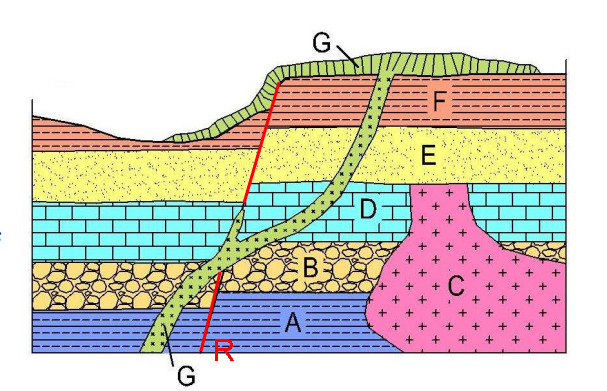
What is the order of these rock layers from Youngest to Oldest?
G, R, F, E, C, D, B, A
500
Urbanization increases surfaces like concrete and asphalt. How does this change water flow and impact the environment?
It increases runoff, reduces groundwater absorption, and can lead to flooding and water pollution