Crunch the Numbers
Lung Logic
Read the Waves
Dial it in
Pressure's On
Houston, We Have a Problem
Critical Condition
100
A patient has the following values:
Hb = 12 g/dL
SaO₂ = 95%
PaO₂ = 80 mm Hg
What is the patient’s arterial oxygen content (CaO₂)?
15.5 mL O₂/dL
(1.34 × 12 × 0.95) + (0.003 × 80)
100
A patient with severe pneumonia remains profoundly hypoxemic despite receiving 100% oxygen. Imaging shows complete consolidation of the left lower lobe. What V/Q abnormality best explains the refractory hypoxemia?
Shunt
100
What points make up the inspiratory time?
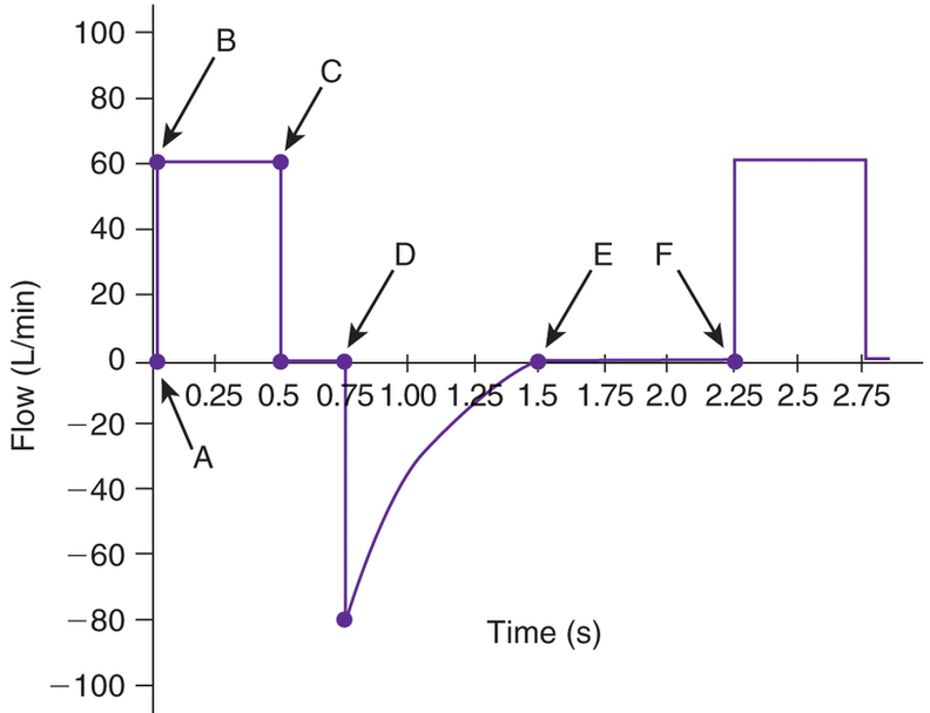
A-D
100
A 70-kg IBW patient is intubated following an opioid overdose. Before intubation: RR: 4/min, SpO₂: 86% on 4 L/min NC, Breath sounds: clear bilaterally
ABG: pH 7.18 /PaCO2 72 /PaO2 58 /HCO3 26
The patient has no known pulmonary disease.
What initial vent settings would you recommend?
A. VC 420, RR-16, +8, 100%
B. VC 420, RR-24, +8, 100%
C. VC 560, RR-16, +8, 100%
D. VC 420, RR-12, +8, 100%
A. VC 420, RR-16, +8, 100%
100
A mechanically ventilated patient has the following measurements:
- PIP: 34 cm H₂O
- Plateau pressure: 27 cm H₂O
- Set PEEP: +10 cm H₂O
- Total PEEP: +12 cm H₂O
- Mean airway pressure: 17 cm H₂O
- FiO₂: 0.50
- SpO₂: 94%
What is the patient’s driving pressure?
15 cm H₂O
Driving pressure = Pplat − total PEEP
= 27 − 12
100
A patient underwent tracheostomy placement 4 days ago. During repositioning, the tracheostomy tube becomes dislodged and the patient becomes acutely hypoxemic. How would you respond?
Do not blindly reinsert the tracheostomy tube due to the immature stoma. Provide oxygen/ventilation via the upper airway while occluding the stoma and call for assistance to reestablish the airway.
100
A patient is admitted following a witnessed aspiration event and is placed on HFNC at 60 L/min and FiO₂ 0.80. Two hours later, the patient has the following findings:RR: 34/min with marked accessory muscle use, HR: 118/min, SpO₂: 85%, Breath sounds: coarse crackles bilaterally pH: 7.29/ PaCO₂: 58 mm Hg/ PaO₂: 49 mm Hg What would you recommend to the team?
A. Place on BiPAP
B. Continue HFNC, just increase FiO2
C. Intubate and mechanically ventilate
D. Place on CPAP
A. Place on BiPAP
B. Continue HFNC, just increase FiO2
C. Intubate and mechanically ventilate
D. Place on CPAP
C. Intubate and mechanically ventilate
200
A patient is breathing room air at sea level.
PaCO₂ = 32 mm Hg
PaO₂ = 72 mm Hg
What is the patient’s A-a gradient?
(Assume PB =760 mm Hg and PH2O =47 mm Hg)
37 mm Hg
PAO₂ = [0.21 × (760 − 47)] − (32/0.8)
PAO₂ ≈ 110 mm Hg
A-a gradient = 110 − 72 = 38 mm Hg
200
Ventilation that reaches alveoli that are not receiving pulmonary blood flow is described as what?
Dead space
200
What mode is this?
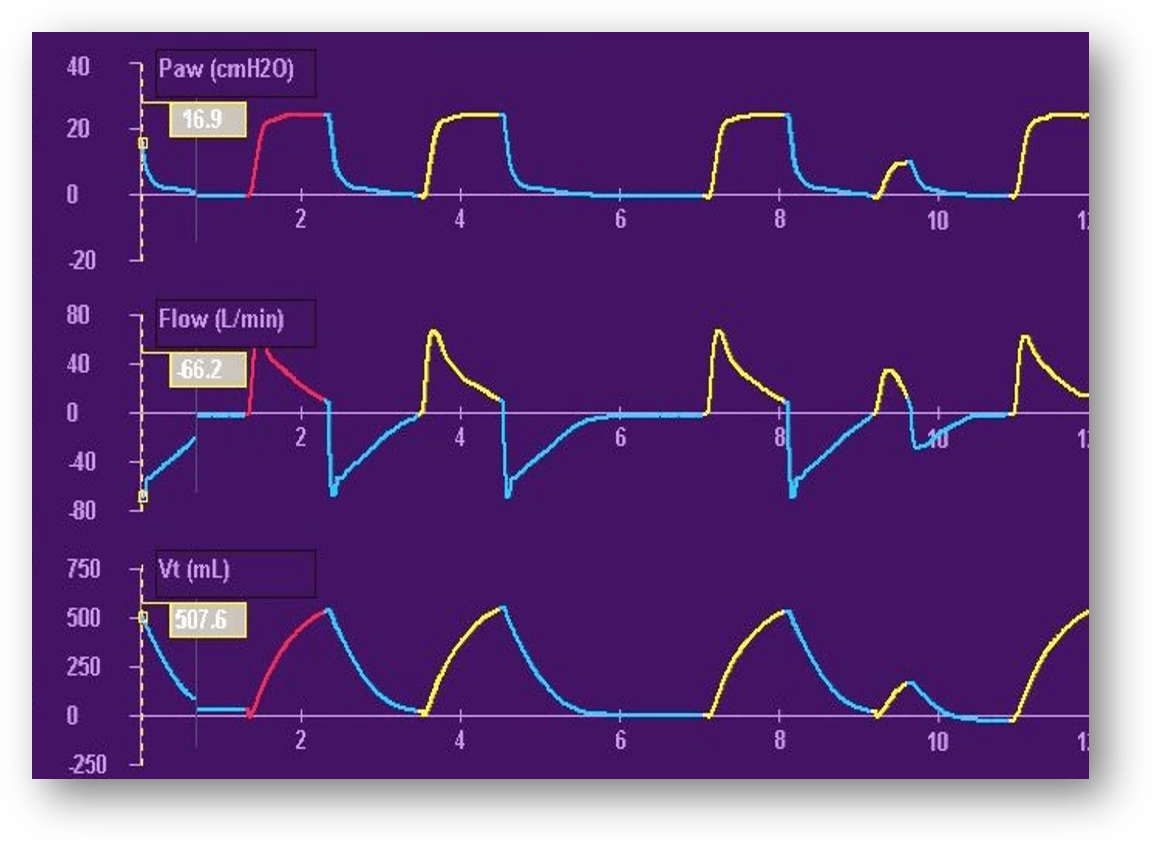
PC-SIMV
200
A 60-kg IBW patient with septic shock and severe lactic acidosis requires intubation due to worsening respiratory distress.
Before intubation:
RR: 30/min, HR: 102, BP: 108/56
ABG: pH 7.21 /PaCO2 24 /PaO2 68 /HCO3 10
What initial ventilator settings would you recommend?
VC 360, RR 30, +5-8, 100%
200
A patient with ARDS undergoes a PEEP titration, and optimal PEEP is identified at +14 cm H₂O. After the titration, the following values are obtained:
VT: 450 mL
RR: 20/min
Total PEEP: +14 cm H₂O
FiO₂: 0.50
Plateau pressure: 30 cm H₂O
SpO₂: 95%
Minute ventilation: 7.5 L/min
What ventilator adjustment would you recommend?
Decrease tidal volume and increase RR
200
A patient receiving VC/AC develops a high-pressure alarm. PIP has increased from 28 to 42 cm H₂O, while plateau pressure remains unchanged at 24 cm H₂O.
Name 3 possible causes of the high-pressure alarm.
- Airway secretions
- Bronchospasm
- Kinked ETT
- Patient biting the ETT
- Water/obstruction in the ventilator circuit
200
A 67-year-old patient is admitted with several days of profuse diarrhea and worsening weakness. The patient is hypotensive but has already received appropriate fluid resuscitation. Laboratory values and ABG are:
pH: 7.16
PaCO₂: 27 mm Hg
PaO₂: 88 mm Hg
HCO₃⁻: 9 mEq/L
Na⁺: 136 mEq/L
Cl⁻: 118 mEq/L
What intervention would be most appropriate and why?
Administer bicarbonate
Anion gap:
AG = Na⁺ − (Cl⁻ + HCO₃⁻)
AG = 136 − (118 + 9)= 9
Normal anion gap metabolic acidosis, consistent with bicarbonate loss from diarrhea.
300
A patient with severe ARDS is receiving volume-controlled mechanical ventilation. The following data are obtained:
VT: 420 mL
FiO₂: 0.70
PEEP: 12 cm H₂O
Plateau pressure: 28 cm H₂O
Mean airway pressure: 16 cm H₂O
PaO₂: 70 mm Hg
PaCO₂: 42 mm Hg
What is the patient’s oxygenation index?
16
OI = (FiO₂ × Mean Airway Pressure × 100) / PaO₂
OI = (0.70 × 16 × 100) / 70
300
Which of the following is the consequence of increased resistance or compliance?
A. It takes less time to fill and empty the alveoli
B. It takes less time to fill and more time to empty the alveoli
C. It takes more time to fill but less time to empty the alveoli
D. It takes more time to fill and empty the alveoli
D. It takes more time to fill and empty the alveoli
300
What type of asynchrony is this and how would you fix it?
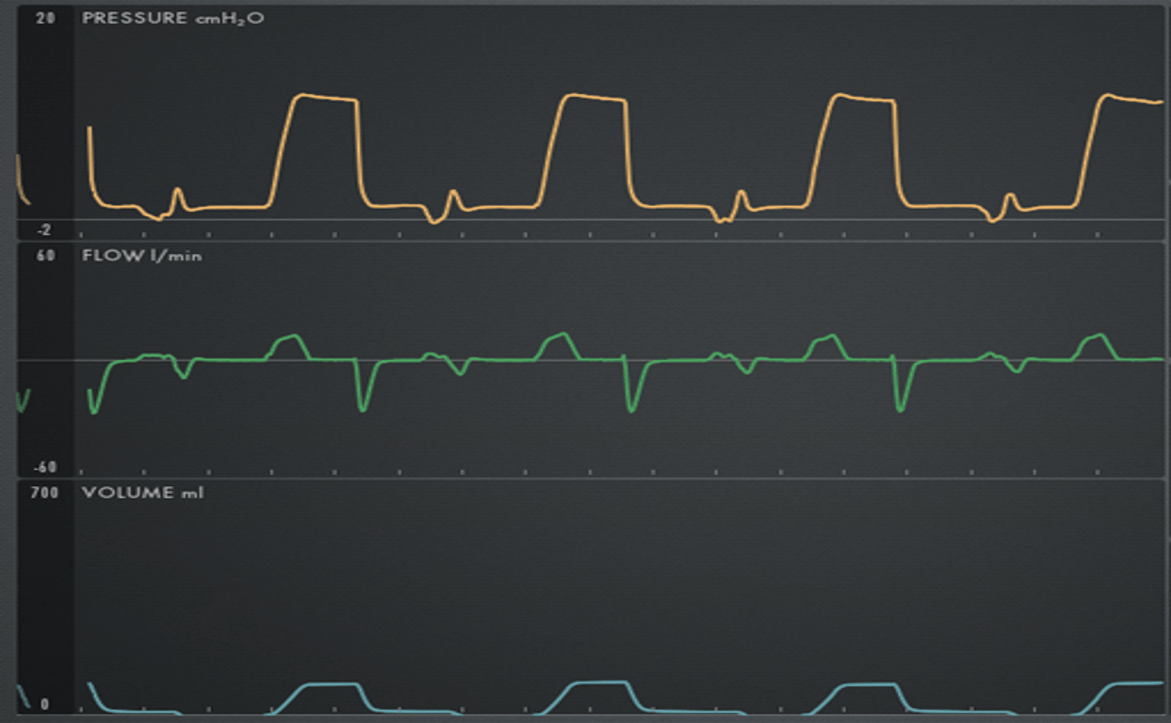
Trigger asynchrony (failed/missed trigger)
Adjust sensitivity
300
A 75-kg IBW patient is intubated for acute hypoxemic respiratory failure secondary to pneumonia.
Before intubation:
RR: 28/min, HR: 98, BP: 134/67
SpO₂: 84% on NRB
ABG: pH 7.48 /PaCO2 31 /PaO2 52 /HCO3 23
What initial vent settings do you recommend?
VC 450, R-16, PEEP +8, 100%
OR
VC 600 R-12, PEEP +8, 100%
300
Referring to the patient data below, the optimal PEEP level for this patient is:
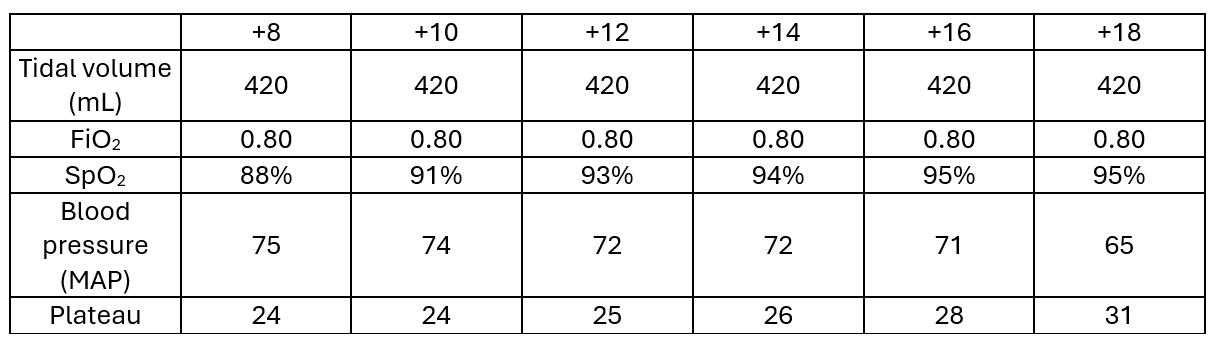
+16
300
Name 3 signs that may indicate an endotracheal tube cuff leak.
- Unable to maintain cuff pressure
- Audible air leak
- Decreased exhaled tidal volume
- Low-pressure or low minute volume alarms
300
A patient is receiving APRV with the following settings:
PHigh: 28 cm H₂O
PLow: 0 cm H₂O
THigh: 4.0 sec
TLow: 0.5 sec
FiO₂: 0.40
ABG: pH: 7.48/ PaCO₂: 30 mm Hg/ PaO₂: 72 mm Hg
Name 2 APRV adjustments that could be made to correct the acid-base abnormality.
Decrease PHigh
Lengthen THigh
400
A mechanically ventilated patient has:
VT = 550 mL
RR = 12/min
VD/VT = 0.40
What is the patient’s alveolar ventilation?
3.96 L/min
Dead space = 550 × 0.40 = 220 mL
Alveolar volume per breath: 550 − 220 = 330 mL
Alveolar ventilation: 330 × 12 = 3,960 mL/min
400
A patient with extensive left-sided pneumonia is persistently hypoxemic. Which side should the patient lie on to maximize oxygenation?
Right side down
400
What mode is the patient in based on the flow volume loop and what are the trigger, limit, and cycle?
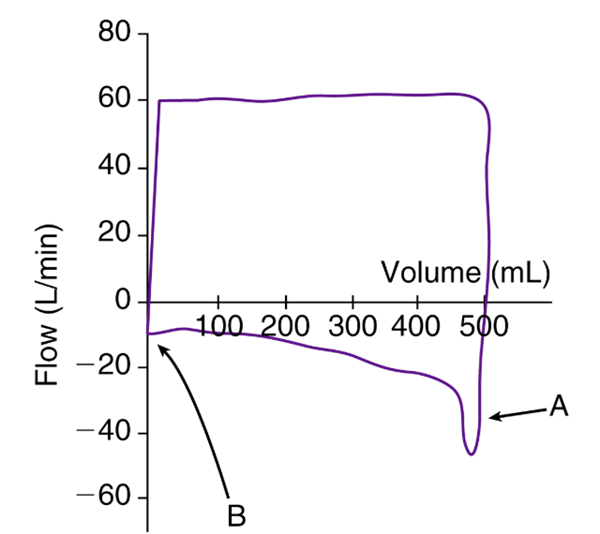
Volume control
trigger: patient/time
limit: flow/volume
cycle: volume/time
400
A 72-kg IBW patient following open-heart surgery is receiving VC/AC:
VT: 430 mL
Set RR: 16/min
Total RR: 24/min
PEEP: +5 cm H₂O
FiO₂: 0.40
PIP: 25 cm H₂O
Pplat: 21 cm H₂O
SpO₂: 97%
ABG: pH 7.27 / PaCO₂ 54 / PaO₂ 92 / HCO₃ 25
What ventilator change would you recommend?
Increase to 7ml/kg IBW: 505mL
400
Referring to the patient data below, the optimal PEEP level for this patient is:
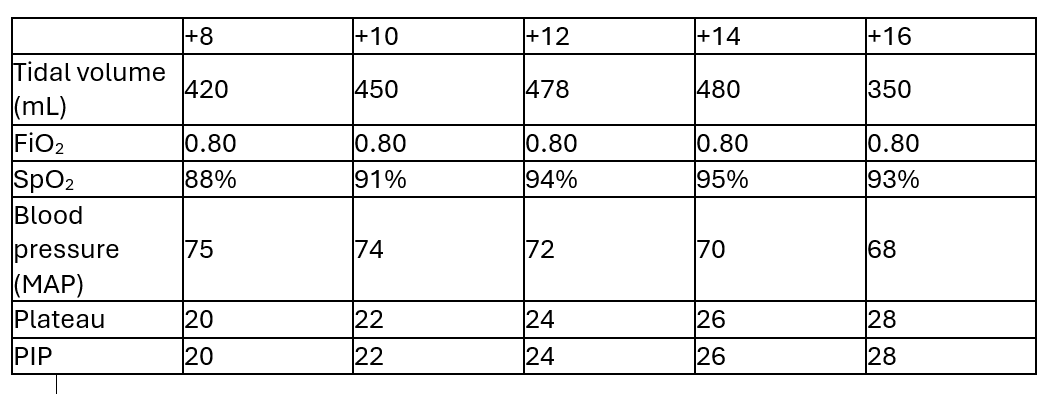
+14
400
A patient receiving PC/AC develops copious airway secretions. Name 2 ventilator alarms you would expect to sound.
Low tidal volume alarm
Low minute ventilation alarm
400
A 66-year-old patient with severe ARDS and a predicted body weight of 68 kg is receiving volume-controlled ventilation with the following settings:VT: 410 mL, RR: 22/min, PEEP: +16 cm H₂O, FiO₂: 0.60 Ventilator measurements:PIP: 32 cm H₂O Plateau pressure: 28 cm H₂O Total PEEP: +16 cm H₂O End-expiratory esophageal pressure: 9 cm H₂O SpO₂: 96% Which ventilator adjustment would you recommend based on the esophageal pressure measurements?
Decrease PEEP
End-expiratory transpulmonary pressure:
= 16 − 9 = +7 cm H₂O
Goal: 0 to +2
500
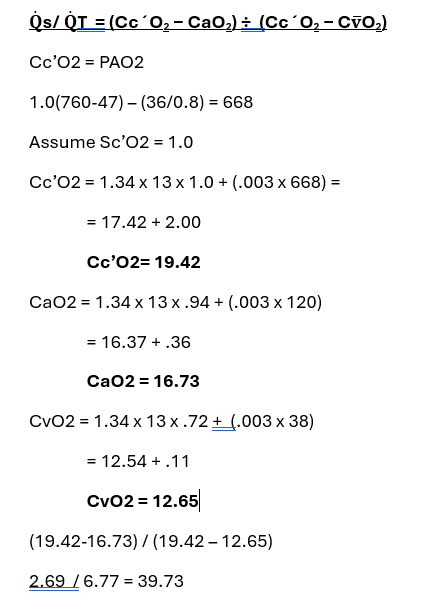
A patient is receiving 100% oxygen. The following values are obtained: Hb = 13 g/dL SaO₂ = 0.94 PaO₂ = 120 mm Hg SvO₂ = 0.72 PvO₂ = 38 mm Hg PaCO₂ = 36 mm Hg
What is the patient’s calculated shunt fraction?
(Hint: Assume PB = 760 mm Hg, PH2O =47 mm Hg, and Sc'O2 =1.0)
40%
500
Name 3 conditions that cause decreased lung compliance and 2 conditions that cause decreased thoracic compliance.
Decreased lung compliance: ARDS, pulmonary edema, pneumonia, pulmonary fibrosis, atelectasis
Decreased thoracic compliance: obesity, ascites, kyphoscoliosis
500
A patient is receiving VC/AC with:
VT: 400 mL, RR: 26/min, Flow: 52 L/min, decelerating waveform, PEEP: +5 cm H₂O, FiO₂: 0.40
Based on the flow-volume loop shown, identify the problem and name 3 ventilator adjustments that could help correct it.
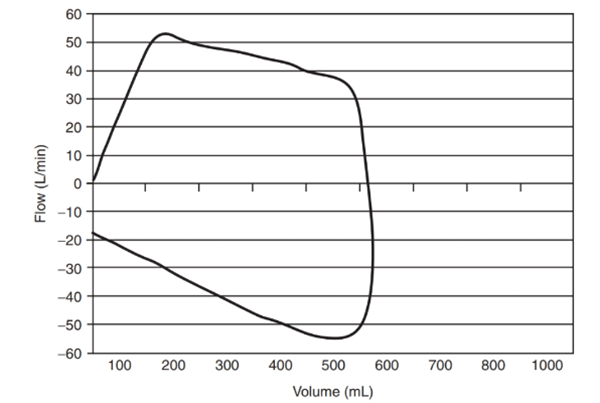
Air trapping
- Decrease respiratory rate
- Increase inspiratory flow
- Change the inspiratory flow waveform from decelerating to square
500
A 70-kg PBW patient with ARDS is receiving VC/AC ventilation with the following settings:
VT: 420 mL
RR: 24/min
PEEP: +10 cm H₂O
FiO₂: 0.60
Observed values:
PIP: 36 cm H₂O
Plateau pressure: 33 cm H₂O
SpO₂: 93%
ABG: pH 7.37 / PaCO₂ 40 / PaO₂ 68 / HCO₃⁻ 24
According to the ARDSNet protocol, what ventilator change is most appropriate?
VT: 420 mL
RR: 24/min
PEEP: +10 cm H₂O
FiO₂: 0.60
Observed values:
PIP: 36 cm H₂O
Plateau pressure: 33 cm H₂O
SpO₂: 93%
ABG: pH 7.37 / PaCO₂ 40 / PaO₂ 68 / HCO₃⁻ 24
According to the ARDSNet protocol, what ventilator change is most appropriate?
Decrease tidal volume to 350 mL (5 ml/kg)
500
Describe what happened to compliance at each PEEP change:
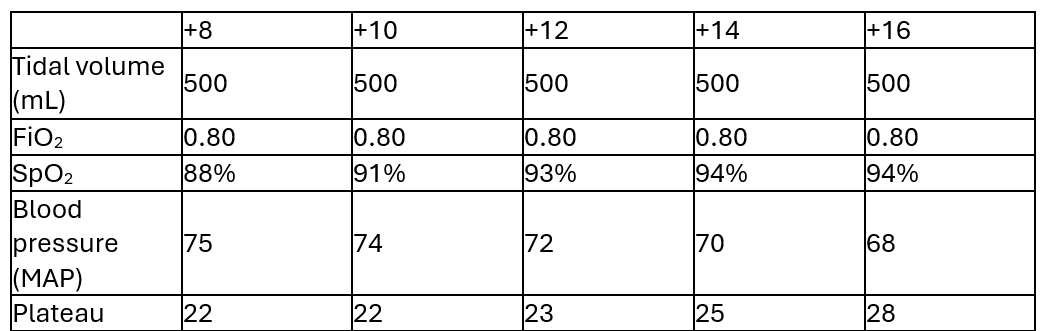
8 --> 10 increased
10 --> 12 increased
12 --> 14 stayed the same
14 --> decreased
500
List 3 causes of ETCO₂ suddenly falling to zero
Cardiac arrest, apnea, ventilator/circuit disconnect.
500
A 64-year-old male with an IBW of 68 kg has severe ARDS with persistent hypoxemia despite prone positioning, inhaled nitric oxide, and neuromuscular blockade. The patient is cannulated for VV ECMO and is returning to the ICU.
What ventilator settings would you place the patient on?
PC-A/C, total pressure: 25 cm H2O, PEEP: 10 cm H2O, RR: 10, FiO2: 0.40