Ear
Cranial Nerves
Cranial Nerves
Cranial Nerve
Misc.
100
What is the arrow pointing to?
The Tympanic Membrane
100
What are the first three cranial nerves on this image?
1. Olfactory 1
2. Optic 2
3. Oculomotor 3
100
Which cranial nerve is the Trigeminal Nerve?
Cranial nerve 5
100
Which Cranial nerve is considered the facial nerve?
Cranial Nerve 7
100
Which Cranial Nerve is involved in Taste?
Cranial Nerve 7
200
What does the outer, middle, and inner ear do?
the outer ear collects and shapes sounds.
the middle ear provides a match between the low impedance of air and the high impedance of endolymph.
the inner ear converts sound ( which is now fluid) to electrical code
200
How is sense of smell detected?
The sense of smell is detected by olfactory receptors located within
the nasal epithelium. They penetrate the small foramina in the
cribriform plate of the ethmoid bone and enter the cranial cavity.Once in the cranial cavity, these neurons enter the olfactory
bulb, which lies in the olfactory groove within the anterior cranial
fossa, and synapse with second order neurons that proceed to the
limbic areas of the brain
200
What are the 3 branches of the 5th Cranial Nerve
- Ophthalmic Branch
- Maxillary Branch
- Mandibular Branch
200
For Cranial Nerve 7 what is central lesion?
up in the brain lesion
paralysis of contralateral Lowe face but the contralateral of the forehead is okay
200
Which cranial nerve is consider Spinal Accessory?
Cranial Nerve 11
300
Name the parts of the middle ear?
the hammer(malleus), Anvil(Incus) and stirrup (stapes)
300
What are the names of CN 3,4,6?
3- Oculomotor
4- Trochlear
6- Abducens
300
What is characteristics of the Ophthalmic Branch?
- small, superior nerve of the Trigeminal and its entirely sensory
-transmit sensory information from the skin of the upper face
300
For Cranial Nerve 7 what is the peripheral lesion?
Complete paralysis of ipsilateral
hemiface
• Depending on site of lesion,
additional deficits, e.g.,
decreased lacrimation and
salivation or loss of taste in
anterior two-thirds of tongu
300
which cranial nerve supplies motor innervation to the intrinsic muscles of the tongue?
Hypoglossal cranial nerve 12
400
Purpose of the semicircular canals?
they are three tiny, fluid filled tubes in the inner ear that help you keep your balance. so when your head moves around the liquid since moves around.
400
What does CN 3, 4, and 6 do?
The activation of muscles served by these motor nerves of the eye result in movement.
400
Characteristics of the Maxillary Branch?
-only sensory
- It transmits information from the lower eyelid, skin on the sides of the nose, upper jaw, teeth, lip, mucosal lining of buccal and nasal cavities, maxillary
sinuses, and nasopharynx.
400
What does this phrase mean" the zebra bite my delicious sour cake"?
Temporal: (wrinkle forehead, close eyelids, wiggle ear)
• Zygomatic: close eye, raise corners of mouth
• Buccal: buccinator
• Marginal mandibular: mentalis; etc. Innervates mm of lower lip
and chin.
• Digastric: posterior belly of digastric
• Stylohyoid: stylohyoid
• Cervical: platysma, depressor anguli oris
400
Sensory and Motor functions of the Vagus Nerve?
Motor:
• Superior laryngeal nerve external branch (SLNeb) supplies cricothyroid only (!)
• Recurrent laryngeal nerve (RLN a.k.a. inferior -> recurrent) supplies all other intrinsic
laryngeal muscles
Sensory:
SLNib is sensory from inside laryngeal vestibule to level of vocal folds
Inferior laryngeal nerve is sensory inside larynx below level of vocal fol
500
What is even letter pointing to?
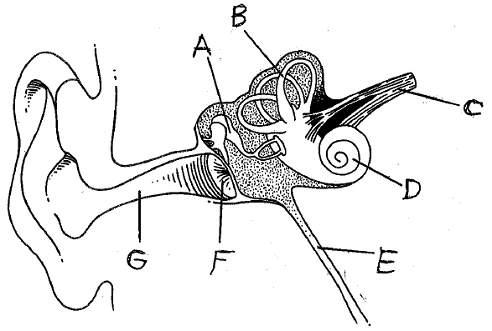
A. Incus
B. Semicircular Canal
C. Vestibular nerve
D. Cochlea
E. Eustachian tube
F. Tympanic Membrane
G. External auditory meatus
500
Put the Visual Pathway in order?
A. Light photon
B.Optic Nerve
C.Optic Tract
D.retinal cells at back of eyeball
E. Optic Radiations
F. Occipital lobe of brain
G. Optic chasm where nasal retinal information cross
H. LGN of thalamus
1.A
2. D
3. B
4. G
5. C
6. H
7. E
8. F
500
Characteristics of the Mandibular branch Sensory and Motor part?
SENSORY PART
-The mandibular nerve is both general somatic afferent and special visceral efferent.
-The afferent component conducts GSA from the mandible, including the skin, lower teeth, gums, and lip;a portion of the skin and mucosal lining of the cheek; the external auditory meatus and auricle; the temporomandibular joint; and the region of the temporal bone, as well as kinesthetic and proprioceptive
sense of muscles of mastication. The lingual nerveconducts somatic sensation from the anterior two thirds of the mucous membrane of the tongue and floor of the mouth.
MOTOR PART
The special visceral efferent component arises from the trigeminal motor nucleus of the pons, innervates the muscles of mastication (masseter, medial and lateral pterygoids, temporalis), the tensor tympani, the mylohyoid, the anterior digastricus, and the tensor veli palatini muscles.
500
What are the main functions of Cranial Nerve 7?
. Efferent (motor) fibers from the facial motor nucleus in the pons
innervate:
• Muscles of facial expression
• Stylohyoid muscle
• Posterior belly of the digastric muscle
• Stapedius muscle
2. Efferent – “parasympathetic motor” innervate the:
• Lacrimnal (tear) and many salivary glands (except parotid, which is innervated by CN IX - 9)
3. Special Afferent - Taste from anterior 2/3 tongue (i.e., “oral” tongu
500
Overview of the 9th Cranial Nerve?
GVE Motor to stylopharyngeus
and pharyngeal constrictors
• GVA Touch, pain & temperature
from the pharyngeal tongue
(posterior 1/3)
• SVA Taste from pharyngeal
tongue (posterior 1/3)
• GVE Parasympathetic salivation
to parotid glan