Round 1
Round 2
Round 3
Round 4
Round 5
100
The lipid layer that forms the foundation of cell membranes is primarily composed of molecules called ____________.
Phospholipids
100
Osmosis occurs as water crosses the lipid bilayer through specialized channels for water movement called _____________.
Aquaporins
100
How are the tails and heads of membrane phospholipids oriented in their environment?
Polar heads towards the extracellular and intercellular space and non-polar tails in the center of the membrane.
100
Diffusion of substances down their concentration gradient that require the aid of carrier proteins in the membrane is called _________________.
Facilitated Diffusion
100
If ATP production is blocked, then what type of transport is most affected?
Active Transport
200
While water continually orients phospholipids into a lipid bilayer, it does not fix the lipids permanently into position. Thus, the bilayer is considered to be ________
Fluid
200
The plasma membrane is a thin sheet of lipids embedded with ___________.
Proteins
200
All of the following are proteins involved in the membrane EXCEPT:
Transport Channels / Hormones / Receptors
Enzymes / Identity Markers
Hormones
200
The function of cholesterol in the plasma membrane is to help maintain membrane ___________.
Fluidity
200
A dehydrated person can rehydrate their cells by drinking water. Explain how drinking extra water causes their cells to rehydrate.
Drinking water makes the extracellular area hypotonic and therefore water will rush into their cells via osmosis.
300
What is the movement of substances down their concentration gradients called? (move from high concentration to low concentration)
Diffusion
300
Membrane proteins are not very soluble in water because they possess long stretches of non-polar amino acids that are _______.
Hydrophobic
300
If two solutions have unequal concentrations then what is the solution with the lower concentration called?
_____tonic
Hypotonic
300
What type of pump helps maintain the concentration gradient needed for neurological cells to maintain the appropriate concentration of sodium that they need?
Na+/K+ (Sodium/Potassium) Pump
300
Which of the following molecules would likely cross the cell membrane via simple diffusion (no carrier proteins needed).
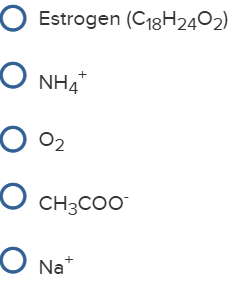
O2 (small non-polar)
400
Osmosis is the diffusion of water across a membrane in response to the concentration of one or more of the _____________.
Solutes
400
If a cell has the same internal concentration of dissolved molecules as its outside environment, the cell's condition is referred to as being ____tonic
Isotonic
400

What cellular feature of bacterial, fungal, and plant cells that allow for high internal pressure generated by osmosis to not cause these cells to burst (unlike animal cells)
Cell Walls
400
A membrane that is semi-permeable that allows water to pass through but not ions is used to separate two solutions. Solution A has a 5% ion concentration and Solution B has a 1% ion concentration.
Water will move towards which solution via Osmosis?
A (water moves towards higher concentration)
400
a) Plants will wilt when placed in a ______tonic solution.
b) Plants will become turgid in a ____tonic solution.
a) Hyper
b) Hypo
500
Which type of protein is embedded in the cell membrane for both active transport and facilitated diffusion?
Carrier
500
Transport of a solute across a membrane where the solute is going up its concentration gradient and using protein carriers driven by the expenditure of chemical energy is called __________ transport.
Active Transport
500
Two types of endocytosis are
a) "Cellular Eating"
b) "Cellular Drinking"
What are the names of these two processes?
a) Phagocytosis
b) Pinocytosis
500
Is the rate of diffusion faster or slower in warmer conditions?
Faster
500
What is the name of the protein that is a catalyst (speeds up chemical reactions without being consumed) .
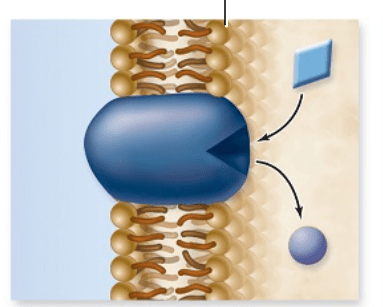
Enzyme