Name that Disease
Infections
Histology
Neuroanatomy
Genetics
100
The family of a previously healthy 65 yo who has suffered repeated falls during the previous months brings him to a neurologist. The neurologist observes a dull man who is slow to speak and very slow moving around. He has facial grimacing. He is oriented and recalls 4/6 digits. Muscle strength and DTRs are normal but tone is increased. The patient despite having postural instability, walks erect with short steps. He cannot look upward or downward. What is his diagnosis? What substance accumulates in the brain in this disease?
PSP
Tau proteins
100
a 16 year old boy loses interest in school, his farm work, and then his friends. When he becomes apathetic, his parents bring him for a full eval. The neurologist detects mild but definite cognitive impairment and subtle myoclonus. An EEG shows periodic sharp wave complexes and the CSF contains a markedly elevated level of antibodies to measles, but no cells and no 14-3-3 protein. Which illness does the evaluation indicate?
A. Variant CJD
B. Subacute sclerosing panencephalitis (SSPE)
C. Schizophrenia
D. Gerstmann Syndrome
SSPE- dementia and myoclonus in children or adults
variant CJD- teens and young adults and the EEG would lack the periodic complexes
Gerstmann- also prion disease like CJD; autosomal dominant; dysarthria, ataxia and dementia
100
3 Diseases with tau containing neurofibrillary tangles
PSP, frontotemporal dementia, and Alzheimer disease
100
Name the disease and the anatomical findings associated.
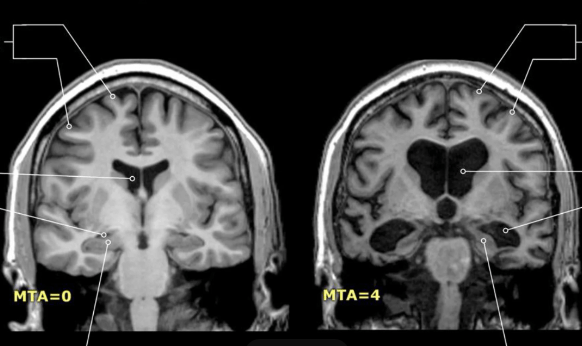
Alzheimer disease
-enlarged third ventricle and atrophy of the hippocampus
100
Genes + associated chromosome with higher risk for Alzheimer disease
chromosome 1- Presenilin 2
Chromosome 14- Presenilin 1 (more common than 2)
chromosome 19- ApoE (most powerful genetic risk, promotes AB deposition)
chromosome 21- APP
*Notes: AB binds to ACh receptors; you have significant loss of neurons in the basal nucleus of Meynert (less ACh)
200
A family of a 45 yo waiter brings him to the ER because he had been confused and behaving strangely during the previous day. They stated he had not experienced any unusual event, stress or trauma. EEG, MRI, and LP were normal. The patient cannot state name, birthday, or date. He cannot recall any personal events for the last 6 months or any current political events. His affect is constricted. What is the most likely diagnosis?
A. transient global amnesia
B. Dissociative amnesia
C. Wernicke-Korsakoff
D. Frontal lobe dysfunction
E. Status Epiepticus
Dissociative amnesia
200
35 yo man with HIV for 17 years and a CD4 count of 190 ells/mL presents with left hemiparesis and bilateral ataxia that have evolved over several weeks. His cognitive function is within normal limits. His MRI shows several large areas of demyelination, without mass effect, in the cerebral hemispheres. Which test would most likely indicate the diagnosis?
A. CSF analysis for JC virus
B. CSF analysis for oligoclonal bands
C. Brain biopsy for toxo
D. Brain biospy for lymphoma
He has PML therefore CSF would contain JC virus on PCR. PML occurs when CD4 less than 200 cells/mL.
oligoclonal bands- MS
toxo and lymphoma would cause increased intracranial pressure
200
which 2 diseases have eosinophilic inclusions that stain for alpha synuclein
parkinson disease, dementia with lewy bodies
200
Name the disease and anatomical finding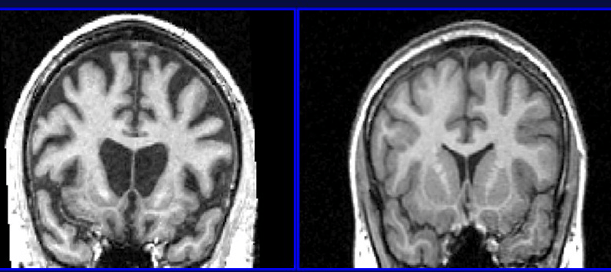
Huntington disease
atropy of the caudate nuclei
200
inheritance pattern for wilson's disease including gene mutation
autosomal recessive, mutation on gene in chromosome 13 that codes for a protein necessary for copper transport. Mutation leads to insufficient serum copper binding and hepatic excretion, therefore there is a surplus of unbound serum copper that deposits in brain, liver, cornea (kayser Fleishcher rings)
300
A malnourished man with hx of chronic alcohol abuse was admitted with seizures and postictal delirium. his physicians treated him with an AED, thiamine, niacin, glucose, and hypertonic saline due to sodium of 119. When the delirium persisted for several days, they consulted neurology who found nystagmus, dysarthria, ataxia, quadriparesis, confusion, and disorientation. which is the most likely diagnosis?
A. Wernicke Korsakoff
B. Pellagra
C. Osmotic demyelination syndrome
D. Subdural hematoma
location of injury here is the Pons suggesting central pontine myelinolysis due to too rapid correction of sodium which leads to myelin breakdown in the pons
note- pellagra associated with dermatitis, dementia, and diarrhea (vitamin B3 def)
WK- limbic structures and vermis (cerebellum)
300
Which is the most frequently occurring nonepidemic form of encephalitis?
A. HIV encephalitis
B. Herpes simplex encephalitis
C. Herpes zoster encephalitis
D. Meningococcal encephalitis
Herpes simplex; the virus invades the temporal lobes and attacks the limbic system which causes seizures, amnesia, and Kluver Bucy Syndrome
HIV and meningococcus occur in epidemic patterns
300
What disease has cowdry bodies as the histological finding?
Subacute sclerosing panencephalitis (SSPE)
300
What disease causes atrophy of the cerebellar vermis?
chronic alcoholism
300
Which feature distinguishes cases of Alzheimer dementia attributable to trisomy 21 from those associated with apolipoprotein E4 allele on chromosome 19?
A. Onset in 4th and 5th decade
B. low concentrations of cerebral choline acetyltransferase
C. reduced amyloid precursor protein (APP)
D. low concentrations of cerebral acetylcholine
E. Abundant plaques and tangles
alzheimer dementia in the setting of Trisomy 21 appears in 4th or 5th decade.
gene on chrom 21 codes for APP, so there would be excess APP and thus excess B amyloid
B, D, and E are the same regardless of cause
400
17 yo with initial symptoms include mood, personality, or conduct changes eventually progressing to thought disorder and cognitive impairment. Neurological signs include dysarthria, dysphagia, gait impairment, and wing beating tremor. end stage disease includes cirrhosis.
Wilsons disease
400
Which region of the brain is most affected by toxic metabolic encephalopathy?
A. Frontal lobes
B. Reticular activating system
C. Hippocampus
D. Limbic system
RAS dysfunction leads to depressed level of consciousness and inattention
400
What histologic feature is the severity of Alzheimer disease dementia most closely associated?
A. Accumulation of tau
B. increased concentration of plaques
C. Increased concentration of tangles
D. Degree of synapse loss
loss of synapses. on a macroscopic level, atrophy of the hippocampus is most closely associated
400
Which of the following structures is not subject to age related neuron loss?
A. Locus coeruleus
B. Suprachiasmatic nucleus
C. Substantia nigra
D. Nucleus basalis of Meynert
E. Mammillary bodies
mammillary bodies resist change with aging
disturbance of affect- LC
sleep- LC and suprachiasmatic
locomotion- SN
400
autosomal dominant, excessive trinucleotide repeat mutation on chromosome 4
Huntington disease; the huntingtin gene on chromosome 4
important terms for all trinucleotide repeat mutations are ampliification (increases in length in successive generations) and anticipation (seen earlier in successful generations)
500
70 yo man, retired high school physics teacher, came to a psychiatrist for 3-6 months of increasingly vivid nocturnal hallucinations and memory problems throughout the day. During the initial evaluation, he was alert and oriented. His MMSE was 25/30. He had reduced spontaneous mov'ts and increased tone in the wrist and elbows. His gait was shuffling with a positive pull test. CT and labs were normal. In a follow up appt, he was lethargic and scored a 20/30 on the MMSE. What is the dx?
Dementia with lewy bodies- parkinsonism, visual hallucinations, fluctuating cognition +/- REM sleep disorder and antipsychotic hypersensitivity
Biggest differentiator from Parkinsons is that early on, parkinson does not cause cognitive impairment or visual hallucinations but these are early findings in dementia with lewy bodies
500
What do all of the following have in common: tolune abuse, MS, progressive Multifocal leukoencephalopathy, metachromatic leukodystrophy, and adrenoleukodystrophy?
A. all are commonly associated with seizures
B. all are infectious illnesses
C. all affect cerebral white matter
D. all cause dementia early in their course
all affect white matter
- bc these illnesses spare cerebral cortex gray matter, they usually cause dementia only in the late stages
500
Which CSF pattern is a marker for Alzheimer Disease?
A. low AB and low tau protein
B. high AB and high tau protein
C. low AB and high tau protein
D. High AB and low tau protein
low AB and high tau in CSF
500
Petechial hemorrhages in the mammillary bodies and periaqueductal gray matter
Wernicke Korsaff