Dementia
SCREENING
Delirium
MISC
Delirium vs. Dementia
100
“Dementia” refers to several disorders that cause significant decline in one or more areas of cognitive functioning severe enough to result in _______ decline
Functional decline
100
A 79-year-old patient recalls only one of three words and draws an abnormal clock on the Mini-Cog.
What is the most appropriate interpretation?
A. Normal cognitive function
B. Confirmed Alzheimer's dementia
C. Positive screen for cognitive impairment
D. Diagnostic of delirium
C. Positive screen for cognitive impairment
A Mini-Cog score of 0–2 is a positive screen warranting further evaluation. It does not establish a dementia diagnosis.
100
The best treatment for delirium is
A. Prevention
B. Haloperidol
C. A sitter
D. Lorazepam
E. Restraints
A. Prevention
Multifactorial HELP intervention: cognitive impairment, sleep deprivation, immobility, sensory impairment, dehydration.
- 1999 study: reduced delirium incidence by 40% (SOE = A)
- 2015 meta-analysis: similar findings (SOE = A)
100
"I see dead people." In older adults, recurrent, detailed visual hallucinations accompanied by fluctuating cognition and parkinsonism are characteristic of which dementia subtype? 
A. Alzheimer's disease
B. Lewy body dementia
C. Frontotemporal dementia
D. Vascular dementia
B. Dementia with Lewy bodies
- associated with recurrent, well-formed visual hallucinations, fluctuating cognition, parkinsonism, and REM sleep behavior disorder.
100
An 83-year-old woman with hypertension and osteoarthritis is hospitalized for a urinary tract infection. Her daughter reports that she was cognitively intact before admission but became confused overnight. During the examination, the patient repeatedly loses track of the conversation and cannot recite the months of the year backward. She answers questions appropriately at times but becomes disoriented later in the day. Her level of consciousness is normal.
Delirium
The patient demonstrates acute onset, fluctuation, and inattention. Under the CAM algorithm, features 1 (acute change or fluctuation) and 2 (inattention) are necessary, along with either feature 3 (disorganized thinking) or feature 4 (altered level of consciousness).
A normal level of consciousness does not exclude delirium.
200
What are the two greatest risk factors for Alzheimer Disease?
Age and Family History
Studies that account for death from other causes suggest that by 90 years of age, nearly half of people who have first-degree relatives with AD develop the disease themselves
200
A 73-year-old patient has progressive difficulty planning meals and organizing medications, but scores 30/30 on the MMSE. Which statement best explains this finding?
A. Dementia is excluded.
B. MMSE is highly sensitive to all executive dysfunction.
C. MMSE may miss subtle executive dysfunction and early MCI.
D. Cognitive testing is unnecessary.
C. MMSE may miss subtle executive dysfunction and early MCI.
A normal MMSE does not exclude cognitive impairment, particularly when executive dysfunction predominates.
200
Name a non-pharmacological management strategy for Delirium.
- Provide “social” restraints (family or sitter, placing near nursing station).
- Use orienting stimuli (clocks, calendar, radio)
- Use eyeglasses and hearing aids appropriately
- Mobilize patient early and often
- Avoid physical or pharmacologic restraints (ex. IVs, foleys, telemetry)
- Ensure adequate intake of nutrition and fluids, by hand feeding if necessary
200
In Pixar's Coco, Miguel's great-grandmother, Mamá Coco, has significant memory impairment. Which song helps evoke memories of her father?

A. Let It Go
B. Remember Me
C. You've Got a Friend in Me
D. A Whole New World
B. Remember Me
Familiar music can evoke autobiographical memories and support emotional connection in some patients with dementia, even when other cognitive abilities have declined.
200
An 85-year-old man with chronic kidney disease and a history of dementia undergoes hip fracture repair. On postoperative day two, nursing staff report that he alternates between agitation and excessive sleepiness. His family states that he was able to hold conversations before surgery.
During a CAM assessment, he is unable to maintain attention while counting backward from 20. When asked, "Can you use a hammer to pound a nail?" he responds, "No, because the television is watching me." His mental status fluctuates throughout the day.
Delirium
Acute postoperative cognitive deterioration, fluctuation, inattention, and disorganized thinking strongly indicate delirium. The patient also has multiple risk factors: advanced age, preexisting dementia, recent surgery, and chronic kidney disease. New confusion after surgery should not be attributed automatically to baseline dementia or normal postoperative recovery.
300
Name two Non-pharmacological management strategies for the treatment of dementia.
Mental stimulation (cross word puzzle/word games)
Occupational therapy
Structured physical exercise programs
Leisure activity (patient’s hobbies)
Aromatherapy
Massage/music therapy
Light therapy
300
An 82-year-old patient with severe visual impairment is unable to complete clock drawing or visuospatial tasks on a standard MoCA.
What is the best approach?
A. Automatically score all visual tasks as zero.
B. Diagnose severe dementia.
C. Use an appropriately validated vision-adapted cognitive assessment.
D. Avoid cognitive assessment entirely.
C. Use an appropriately validated vision-adapted cognitive assessment.
Visual, hearing, language, and literacy barriers can affect screening accuracy. The MoCA-Blind is one option for patients unable to complete visual items, with its own scoring interpretation.
300
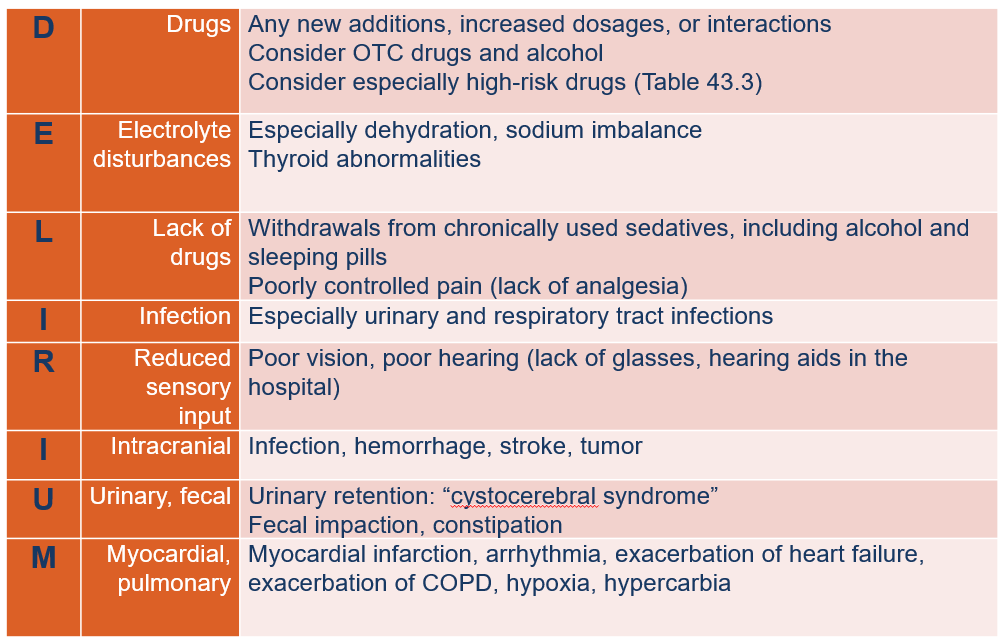
Name 2 reversible causes of Delirium.
300
Jack Skellington is surrounded by clocks and spooky surprises. Speaking of clocks, approximately how long does the Mini-Cog (which includes a clock-drawing task) take to administer?

A. 3 minutes
B. 1 minute
C. 10 minutes
D. 30 minutes
A. 3 minutes
The Mini-Cog typically takes about 3 minutes and combines three-word recall with clock drawing. A positive screen requires further evaluation.
300
An 87-year-old woman with hypertension and chronic kidney disease is hospitalized for dehydration and acute kidney injury. On hospital day two, nursing staff report that she has become unusually quiet and spends most of the day sleeping. Her family confirms that she was previously alert and conversational.
During a CAM assessment, she is unable to recite the months backward, frequently loses track of questions, and requires repeated stimulation to remain awake. Her mental status fluctuates throughout the day.
Hypoactive Delirium
The acute onset of reduced alertness, fluctuating mental status, and inattention meets the core CAM features for delirium. Dehydration and acute kidney injury are plausible precipitants.
Hypoactive delirium is frequently missed because patients appear quiet, sleepy, or withdrawn rather than agitated.
400
A trial of ______ should be offered for all patients with mild dementia with periodic assessment.
A. Memantine
B. Lecanemab
C. Selegiline
D. Donepezil
D. Donepezil (SOE=A)
Cholinesterase Inhibitors: Donepezil (Aricept), Galantamine (Razadyne), Rivastigmine (Exelon)
Clinical trials demonstrate modest delay in cognitive decline, delay in onset of behavioral problems, and delay in ADL decline compared with placebo in AD
400
A 68-year-old accountant reports difficulty multitasking and managing complex finances. He remains independent in daily activities. His MMSE score is 29/30.
Which screening tool would be more sensitive for mild cognitive impairment (MCI)?
A. Mini-Cog
B. MoCA
C. MMSE
D. PHQ-9
B. MoCA
The MoCA assesses executive function, attention, visuospatial skills, and memory and is generally more sensitive than the MMSE for detecting MCI.
400
Delirium screening tool adapted specifically for ED patients; validated in ED and geriatric ward.
b-CAM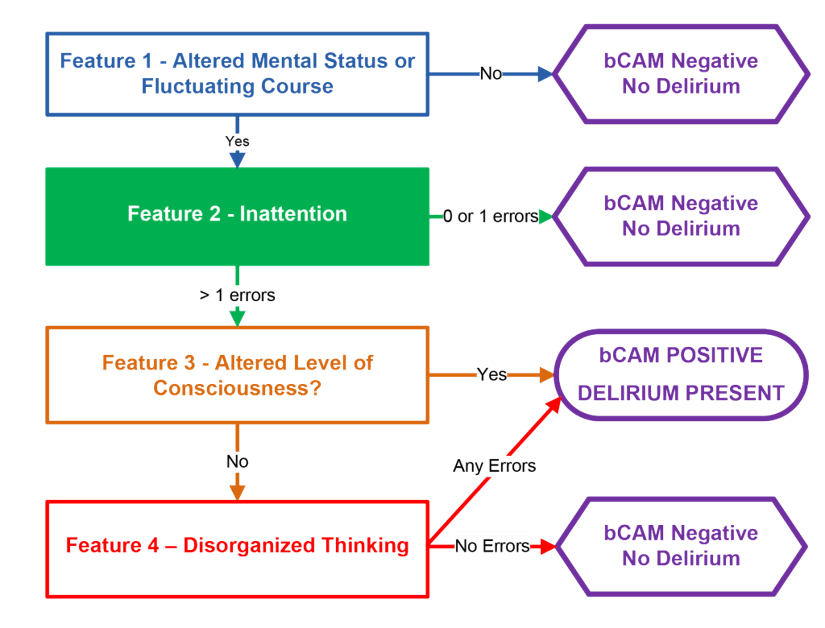
400
In Ghostbusters, the team uses proton packs to capture ghosts. Which neurotransmitter deficiency is most closely associated with delirium?

A. Glutamate
B. Dopamine
C. Serotonin
D. Acetylcholine
A. Acetylcholine
Cholinergic deficiency is one proposed mechanism of delirium, although delirium is multifactorial. Anticholinergic medications can precipitate delirium, especially in older adults.
400
A 79-year-old retired accountant is evaluated for worsening memory over the past three years. His wife reports gradually increasing difficulty managing finances and remembering appointments, without any sudden deterioration or significant fluctuations.
During a 3D-CAM assessment, he correctly recites the days of the week backward, remains attentive throughout the interview, and appropriately answers questions about his surroundings. He is alert and demonstrates organized thinking but cannot recall three words after several minutes.
Dementia
Progressive cognitive and functional decline over several years, preserved attention, normal arousal, and absence of an acute fluctuating change favor dementia. Impaired memory alone does not establish delirium; acute change and inattention are more discriminating features.
500
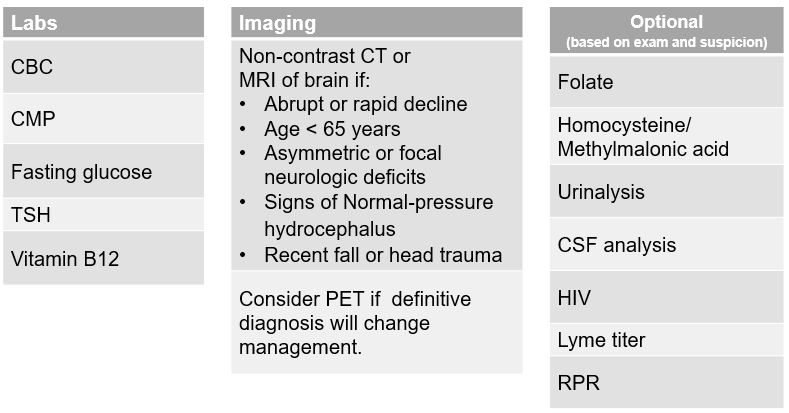
Based on American Academy of Neurology recommendations, what lab tests can you routinely order in your evaluation for suspected Dementia?
Name 3.
500
What domain does this portion of the Montreal Cognitive Assessment (MOCA) primarily assess?
Alternating Trail Making: "Draw a line connecting numbers and letters in an alternating, ascending sequence (ex. 1 – A – 2 – B –3 ...)"
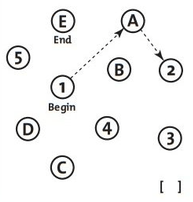
Visuospatial
500
Although there is no single universally accepted mechanism for the neuropathophysiology of Delirium, what are two suggested theories explaining its pathophysiology.
Cholinergic deficiency
Inflammation
Oxidative stress hypothesis, Neuronal aging / reduced cognitive reserve, Cerebral metabolic insufficiency, Circadian rhythm / sleep-wake dysregulation
500
In Harry Potter, Dumbledore uses a Pensieve to store and revisit memories. Which brain structure is especially important for forming new episodic memories?

A. Cerebellum
B. Hippocampus
C. Medulla
D. Occipital cortex
B. Hippocampus
Hippocampal dysfunction is a hallmark of Alzheimer's disease, contributing to impaired formation of new episodic memories.
500
An 81-year-old man with a three-year history of progressive cognitive decline is brought to clinic by his wife because of increased confusion in the evenings over the past six months. He occasionally becomes restless and asks to go home despite being in his own house. His symptoms have developed gradually, without any abrupt deterioration.
During examination, he is alert and attentive, correctly recites the months backward from December to July, and answers simple questions logically. His wife confirms that his cognitive function has remained near his usual baseline.
Alzheimer dementia with sundowning
The gradual cognitive decline, chronic evening behavioral symptoms, preserved attention, and absence of an acute change support dementia with sundowning rather than delirium.