Etiology
Pathology
Evaluation
Presentation
Misc
100
Which enzyme may be deficient in Alzheimer disease?
Choline acetyltransferase
100
What are Lewy bodies made of?
Alpha-synuclein intracellular eosinophilic inclusions
Cortex in LBD, basal ganglia in PD

100
EEG and CSF findings for Creutzfeld-Jakob disease
EEG: periodic sharp waves
CSF: increased 14-3-3 protein
100
How might frontotemporal dementia (Pick disease) present?
Usually presents before age 65
Frontotemporal lobe atrophy
Frontal: personality changes, impaired judgement, disinhibition
Temporal: aphasia
100
Name two complications of dementia
Difficulty chewing/swallowing
Cerebral amyloid angiopathy
Loss of bladder/bowel control increases risk of infection
Pressure sores and ulcers
Average life expectancy after dx of AD is 8-10 years
200
Explain the pros and cons of genetic testing for Alzheimer disease
Pros: can make lifestyle changes
Cons: 95% of cases of AD are sporadic, increased anxiety, environmental factors, expensive
200
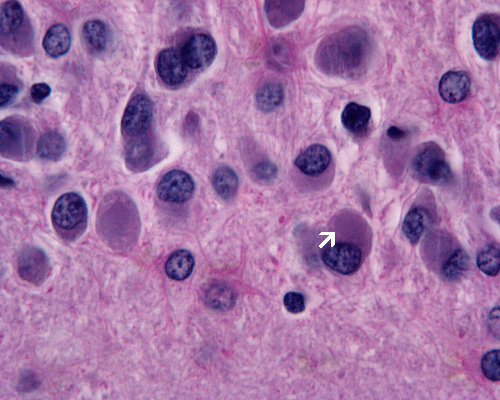
Histological findings in frontotemporal dementia (Pick disease)
Intracytoplasmic spherical inclusions of tau protein (Pick bodies)
-Ubiquitinated TDP-43 may also be present
200
Differentiate Lewy body dementia from Parkinson's dementia
PD: movement symptoms before dementia
LBD: cognitive and motor symptom onset <1 year apart, visual hallucinations, REM sleep behavior disorder
200
Presentation of Creutzfeldt-Jakob disease
Rapidly progressive dementia over weeks-months (death within a year)
Startle myoclonus to trivial stimuli
Ataxia
200
Treatment of delirium & which medication to avoid
Treat underlying cause and supportive measures like IV fluids, decreased noise/lights, minimize mechanical restraints
If individual is combative, haloperidol
Avoid benzodiazepines
300
Name two risk factors for Alzheimer disease
African-Americans
FHx
Obesity
Type II DM
HTN
Hyperlipidemia
Traumatic brain injury
300
Pathophysiology of Creutzfeldt-Jakob disease
Abnormal prion PrPSc promotes misfolding of normal prion PrPc into PrPSc (beta-pleated sheets), which is protease-resistant. PrPSc damages neurons, resulting in intracellular vacuoles and spongiform cortex.
3 forms: sporadic, familial, transmitted

300
Name 3 components of the Montreal Cognitive Assessment

300
Differentiate the presentation of delirium from dementia
Delirium: acute (hours-days), waxing/waning LOC, decreased attention, disorganized thought, hallucinations, illusions, sleep-wake disturbance
-EEG: diffuse background rhythm slowing
Dementia: chronic (months-years), progressive cognitive decline, no change LOC, memory deficits, impaired judgment, personality changes
300
Name 3 causes of delirium
Infection (UTI, encephalitis, meningitis, sepsis)
Drugs (anticholinergics, aspirin, MDMA OD)
Hypothyroidism or thyrotoxicosis
Dehydration and electrolyte imbalance
Hypoglycemia
Encephalopathy (hypertensive, hepatic, uremic)
Anemia
400
Name two reversible causes of dementia & their treatments
Hypothyroidism (Tx: thyroid hormone replacement)
Vitamin B12 deficiency (Tx: B12 supplement)
Neurosyphilis (Tx: penicillin)
Normal pressure hydrocephalus (tx: ventriculoperitoneal shunt)
400
Explain the role of apolipoprotein E in Alzheimer disease
Epsilon 4 allele increases likelihood of beta cleavage of APP
Epsilon 2 allele is protective
400
Differentiate major neurocognitive disorder (dementia) from mild neurocognitive disorder according to DSM-5
Major neurocognitive disorder: evidence of significant cognitive decline in at least 1 cognitive domain (learning/memory, language, perceptual-motor, social cognition, complex attention) that impairs independence
-not due to delirium or depression
Minor neurocognitive disorder: modest cognitive decline that does not impair daily functioning/independence
400
Describe the presentation of vascular dementia
Step-wise decline in cognitive ability
Result of multiple infarcts and/or chronic ischemia
Risk factors: Older age, PMHx stroke, CV disease
400
Name 3 gross pathologic findings on brain autopsy in Alzheimer disease
Widespread cortical atrophy, esp hippocampus
Narrowed gyri, widened sulci
Hydrocephalus ex vacuo (ventricles appear larger due to atrophy)
500
Name two causes of early-onset Alzheimer disease
1. Down syndrome because amyloid precursor protein gene is on chromosome 21
2. Familial forms due to presenilin-1 and presenilin-2 gene mutations, which increase beta cleavage of APP
500
Name two histological findings in Alzheimer disease
Senile plaques in gray matter: extracellular deposits of Beta-amyloid protein
Neurofibrillary tangles: intracellular hyperphosphorylated tau

500
Describe the workup for the dementia
Depression screening: PHQ-2
Delirium screening: Confusion Assessment Method
Mental status exam: Mini-Mental State Examination, MoCA, St. Louis University Mental Status Exam
Labs: TSH, Vitamin B12, RPR (if high suspicion)
CT/MRI: brain atrophy, rule out tumor/stroke/hydrocephalus
500
Describe 3 possible symptoms of dementia
Amnesia: memory loss, episodic first
Aphasia: difficulty in understanding/expressing language
Apraxia: difficulty performing learned tasks
Agnosia: inability to recognize objects/people/places
500
Name two pharmacological treatments for Alzheimer disease and their MOA
Donepezil, galantimine, rivastigmine: acetylcholinesterase inhibitors (A/E: nausea, dizziness, insomnia)
Memantine: NMDA receptor antagonist, helps prevent excitotoxicity (A/E: dizziness, confusion, hallucinations)
Vitamin E: antioxidant and anti-inflammatory