LINK UP
SHUT UP AND DERIVE
SO SWEET I GOT A CONCAVITY
WAX OR WANE?
DON'T CONVEX, CONCAVE
100
Differentiate:
y=(5x^4+1)^2
y'=40x^3(5x^4+1)
100
Find the derivative of the given function:
f(x)=4x^4+6x^3-2x+3
f'(x)=16x^3+18x^2-2
100
Given f(x) below, find the interval when the function is concave up and when it's concave down.
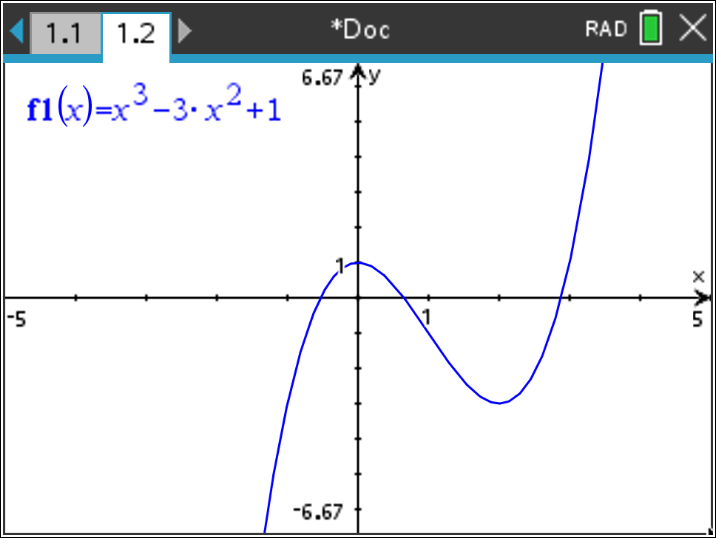
Concave down:
(-oo, 1)
Concave up:
(1, oo)
100
Given the function below, determine the interval(s) where the graph is concave down.
f(x)=-(x-5)^2+2
Interval:
(-oo,oo)
100
Find the point(s) of inflection for the function below:
f(x)=x^4-2x^3-7
P.O.I.=(0,-7), (1,-8)
200
Differentiate:
f(x)=(7x^8+3x^2)^(5/2)
f'(x)=(140x^7+15x)(7x^8+3x^2)^(3/2)
200
Find the derivative of f(x):
f(x)=2x^5*7x^5-3x^2+8x-Log(7)
f'(x)=140x^9-6x+8
200
Find the point(s) of inflection for the function below:
f(x)=1/3x^3+2x^2-3
P.O.I. =(-2,7/3)
200
Given the function below, determine the concavity of the graph on the given interval:
f(x)=-sin(x)
Interval:(0,pi)
Concave Up
200
A quadratic function is (always, sometimes, never) concave down.
Sometimes
300
Differentiate:
f(x)=((2x-5)/(5x+4))^3
f'(x)=(99(2x-5)^2)/(5x+4)^4
300
Find the derivative of f(x):
f(x)=-2x^6+7x^6-4x^-4-3^-4+5/x-6root()(x)
f'(x)=30x^5-5/x^2+16/x^5-3/root()(x)
300
Find the point(s) of inflection for the function below:
f(x)=x^4-x^3+1
P.O.I.=(0,1) and (1/2,15/16)
300
Locate the inflection point(s) of the following function:
f(x)=x(2x^2+x^0+1/x)+x^4
P.O.I.=(-1,-1)
300
True or False: A quadratic function only has one point of inflection.
False
400
Differentiate:
f(t)=5+e^(4t+t^7
f'(t)=(7*t^(6)+4)*e^(4t+t^7)
400
Find the derivative of the function:
f(x)=(2x*sin(π/(4)))/(64*cos(π))
f'(x)=-root()(2)/64
400
Find the intervals where the function below is concave down and concave up:
f(x)=5x^3-15x^2+7
ConcaveDown:(-oo,1); Concave Up:(1,oo)
400
A quintic function will have at most _____ inflection points.
Three
400
When a velocity function changes from positive to negative, what does that represent?
A change in direction
500
Find the equation of the tangent line passing thru the point (4, 2) for the function below:
f(x)=-2(x-3)^2+4
y=-4x+18
500
Find the derivative of the function:
f(x)=1/cos(x)*cot(x)*1/sec(x)
f'(x)=(-1)/(sin(x))^2
500
A function is represented by the graph below. Find its point of inflection.
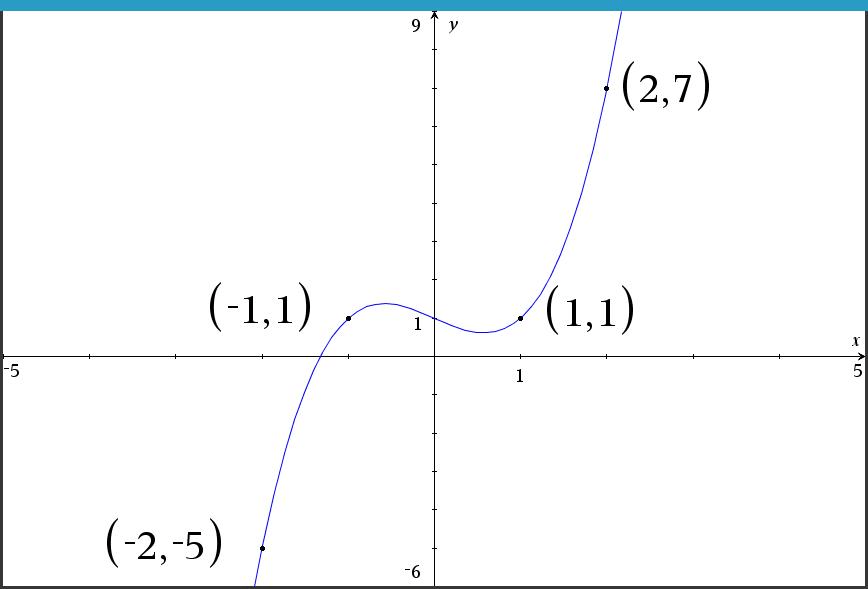
P.O.I.=(0,1)
500
Determine the concavity of the function below on the given interval:
Interval:(-pi/4,(3pi)/4)
Concave Up
500
True or False: Only polynomial functions can have a point of inflection.
False
600
The velocity of a rocket in feet per second is represented by the function below. What is the position (height) of the rocket at time t=8 sec if after 4 seconds the rocket reaches 800 feet? Assume the rocket was traveling in a vertical trajectory.
V(t)=256-32t
h(8)=1056 feet
600
The velocity of a baseball in feet per second is represented by the function below. How high above the ground is the ball at time t=4 sec if it was 200 feet above the ground after 6 seconds? Assume the ball was traveling in a vertical trajectory.
V(t)=128-32t
h(4)=264 feet
600
A position function is represented by S(t) below. Find its corresponding acceleration function:
S(t)=-2t^4+5t^3-3t^2+6t+10
A(t)=-24t^2+30t-6
600
A position function is represented by S(t) below. Find its corresponding acceleration function:
S(t)=-4.9t^2+30t+45
A(t)=-9.8
600
Describe the concavity of the function below:
f(x)=x^4
Concave up throughout its domain