Power Rule
Rates of Change
Differentiability
Mean Value Theorem
Product/Quotient Rule
100
The derivative of
y=3x^5-8x^2+4
y'=15x^4-16x
100
Find the slope of the secant line for f(x)=3x^2
on the interval [-1,3]
ARoC=6
100
List the three(3) scenarios where a function f(x) is non-differentiable at x = c.
1. Any discontinuity
2. Corner/cusp
3. Vertical tangent
100
State the definition of the Mean Value Theorem.
There exists some value c where
f'(c)=(f(b)-f(a))/(b-a)
100
Find the derivative of the function f(x)=(x^2+1)(x^3-4x)
f'(x)=(x^3-4x)(2x)+(x^2+1)(3x^2-4)
200
The derivative of
f(x) = 8/x+root(5)x^2-(2x)/x^2
f'(x)=-8x^-2+2/5x^(-3/5)+2x^-2
200
Find the average rate of change of
f(x) = 2x+5 on the interval
[-127, 399]
ARoC=2
200
List all the x-values where the graph f(x) below is non-differentiable. State why.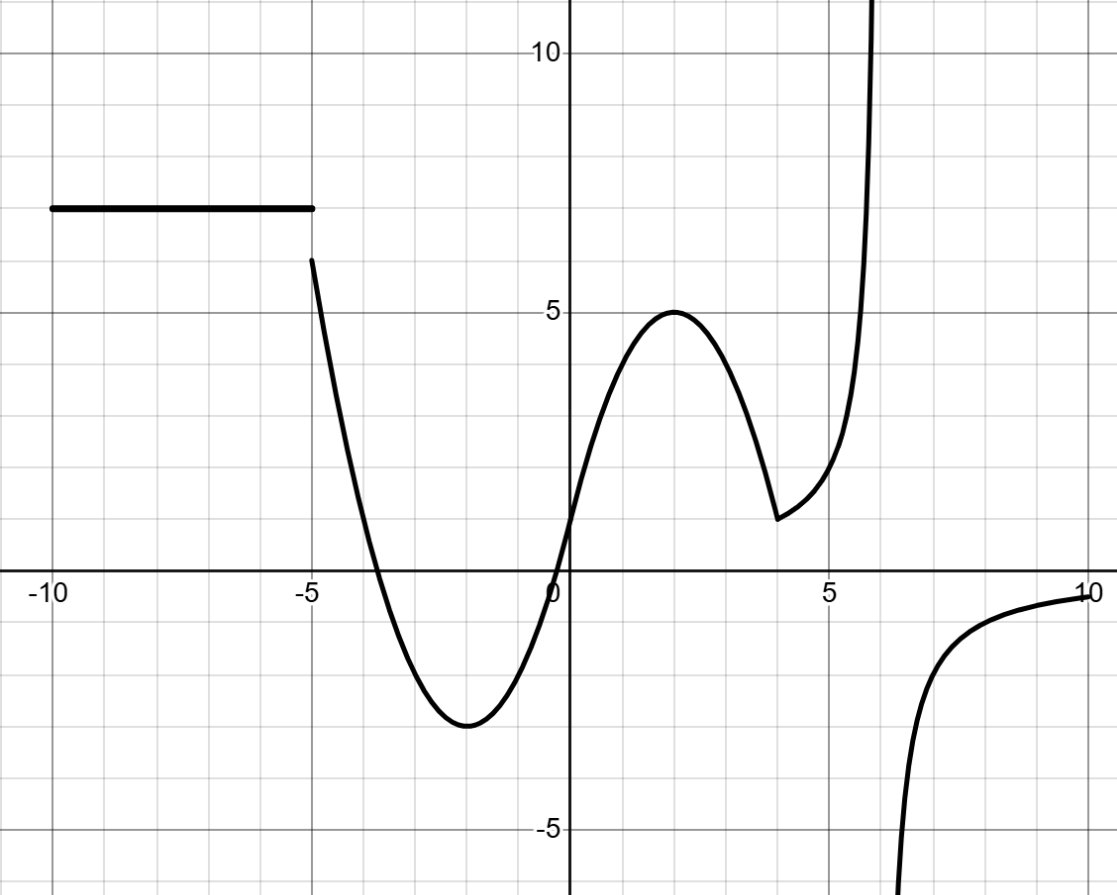
x = -5, jump discontinuity
x = 4, cusp
x = 6, vertical asymptote
200
Find a value c in the function f(x)=x^2+1 on the interval [1,5] that satisfies the Mean Value Theorem.
c=3
200
Find the derivative of the function f(x)=(4x+1)/(x^2-3)
f'(x)=(4(x^2-3)-(4x+1)(2x))/(x^2-3)^2
300
The derivative of
g(x) = (2x^4-3x^3+4x^2)/(2x)
g'(x) =3x^2-3x+2
300
Find the instantaneous rate of change of f(x)=4x^3-2x
at x=-1
IRoC=10
300
Find values of a and b that make f(x) differentiable everywhere.
f(x)={(ax+bifx<0),(x^3-x+2ifx>=0):}
a=-1,b=2
300
For f(x)=x^2+2 on [0,4], find c using the MVT.
c=2
300
The derivative of
f(x)=(2x-1)^3
f'(x)=(2x-1)(8x-4)+(4x^2-4x+1)(2)
400
The derivative of
f(x) = 4/x^4-6sqrtx+pix
f'(x) = -16x^-5-3x^(-1/2)+pi
400
Write the equation of the tangent line to g(x)=4/x^2+2sqrtx
at x=4
y-4.25=0.375(x-4)
400
For which values of x is the following function non-differentiable?
(2x^2-4x)/(x^2-7x+10
x=2 and x=5
400
Find a value c that satisfies the Mean Value Theorem, if applicable, for the function
f(x)=(x^2-4)/(x-2)
On the interval [1,3].
MVT is not applicable due to the discontinuity at x = 2
400
Find the derivative of the function
f(x)=(x^3-2x+1)/(x^2+1)
f'(x)=((x^2+1)(3x^2-2)-(x^3-2x+1)(2x))/(x^2+1)^2
500
The derivative of
f(x) = (2x^3-16x^2+8sqrtx-6)/(4x^2
f'(x) = 1/2-3x^(-5/2)+3x^-3
500
A ball's height h(t) in feet is modeled by h(t)=-16t^2+48t+5 , where t is the number of seconds since the ball was thrown.
Find the ball's velocity after exactly 2 seconds.
IRoC=-16 ft/s
500
Find values of a and b that make the following function continuous everywhere:
f(x)={(x^2+ax+b, x<2),(3x-1, x>=2):}
a=-1,b=3
500
The average rate of change of f(x) = x^3-6x^2+9x+2 on the interval [0, 3] is 0.
Find all values of c in (0,3) that satisfy the Mean Value Theorem.
c=1
500
The derivative of
f(x)=((x^2+1)(x-3))/(2x+2)
f'(x)={(x+2)[(x-3)(2x)+(x^2+1)]-(x^2+1)(x-3)}/(2x+2)^2