The Neutral
Doing Time
More than Words
Dirty Low Down
Down with the Sickness
OHI
Instruments
Charting & Documentation
100
The study of the relationship between a person's body and their work environment.
What is Ergonomics?
100
This is what we call the clinician's angle of approach to a patient because it is compared to the numbers on a clock.
What is clock position?
100
This structure can be divided into the following parts: Free - Interdental - Attached - Junctional Epithelium - Mucogingival Junction - Alveolar Mucosa - Sulcus
What is the gingiva?
100
This mature, highly mineralized deposit is found apical to the gingival margin.
What is subgingival calculus?
100
This inflammatory lesion is usually not accompanied by any clinically visible signs of inflammation.
What is the initial lesion?
100
This is the recommended duration for toothbrushing.
What is 2 minutes?
100
This instrument is used for indirect vision, retraction and illumination.
What is the mouth mirror?
100
This is also known as the "tooth chart"
What is the odontogram?
200
When these body parts are in neutral position, they are flat on the floor, shoulder width apart.
What are the feet?
200
This trait of a clinician will determine whether they approach the patient from the right or left side.
What is dominant hand? (also acceptable: Left-or Right- handed)
200
This structure is the fibrous connective tissue that surrounds and attaches the alveolar bone to the cementum.
What is the Periodontal Ligament (PDL)?
200
This mature, highly mineralized deposit is found coronal to the CEJ.
What is supragingival calculus?
200
This inflammatory condition is contained within the gingiva and does not extend into other components of the periodontia.
What is gingivitis?
200
This is how often the ADA recommends replacing your toothbrush.
What is every 2-3 months?
200
This is the ring finger of your dominant hand during instrumentation.
What is a fulcrum?
200
The "O" in SOAP note stands for this.
What is Objective?
300
When this body part is in neutral position, the wrist is aligned with the forearm, and the little finger is slightly lower than the thumb.
What is the hand?
300
This range of clock position is used by both the right-and left-handed clinician for treating a patient's anterior teeth.
What is 11 o'clock to 1 o'clock.
300
This tissue is a thin layer of calcified connective tissue that covers the tooth from the CEJ to the apical foramen.
What is cementum?
300
This non-mineralized mixture of colonized bacteria, organic and inorganic elements, and extracellular matrix is found on the crowns of teeth.
Supragingival biofilm
300
This stage is the most severe stage of advanced periodontitis.
What is Stage IV periodontitis?
300
This is the ideal timing for giving oral hygiene instructions to your patient.
What is BEFORE you begin scaling (OR After assessment & Before scaling)
300
These parts of an instrument are labeled #3: 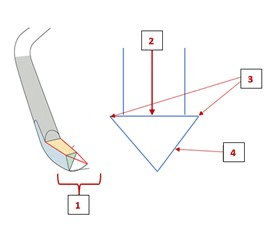
What are the cutting edges?
300
This is a patient's subjective concerns about their oral health which should be documented and addressed first.
What is a chief complaint?
400
When these body parts are in neutral position, they are relaxed, and in a straight line, and NOT hunched forward or lifted toward the ears.
What are the shoulders?
400
This position for the left-handed clinician is equivalent to the 8 o'clock position for the right-handed clinician.
What is 4 o'clock?
400
This structure attaches the gingiva to the tooth, forms the base of the sulcus, and migrates apically when periodontal tissues break down.
What is the junctional epithelium?
400
The source of elements which mineralize this deposit are sulcular fluid and exudate.
What is sub-gingival calculus?
400
This denotes the rate of progression of periodontitis.
What is grade?
400
This interdental aid is the most effective for most patients, if appropriate sizes are used.
What is a proxy brush/interdental brush?
400
The cutting edge of this type of curet adapts only to specific surfaces/teeth.
What is area-specific?
400
This dental restoration material appears similar to natural tooth structure, both clinically and radiographically.
What is composite (or composite resin)?
500
When this body part is in neutral working position, the head is tilted forward 0-20° and there is a vertical line of vision from eyes to treatment area.
What is the neck?
500
The range of clock positions used by right-handed clinicians.
8 to 1 o'clock (also acceptable: 8-12 o'clock)
500
This means that pus is being discharged from a probing site.
What is suppuration?
500
This soft deposit is made up of 4 layers which include predominantly gram-negative anaerobic bacteria and other motile organisms.
What is subgingival biofilm?
500
The stage/severity of periodontitis is determined by: clinical attachment loss, tooth loss due to periodontitis, and this.
What is radiographic bone loss (RBL)?
500
This ingredient in toothpaste is known to reduce hypersensitivity by preventing the nerve impulse.
What is potassium nitrate?
500
This part of an instrument is labeled #2: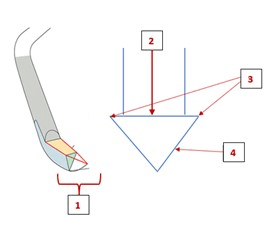
What is the face?
500
This is the name of the computer-generated notations that appear below the tooth chart.
What is "ledger"?