DNA need to know
DNA structure
Enzymes
Initiation of replication
replication 2
100
What is the criteria for genetic material
DNA replication occurs in what phase of interphase
Store information
• Replicate
• Express information
• Allow variation by mutation
The S phase
100
DNA replication is based on a semi_____ fashion
conservative
100
DNA helicase job
unwind the helix
100
The place where replication starts is called the
bacteria has ____ origin points
eukaryotes have _______ points of origin
origin or origin of replication
one
multiple
100
What is the purpose of Single-stranded DNA-binding proteins (SSB)
keep the helix open so replication can occur.
wraps single-stranded DNA (ssDNA) with high affinity to protect it from degradation and prevent secondary structure formation.
200
What are the requirements for DNA replication
1. A template consisting of single stranded DNA
2. Raw materials to be assembled into a new
nucleotide strand
3. Proteins that read the template and assemble
the substrates into a DNA strand
200

uracil
200
What is the purpose of DNA topoisomerase
enzymes that cleave the
phosphodiester bonds so the helix can swing
around as it unwinds.
regulate DNA supercoiling by catalysing the winding and unwinding of DNA strands.
200
The origin of replication for E.coli is
Replication is ____ from each origin
ori C
bidirectional
200
DNA polymerase can only add from the ___ prime to ___ prime end of DNA which is what strand
5-3
leading strand
300
What are the Four Stages of Replication in Prokaryotes
Define replicon
1) Initiation• Origin of Replication
• RNA Primer
2) Unwinding• Helicase,
• Topoisomerase
3) Elongation• DNA Polymerase III
4) Termination• DNA Polymerase I
• DNA Ligase
the entire region of DNA that is independently replicated from a single origin of replication. A bacterial chromosome contains a single origin, and therefore the whole bacterial chromosome is a replicon.
300

cytosine
300
What is the difference between Topoisomerase I and 2 , which requires ATP . DNA gyrase is a ___
allows transient
breaks in one strand of the helix
to relieve supercoiling. It does
not require ATP
DNA gyrase is a
Topoisomerase II it breaks
both strands of the helix to
relieve supercoiling. It does
require ATP
300
DNA polymerase III is a____enzyme. What does it mean
holoenzyme
= multimeric enzyme with many subunits
• 5’ to 3’ polymerase activity
• 3’ to 5’ exonuclease activity
Exonucleases can act as proofreaders during DNA polymerisation in DNA replication, to remove unusual DNA structures that arise from problems with DNA replication fork progression, and they can be directly involved in repairing damaged DNA.
300
Since DNA polymerase only works from the 5-3 prime, which strand is often coined_______ because it runs from the 5-3 prime and elongates the DNA through Okazaki fragments
lagging strand
400
What are the ingredients(haha) to make a DNA
5 carbon sugar molecule
phosphate group
nitrogen base
400
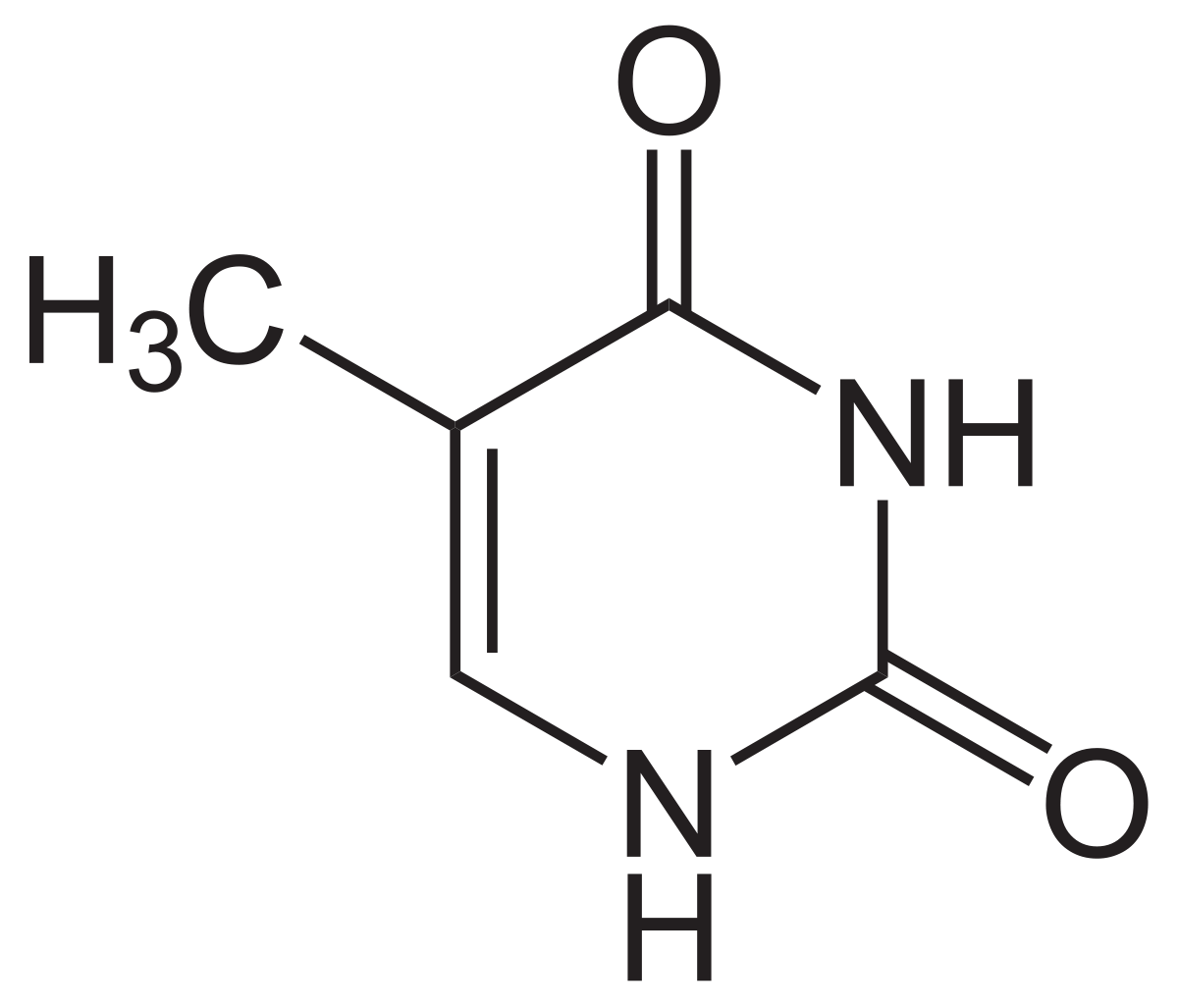
Thymine
400
DNA helicase works by breaking the ____ ____
The point where the splitting starts is the
hydrogen bond
replication fork
400
Chaining Nucleotides Together Into New DNA
Strands is what step of the DNA replication process
elongation
400
DNA polymerase ____ removes RNA primers and replaces it with DNA
what enzyme Joins Okazaki fragments by sealing breaks in the sugar–
phosphate backbone of newly synthesized DNA
1
DNA ligase
500
DNA replicates from - what were the different theories of DNA replication and which one gave 1/2 old and 1/2 new
5 to 3 prime
semi conservative 1/2 old and new \
Conservative
Dispersive-1/2 old and new
Semi conservative - two molecules half old and half new
Conservative - original and you keep ot intact and cell looks at the original and created the exact same thing but new
Dispersive - tak original, blow it up into random pieces, build new with random piece, random mixture of old and new - about ½ old and ½ new
Experiment show that molecules were half old and half new
500
The difference between adenine and guanine is what?
NH2 and carbonyl group on guanine
500
Purpose of DNA polymerase
There are 5 types of DNA polymerase, which is the one that elongates and is important to know for this class especially!
Before DNA polymerase can begin working it needs a what is this called
replicates and adds base pair to the unwound strand and proof reads it.
3
primer -RNA primase
500
• DNA polymerase II, IV, V function
DNA repair
500
DNA polymerase requires a ____ to begin adding onto the DNA, where can the DNA polymerase find this ?
3OH
rna primer.. DNA primase created this RNA primer