Structure and Function of DNA
DNA Replication
RNA and Transcription
Protein Synthesis
Mutations
100
One DNA strand has a base sequence GTCCATA. The base sequence on the second strand of DNA is...
CAGGTAT
100
Why does DNA need to replicate?
Growth and Repair
100
A single stranded piece of a DNA has the following bases: ACTGAG. What is the matching sequence on its RNA transcript?
UGACUC
100
This process turns mRNA into a protein.
Translation.
100
What is a mutation? Name 2 environmental factors can cause a mutation.
Any change to an organism's DNA/genome. Environmental factors: chemicals, radiation, sun, food, & viruses
200
What do we call the monomers of DNA? What are its 3 parts? Which two parts form the backbone?
Nucleotide: phosphate group, sugar (deoxyribose), base (A, C, T, or G). The phosphate and sugar form the backbone.
200
What is the end product of DNA replication (be very specific!)
Two new molecules of DNA, each is identical to each other and to the original molecule.
200
Transcription: What does is make? Where does it take place?
RNA. Nucleus.
200
What cell organelle makes protein? What are the monomers of protein called?
Ribosome / amino acids
200
What is a frameshift mutation?
This type of mutation occurs when bases are inserted or deletedm, causing ALL the codons from the point of mutation forward to change, thus change causing all the amino acids to change.
300
Describe the function/purpose of DNA in organisms. What is a gene?
A gene is a sequence of DNA nucleotides that acts as a recipe for a specific protein.
300
Name the two enzymes involved in DNA replication and describe their function.
Helicase: unzips/unwinds the DNA helix by breaking the bonds between the bases. DNA polymerase: makes DNA by adding complementary bases to the other side of each of the original strands.
300
Why can’t DNA leave the nucleus?
DNA is too long/bulky to exit through the nuclear pores.
300
How many bases make up a codon?
A 3 nucleotide sequence
300
Are all mutations harmful? If not, give a counter example.
Helpful mutations: having ONE sickle cell gene makes you immune to the parasite that causes malaria.
Neutral mutations: blue eyes
400
What is the name of the DNA nucleotide that takes place of Thymine (T) in RNA? (Full points for the name)
Uracil (U)
400
Where is DNA found int he cell?
The nucleus
400
What is the job of tRNA?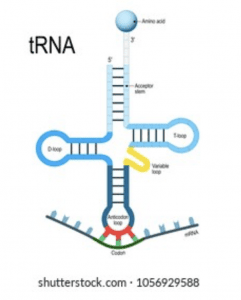
tRNA: transfers the amino acids to the ribosome.
400
A ribosome makes a protein containing 60 amino acids. The corresponding mRNA consists of at least how many codons?
60
400
Give one example of a harmful mutation.
Harmful example: sickle cell anemia, hemophilia, & cancer.
500
In a sample of DNA, 40% of the bases are adenine. What percentage of bases are guanine?
10%
500
Which organelle are proteins made at? (location)
The ribosome
500
Name 2 differences between DNA and RNA.
DNA: deoxyribose, thymine, long, double-stranded, made by DNA replication. RNA: ribose, uracil, short, single-stranded, made by transcription.
500
In many humans, this specific regulatory mutation allows the gene encoding this enzyme to remain "switched on" into adulthood, a condition known as persistence.
Lactase
500
What is a chromosomal mutation? Give an example.
Alterations to a piece of a chromosome or a whole chromosome [e.g., Down syndrome (3 chromosome #21)]