Domain & Range
Graphs
Functions?
Vocabulary
100
Find the domain of the following relation:
{(2, 1) (-1, 0) (-1, 3) (0, 2) (-5, 1)}
D: {-5, -1, 0, 2}
100
Identify the domain and range of the following:
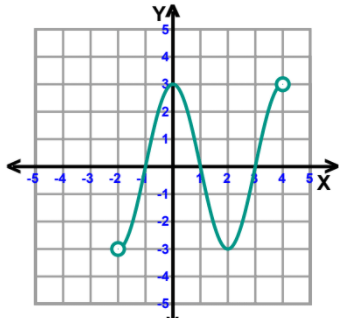
D: (-2, 4)
R: [-3, 3]
100
Does the following represent a function? Why or why not?
{(2, 1) (-1, 0) (-1, 3) (0, 2) (-5, 1)}
No, -1 has two different outputs.
100
What kind of values does the domain represent?
What kind of values does the range represent?
Domain: x-values
Range: y-values
200
Find the range of the following relation:
{(2, 1) (-1, 0) (-1, 3) (0, 2) (-5, 1)}
R:{0, 1, 2, 3}
200
What is the domain and range of the graph?
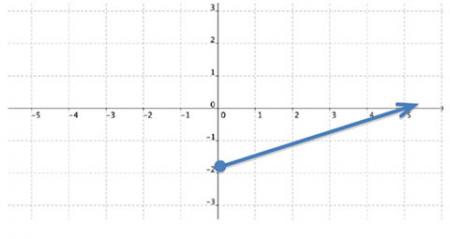
Domain: [0, infinity)
Range: [-2, infinity)
200
Does the following represent a function? Why or why not?
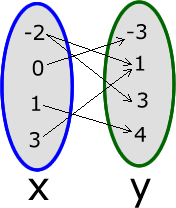
No because -2 goes to both 1 and 3.
200
What notation is used to identify the domain and range of a continuous graph?
Interval notation
300
Find the domain and range of the following:
{(0, 1) (0, 2) (0, 0) (0, -2) (0, -8)}
D: {0}
R: {-8, -2, 0, 1, 2}
300
What is the domain and range of the following?
Domain: (-infinity, infinity)
Range: [-4, infinity)
300
Is the following a function?
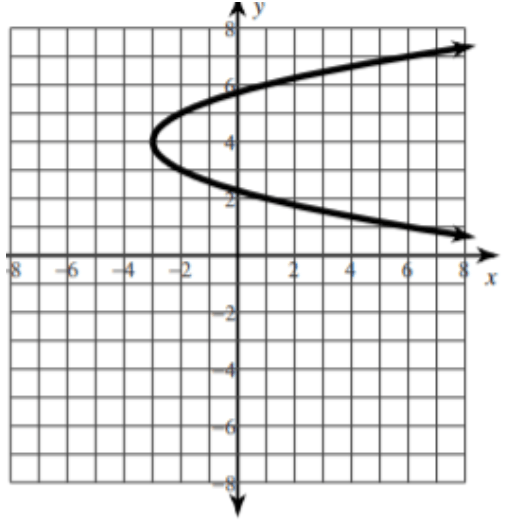
No, it doesn't pass the vertical line test.
300
What notation is used to identify the domain and range of a discrete graph?
Set notation
400
What is the domain of the following?
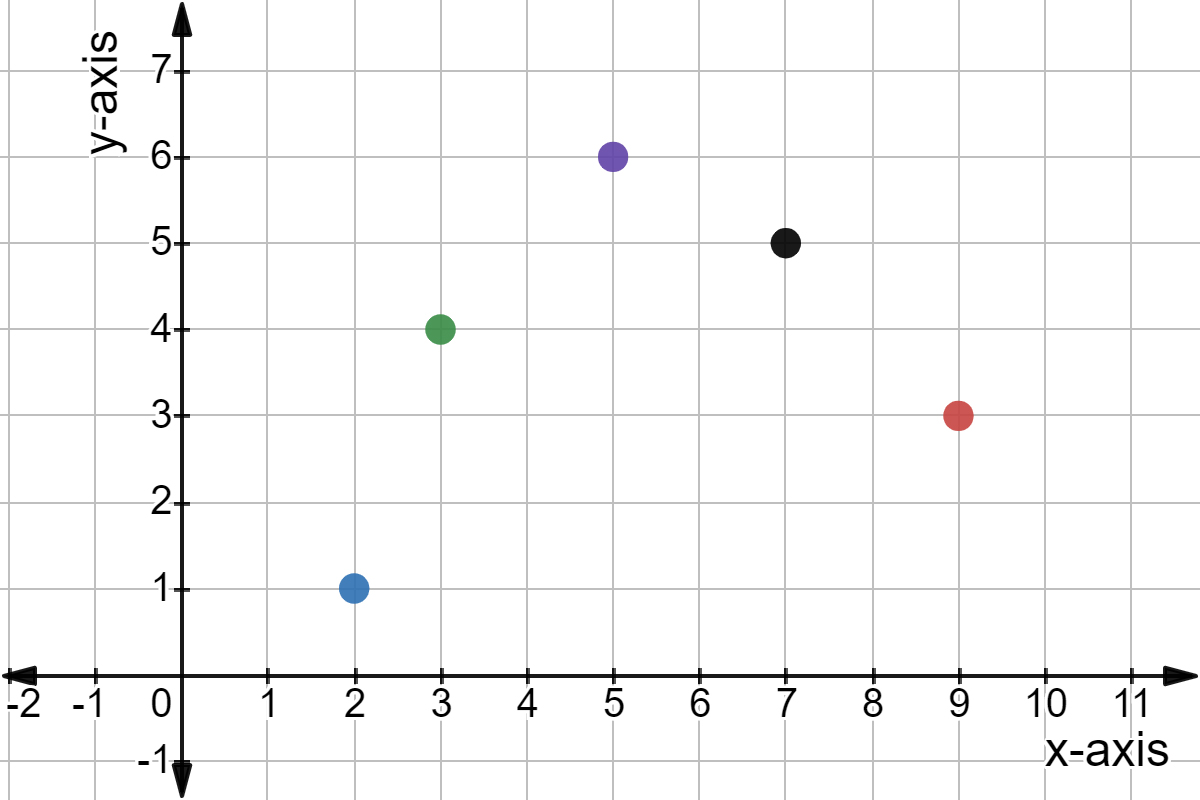
D: {2, 3, 5, 7, 9}
400

What is the domain and range of the function?
Domain: (-infinity, infinity)
Range: (3, infinity)
400
Is the following a function?
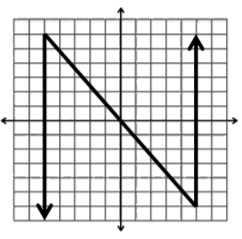
No, it doesn't pass the vertical line test.
400
What is the name of the symbol used to show that a group of objects belong together in a set?
Braces
500
Draw a graph with a range of [2, 5] and a domain of
(-oo,oo)
Multiple answers
500
Find the domain and range.
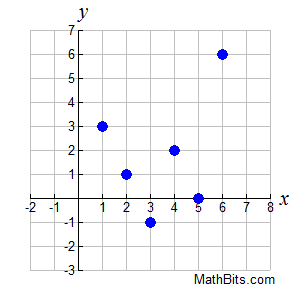
D: {1, 2, 3, 4, 5, 6}
R: {-1, 0, 1, 2, 3, 6}
500
Is the following a function? Why or why not?
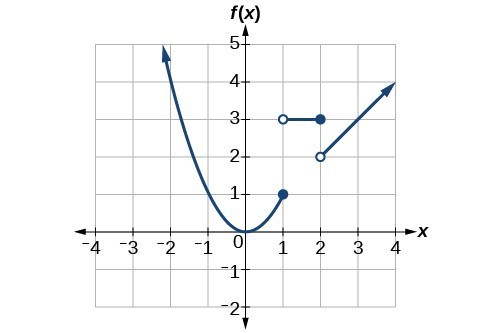
Yes. Every input has only one output. The holes in the graph make it so that no x values will repeat.
500
What is the difference between a discrete and a continuous graph?
A continuous graph has all the points connected and a discrete graph does not.