Driver's Ed #1
Driver's Ed #2
Driver's Ed #3
Driver's Ed #4
Driver's Ed #5
100
Distracted drivers are at a greater risk of a crash when they are using which of the following?
A: CD player
B: Radio
C: Cell phone
D: All of the above
D: All of the above
100
If there are no signals at a railroad crossing, you should:
A: Slow down and be prepared to stop if you see or hear a train approaching.
B: Proceed as quickly as possible over the tracks.
C: Proceed through the crossing at a normal rate.
D: Proceed slowly over the tracks.
A: Slow down and be prepared to stop if you see or hear a train approaching.
100
Highway and expressway guide signs are:
A: Orange with black letters.
B: Green with white letters.
C: Yellow with black letters.
D: Red with white letters.
B: Green with white letters.
100
YOU MAY TURN LEFT AT A RED LIGHT IF:
A. There is no traffic coming in the opposite direction
B. You are turning from a two-way street onto a one-way street
C. You are turning from a one-way street onto another one-way street
D. The car in front of you turns left
C. You are turning from a one-way street onto another one-way street
100
AT AN INTERSECTION CONTROLLED BY A STOP SIGN, IF YOU CAN’T GET A GOOD VIEW OF CROSS-STREET TRAFFIC WHEN YOU STOP BEHIND THE WHITE TOP BAR PAINTED ON THE PAVEMENT, YOU SHOULD:
A. Wait 5 seconds, then proceed.
B. Sound your horn before proceeding.
C. Put down your windows, listen for traffic, and then proceed.
D. Pull forward slowly, check for traffic and pedestrians, and proceed when clear.
D. Pull forward slowly, check for traffic and pedestrians, and proceed when clear.
200
When driving on slick roads, you should:
A: Take turns more slowly than usual.
B: Change lanes quickly.
C: Accelerate quickly.
D: Brake hard.
A: Take turns more slowly than usual.
200
When driving in fog, you should use your:
A: Low beam headlights.
B: High beam headlights.
C: Parking lights.
D: Hazard flashers.
A: Low beam headlights.
200
A steady green light at an intersection means that you:
A: Must slow down and prepare to stop.
B: Must stop and check for oncoming traffic before proceeding.
C: May drive through the intersection if the road is clear.
D: May not turn right.
C: May drive through the intersection if the road is clear.
200
IF A TRAFFIC LIGHT IS BROKEN OR NOT FUNCTIONING YOU SHOULD:
A. Stop and wait for it to be repaired
B. Stop and wait for a police officer to arrive
C. Continue as if it were a four-way stop sign
D. Continue as you normally would
C. Continue as if it were a four-way stop sign
200
THE TOP MAJOR CRASH TYPE FOR 16 YEAR OLD DRIVERS IN PENNSYLVANIA IS:
A. Single vehicle/run-off-the-road
B. Being sideswiped on an interstate
C. Driving in reverse on a side street
D. Driving on the shoulder of a highway
A. Single vehicle/run-off-the-road
300
When sharing the road with a truck, it is important to remember that trucks generally:
A: Require longer distances to stop than smaller vehicles do.
B: Require less time to pass on a downgrade than smaller vehicles do.
C: Require a smaller turning radius than smaller vehicles do.
D: Require less time to pass on an incline than smaller vehicles do.
A: Require longer distances to stop than smaller vehicles do.
300
You should honk your horn when you:
A: Are traveling through an intersection.
B: Are passing a bicyclist.
C: See a child who is about to run into the street.
D: Are parallel parking.
C: See a child who is about to run into the street.
300
It is against the law for anyone under the age of 21 to ____ alcohol.
A: Wear clothing advertising
B: Be in the presence of
C: Consume
D: Serve
C: Consume
300
THE SPEED LIMIT IS _______ MILES PER HOUR WHEN THE YELLOW LIGHTS ARE FLASHING ON THE SCHOOL ZONE SPEED SIGN.
A. 25
B. 15
C. 20
D. 35
B. 15
300
WHEN PASSING A BICYCLIST, YOU SHOULD:
A. Blast your horn to alert the bicyclist
B. Move as far left as possible
C. Remain in the center of the lane
D. Put on your four-way flashers
B. Move as far left as possible
400
When driving near a blind pedestrian who is carrying a white cane or using a guide dog, you should:
A: Slow down and be prepared to stop.
B: Take the right-of-way.
C: Proceed normally.
D: Drive away quickly.
A: Slow down and be prepared to stop.
400
The most effective thing you can do to reduce your risk of being injured or killed in a traffic crash is to:
A: Wear your seat belt.
B: Limit your driving to weekdays.
C: Stay in the right lane on multilane highways.
D: Limit your driving to hours between 3:00 p.m. and 6:00 p.m.
A: Wear your seat belt.
400
Night driving can be more difficult than driving during the day because:
A: Cars overheat more quickly at night.
B: Visibility is reduced in the dark.
C: It is more likely to be raining at night.
D: You are more likely to encounter a motorcycle at night.
B: Visibility is reduced in the dark.
400
LANES OF TRAFFIC MOVING IN THE SAME DIRECTION ARE DIVIDED BY ____ LINES.
A. Yellow
B. White
C. Red
D. Black
B. White
400
IF YOU ARE DRIVING BEHIND A MOTORCYCLE, YOU MUST:
A. Allow the motorcycle to use a complete lane
B. Drive on the shoulder beside the motorcycle
C. Allow the motorcycle to use only half a lane
D. Pass in the same lane where the motorcycle is driving
A. Allow the motorcycle to use a complete lane
500
This road sign means:
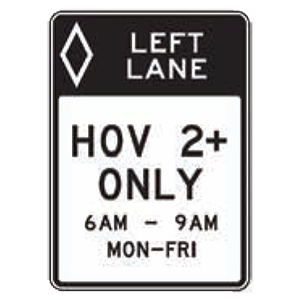
A: The left lane is reserved for vehicles with a specific number of occupants.
B: Specific turning movements are allowed from specific lanes.
C: Do not enter.
D: Drivers in both lanes are responsible for merging smoothly.
A: The left lane is reserved for vehicles with a specific number of occupants.
500
When traveling more slowly than 40 miles per hour on a limited-access highway, you should:
A: Drive on the shoulder.
B: Use your high beams.
C: Sound your horn to warn others.
D: Use your four-way flashers.
D: Use your four-way flashers.
500
Before changing lanes on a multilane highway, you should:
A: Sound your horn.
B: Turn on your headlights.
C: Reduce your speed.
D: Check your mirrors and blind spots.
D: Check your mirrors and blind spots.
500
THE ROAD EDGE ON THE RIGHT SIDE IS MARKED BY A ___________ LINE.
A. Broken white
B. Solid yellow
C. Solid white
D. Broken yellow audio
C. Solid white
500
WHEN TRAVELING BEHIND A MOTORCYCLE:
A. Allow a following distance of at least 2 car lengths
B. Allow at least 2 seconds of following distance
C. Allow at least 4 seconds of following distance
D. Allow a following distance of at least 4 motorcycle lengths
C. Allow at least 4 seconds of following distance