Relations and Functions
Linear Functions
Transformations
Arithmetic Sequences
Scatter Plots
100
Which relation is a function?
A. (1, 2), (3, 2), (1, 4), (3, 4), (2, 5)
B. (0, 0), (1, 1), (2, 2), (3, 5), (4, 4)
C. (5, 6), (6, 6), (5, 7), (7, 7), (8, 8)
D. (2, −1), (2, 3), (4, 4), (5, 5), (6, 6)
B
100
Jack is paid a daily base of $12 plus $6 per hour. Choose the linear function J(h) giving his pay for h hours.
J(h) = 6h + 12
100
Suppose g(x) = f(x) + k. If f(2)=7 and g(2)=12, identify k that transforms f into g.
k = 5
100
Which of the following is an arithmetic sequence?
A. 2, 5, 8, 11, 14, …
B. 16, 8, 4, 2, 1, …
C. 3, 6, 12, 24, 48, …
D. 1, 4, 9, 16, 25, …
A
100
A scatter plot of minutes spent studying vs. quiz score shows points trending upward left→right. What type of correlation?
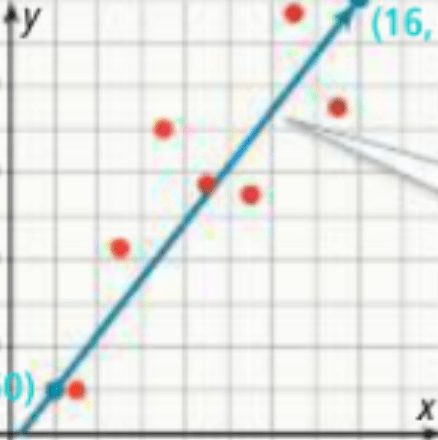
A. positive B. negative C. no correlation D. cannot be determined
A.
200
Which relation is not a function?
A. (−1, 0), (0, 1), (1, 2), (2, 3), (3, 4)
B. (2, 2), (3, 3), (4, 4), (5, 5), (6, 6)
C. (1, 0), (2, 0), (3, 1), (4, 1), (3, 2)
D. (0, 0), (1, −1), (−2, −2), (3, −3), (−4, −4)
C
200
Write a linear functionthat represents the table.

y = 5x + 4
200
Suppose f(x)=x -7 and g(x)=(x+3) - 7. What tranformation turned f(x) into g(x)?
Translation 3 units left.
200
Which of the following lists is not arithmetic?
A. 0, −3, −6, −9, −1 …
B. 5, 10, 15, 20 …
C. 7, 14, 21, 28 …
D. 1, 2, 4, 8, …
D
200
A scatter showing points clustered with no slope — no upward or downward trend — indicates what correlation?
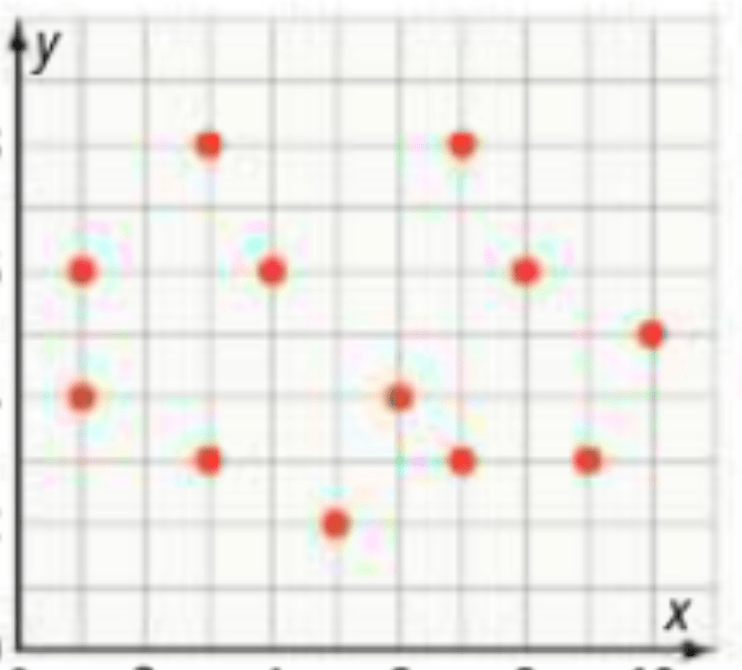
No correlation.
300
Identify the domain and range of the relation: {(−2, 5), (0, 3), (4, 7), (4, 9)}.
Domain: ________ Range: ________
D: -2, 0, 4
R: 3, 5, 7, 9
300
Evaluate f(x) = 3x − 7 for f(4)
f(4) = 5
300
f(x)=−x+4 and g(x)=−(x+1)+4, state the translation applied to f to get g.
One unit left.
300
Use the explicit formula for the arithmetic sequence to find the 20th term of: 6, 3, 0, −3, −6, …
a20 = -51
300
What could be an equation for a trend line that fits a scatter plot with negative slope passing through (0, 50) and (10, 30)?
y = -2x + 50
400
Identify the domain and range of the relation given by ordered pairs: {(1, −1), (2, 0), (3, 2), (5, 2)}.
Domain: ________ Range: ________
D: 1, 2, 3, 5
R: -1, 0, 2
400
Evaluate f(x) = −5x + 12 for f(−2).
f(−2) = 22
400
Given f(x)=2x+5 and g(x)=2(x−3)+5, which transformation occurred?
Translate 3 units right.
400
Use the explicit formula to find the 100th term of: 10, 16, 22, 28, 34 …
a100 = 604
400
What could be an equation of a trend line passing near points (0, 10) and (5, 25)?
y = 3x + 10