Stars and the Universe
Weather and Climate
Plate Tectonics
Galaxies
Gravity & Motion in Space
100
A star forms from a cloud of gas and dust.
What is this early stage of a star called?
What is a Nebula?
100
What is the main source of energy that drives weather on Earth?
What is The Sun?
100
This type of plate boundary forms mountains.
What is a convergent boundary?
100
This is the name of our galaxy.
What is the Milky Way?
100
This force keeps planets in orbit around the Sun.
What is gravity?
200
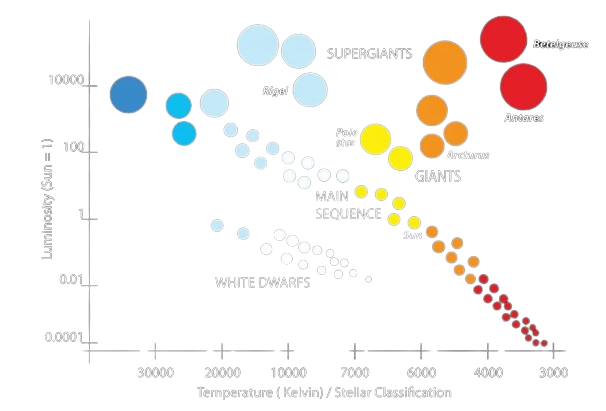
A star is much hotter than the Sun but appears dimmer. What does this tell you about the star’s location on the Hertzsprung-Russell diagram?
The star would be located in the lower left of the H-R diagram.
200
Warm air rises and cool air sinks.
What is this called and how does this movement affect weather?
What is convection and it creates wind and convection currents, driving weather patterns.
200
This type of boundary is described as two plates sliding past each other.
What is a transform boundary?
200
Our solar system is located on this arm.
What is the Orion Arm?
200
This explains why planets closer to the Sun move faster than planets farther away?
What is stronger gravitational pull from the Sun?
300
Compare a star that is very hot and bright to one that is cooler and dimmer.
Where would each be located on the Hertzsprung-Russell diagram?
Hot/bright → upper left
Cool/dim → lower right
300
Why does land heat up faster than water during the day?
Land has a lower specific heat capacity (requiring less energy to raise its temperature) and cannot mix heat to deeper layers
300
This describes when an oceanic plate collides with a continental plate.
What is subduction?
300
This type of galaxy contains older stars and little gas and dust.
What is an elliptical galaxy?
300
This explains the relationship between the mass of an object and its gravitational pull.
What is more mass → stronger gravitational pull?
400
What does it mean to be a main sequence star?
a star that is fusing hydrogen to helium in its core
most common type of star in the universe, making up roughly 90% of all stellar populations.
in a stable, long-lived phase of life
400
How does evaporation from oceans contribute to the formation of storms?
Water evaporates → adds moisture to the air → warm, moist air rises → condenses → releases energy → helps form storms.
400
Give two pieces of evidence that supports the idea that all continents were once joined together as Pangaea.
Matching fossils on different continents
Similar rock formations
Continents fitting together like a puzzle
400
How does star formation differ between elliptical and spiral galaxies, and what causes this difference?
Spiral galaxies: Active star formation because they have lots of gas and dust
Elliptical galaxies: Little to no star formation because they have very little gas and dust
500
A star is located in the upper right of the Hertzsprung-Russell diagram.
Describe this star’s temperature and brightness, and identify its stage.
Cool temperature
very bright
red giant
500
These are the three conditions required for hurricanes to form. Be specific
What are
1) warm ocean temps (26oC +)
2) high humidity
3) low vertical wind shear
500
List 2 possible results at a divergent plate boundary.
- new crust
- mid-ocean ridges
- ocean basins
500
This type of galaxy has no clear shape and has many young stars forming.
What is an irregular galaxy?